Prisms (AQA GCSE Maths): Revision Notes
📚Revision Notes
Prisms
What is a prism?
A prism is a three-dimensional shape that has the same cross-section running all the way through it. The cross-section is the shape you would see if you cut straight through the prism from one end to the other. This cross-section remains constant (the same) along the entire length of the prism.
Note
The key characteristic of any prism is that its cross-section remains identical throughout its entire length. This consistency is what distinguishes prisms from other 3D shapes like pyramids or cones.
Volume of prisms
Volume measures how much space a 3D shape takes up, measured in cubic units (like cm³ or m³).
Volume formula
The formula for finding the volume of any prism is:
This works because you're essentially stacking up identical cross-sections along the length of the prism.
Worked example - trapezium prism
Example
Worked Example: Finding the Volume of a Trapezium Prism
When the cross-section is a trapezium, you need to:
Step 1: Find the area of the trapezium cross-section
- Use the formula:
- For a trapezium with parallel sides 6cm and 10cm, and height 5cm:
Step 2: Multiply by the length of the prism
Surface area of prisms
Surface area is the total area of all the faces (surfaces) that make up the 3D shape, measured in square units (like cm² or m²).
Method for finding surface area
To calculate the surface area of any prism, follow this systematic approach:
Note
Step-by-Step Method:
- Identify all the faces - this includes faces you can't see from one viewpoint
- Calculate the area of each face individually
- Add all the face areas together
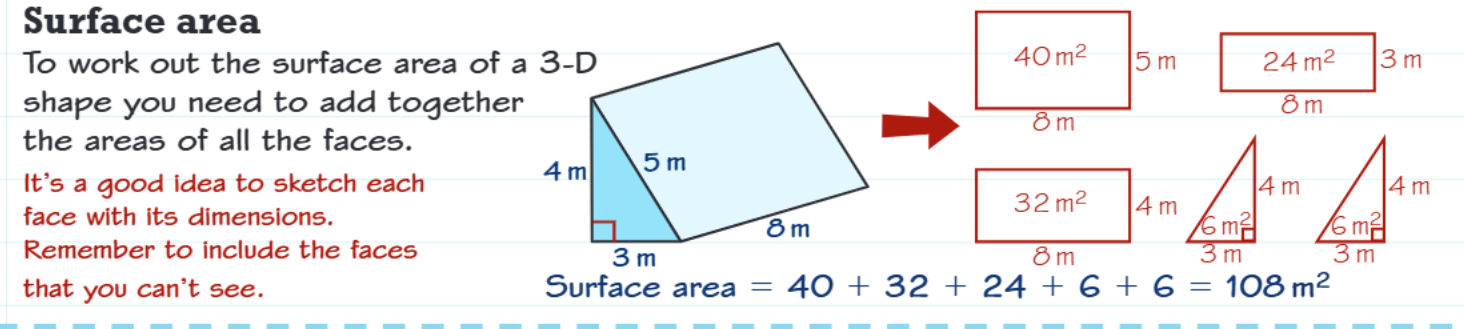
Key tips for surface area
Important
Critical Tips for Success:
- Sketch each face with its dimensions to avoid missing any
- Remember hidden faces - there are always faces you can't see in a diagram
- Check your answer by counting that you have the right number of faces
Worked example - triangular prism
Example
Worked Example: Surface Area of a Triangular Prism
A triangular prism has 5 faces:
- 2 triangular faces (the ends)
- 3 rectangular faces (the sides)
Calculate each area and add them:
- Face 1: 40m²
- Face 2: 32m²
- Face 3: 24m²
- Face 4: 6m² (triangle)
- Face 5: 6m² (triangle)
Total surface area =
Problem solving with unknown variables
When dealing with prisms where some dimensions are unknown, you can use algebraic methods to find missing values.
Note
Problem-Solving Strategy:
- Set up an equation using the volume formula
- Use given information to create equivalent expressions
- Solve the equation to find the unknown value
Example approach
Example
Worked Example: Finding Unknown Dimensions
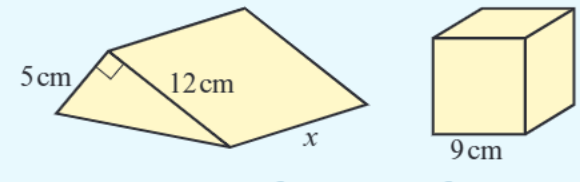
If a triangular prism and cube have the same volume:
- Volume of cube =
- Volume of prism = Area of cross-section × Length
- Set them equal:
- Solve: , so
Working with triangular cross-sections
When the cross-section is a triangle, particularly a right-angled triangle, use this fundamental formula:
Note
The vertical height is the perpendicular distance between the base and the opposite vertex. This is crucial for accurate calculations.
Exam tips
Important
Essential Exam Strategies:
- Show your working clearly at each stage - you can gain marks even if your final answer is incorrect
- Write down what you're calculating as you go through each step
- Double-check you've included all faces when calculating surface area
- Use appropriate units in your final answer (cm², m³, etc.)
Remember!
Summary
Key Points to Remember:
- Volume of prism = Area of cross-section × Length
- Surface area = Sum of all face areas (don't forget hidden faces!)
- Always sketch each face when finding surface area to avoid missing any
- Show your working step by step in exams to maximise your marks
- Check your units are correct in your final answer