Problem-solving practice 2 (AQA GCSE Maths): Revision Notes
📚Revision Notes
Problem-solving practice 2
This revision note covers three important types of geometry problems that appear in GCSE examinations. Each problem type requires specific techniques and careful mathematical reasoning.
Semicircle area problems
Semicircle problems often involve comparing areas of different semicircles or proving relationships between them. These questions typically require you to work with the area of a circle formula and apply it to semicircular shapes.

When tackling semicircle area problems, you need to understand that the area of a semicircle equals half the area of a complete circle. This means if a circle has area , then a semicircle has area .
Key problem-solving strategy
The most effective approach is to choose suitable values for the measurements in your problem. If the problem involves semicircles with different diameters, select simple numbers that make calculations easier. For example, if one semicircle has diameter 2 cm, then a related larger semicircle might have diameter 4 cm.
Note
Strategic Approach: When no specific lengths are given in a diagram, you can use algebraic methods. Try using to represent one length and express other lengths in terms of . Alternatively, choose simple numerical values yourself to make the arithmetic more manageable.
Pythagoras' theorem in real-world contexts
Pythagoras' theorem problems often appear in practical situations like ladder placement, which require you to work with right-angled triangles. These problems test your ability to identify which side of the triangle you need to find and apply the theorem correctly.
The ladder problem approach
When solving ladder problems, always start by drawing a clear sketch showing:
- The ladder as the hypotenuse (longest side)
- The wall as one vertical side
- The ground distance as the horizontal side
Remember that Pythagoras' theorem states:
Important
Critical Formula Rearrangement: When finding a shorter side, rearrange the formula to:
Be particularly careful when working out the length of a shorter side. Many students make errors by not rearranging the formula correctly. Always double-check which side you're finding and whether it's the longest side or one of the shorter sides.
Angles in polygon problems
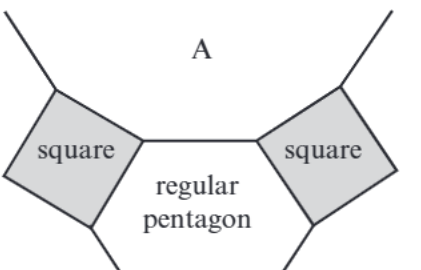
Regular polygon angle problems require understanding both interior angles and exterior angles. These problems often involve complex diagrams with multiple shapes connected together.
Example
Step-by-step Approach for Polygon Angle Problems
When working with polygon angles, follow these systematic steps:
Step 1: Calculate interior angles - Work out the interior angles of any regular polygons shown (such as pentagons and squares)
Step 2: Use the 360° rule - Remember that angles around any point always add up to 360°. Use this to find unknown interior angles
Step 3: Find exterior angles - Subtract interior angles from 180° to find the corresponding exterior angles
Step 4: Apply polygon formulas - Use the relationship that exterior angles of any polygon sum to 360° to find the number of sides ()
Key formula: For a regular -sided polygon, each exterior angle =
Note
Planning Complex Problems: Complex polygon problems often have multiple steps. Before you start calculating, read through the entire question and plan your approach. Write down what you need to find and identify which formulas or relationships you'll need to use.
Problem-solving strategies
Successful geometry problem-solving requires systematic thinking and clear working. Always:
- Draw diagrams when they help visualise the problem
- Show all your working steps clearly
- Check your answers make sense in the context
- Use suitable values or algebraic expressions when measurements aren't specified
- Plan multi-step problems before beginning calculations
Summary
Key Points to Remember:
- Semicircle area problems: Choose simple diameter values and remember that semicircle area =
- Pythagoras' theorem: Always sketch the triangle and check whether you're finding the longest or a shorter side
- Polygon angles: Use the 360° rule for angles around a point and remember exterior angles sum to 360°
- General strategy: Plan complex problems step-by-step before starting your calculations
- Working: Always show clear, neat working as marks are often awarded for method as well as final answers