Pythagoras theorem (AQA GCSE Maths): Revision Notes
📚Revision Notes
Pythagoras theorem
What is Pythagoras' theorem?
Pythagoras' theorem is a mathematical rule that helps you find the length of a missing side in a right-angled triangle. This theorem is extremely useful in geometry and has many real-world applications.
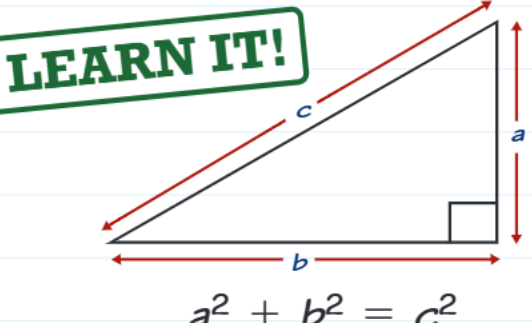
The theorem states that in any right-angled triangle, the square of the longest side (called the hypotenuse) equals the sum of the squares of the two shorter sides.
Note
The hypotenuse is always the side opposite the right angle and is the longest side in any right-angled triangle. Understanding this relationship is fundamental to applying the theorem correctly.
When can you use it?
You can only use Pythagoras' theorem when specific conditions are met. These conditions are essential for the theorem to work correctly.
Important
Critical Requirements for Using Pythagoras' Theorem:
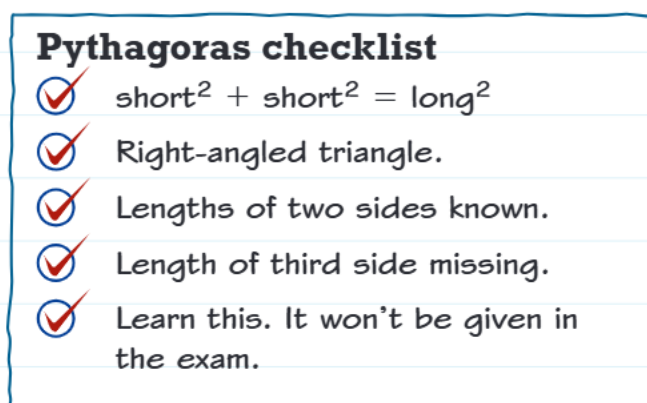
- You must have a right-angled triangle (one angle of exactly 90°)
- You must know the lengths of two sides
- You need to find the length of the third side
- The formula must be memorised - it won't be given in the exam
Missing any of these conditions means you cannot use Pythagoras' theorem!
The formula
The standard formula for Pythagoras' theorem is:
Where:
- a and b are the lengths of the two shorter sides
- c is the length of the longest side (hypotenuse)
Note
Alternative Memory Aid
An easier way to remember this is: short² + short² = long²
This helps you remember that you square the two shorter sides and add them together to equal the square of the longest side.
Step-by-step method for solving problems
When the missing length is one of the shorter sides, follow this systematic approach to ensure accuracy:
Note
5-Step Problem-Solving Method:
- Label the longest side c (the hypotenuse)
- Label the other two sides a and b
- Write out Pythagoras' theorem:
- Substitute the values you know into the formula
- Rearrange the formula and solve for the unknown side
This systematic approach helps ensure you don't make mistakes and shows clear working in your exam answers.
Worked example
Example
Worked Example: Finding a Missing Side
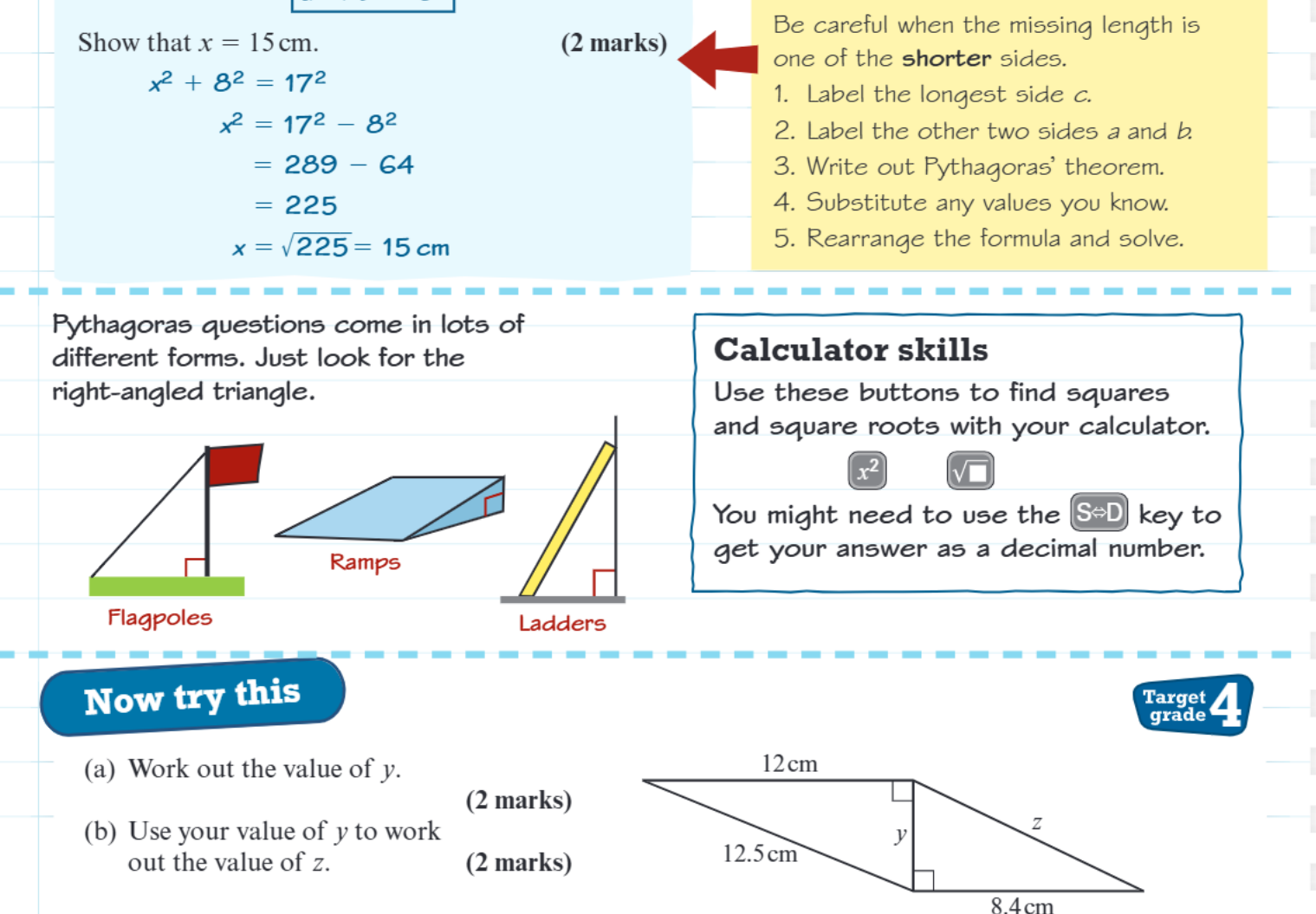
Problem: Find x when the triangle has sides x, 17cm, and 8cm.
Solution:
- Identify that x is one of the shorter sides
- Set up the equation:
- Calculate the squares:
- Rearrange to find :
- Find x by taking the square root:
Answer: x = 15cm
Important
Common Mistake Alert!
Be careful when the missing length is one of the shorter sides - you need to subtract rather than add when rearranging the formula. Many students make errors here!
Real-world applications
Pythagoras' theorem appears in many practical situations that you encounter in everyday life and exam questions.
Note
Spotting Right-Angled Triangles in Real Life
Look for right-angled triangles in these common scenarios:
- Flagpoles - finding the height when you know the ground distance and wire length
- Ramps - calculating the slope length when you know height and base
- Ladders - determining how far from a wall to place a ladder safely
These contexts often appear in exam questions, so practise identifying the right-angled triangle in real-world scenarios.
Calculator skills
Your calculator is an essential tool for Pythagoras problems, and knowing how to use it efficiently will save you valuable time in exams.
Note
Essential Calculator Functions for Pythagoras:
You need to master these calculator operations:
- Use the x² button to find squares
- Use the √ button to find square roots
- Use the S⇔D key to convert your answer to a decimal when needed
Make sure you're comfortable with these calculator functions before your exam, as they'll save you time and reduce errors.
Remember!
Summary
Key Points to Remember:
- Pythagoras' theorem only works with right-angled triangles
- You must memorise the formula as it won't be provided
- Always check you have two known sides and one missing side
- Be extra careful when the missing side is shorter - you'll need to subtract when rearranging
- Show all your working clearly in exam questions for full marks