Reading scales (AQA GCSE Maths): Revision Notes
📚Revision Notes
Reading scales
Reading scales accurately is a crucial skill in geometry and measures. Whether you're using measuring tapes, weighing scales, or measuring cylinders, there are three essential techniques you need to master.
Understanding scale divisions
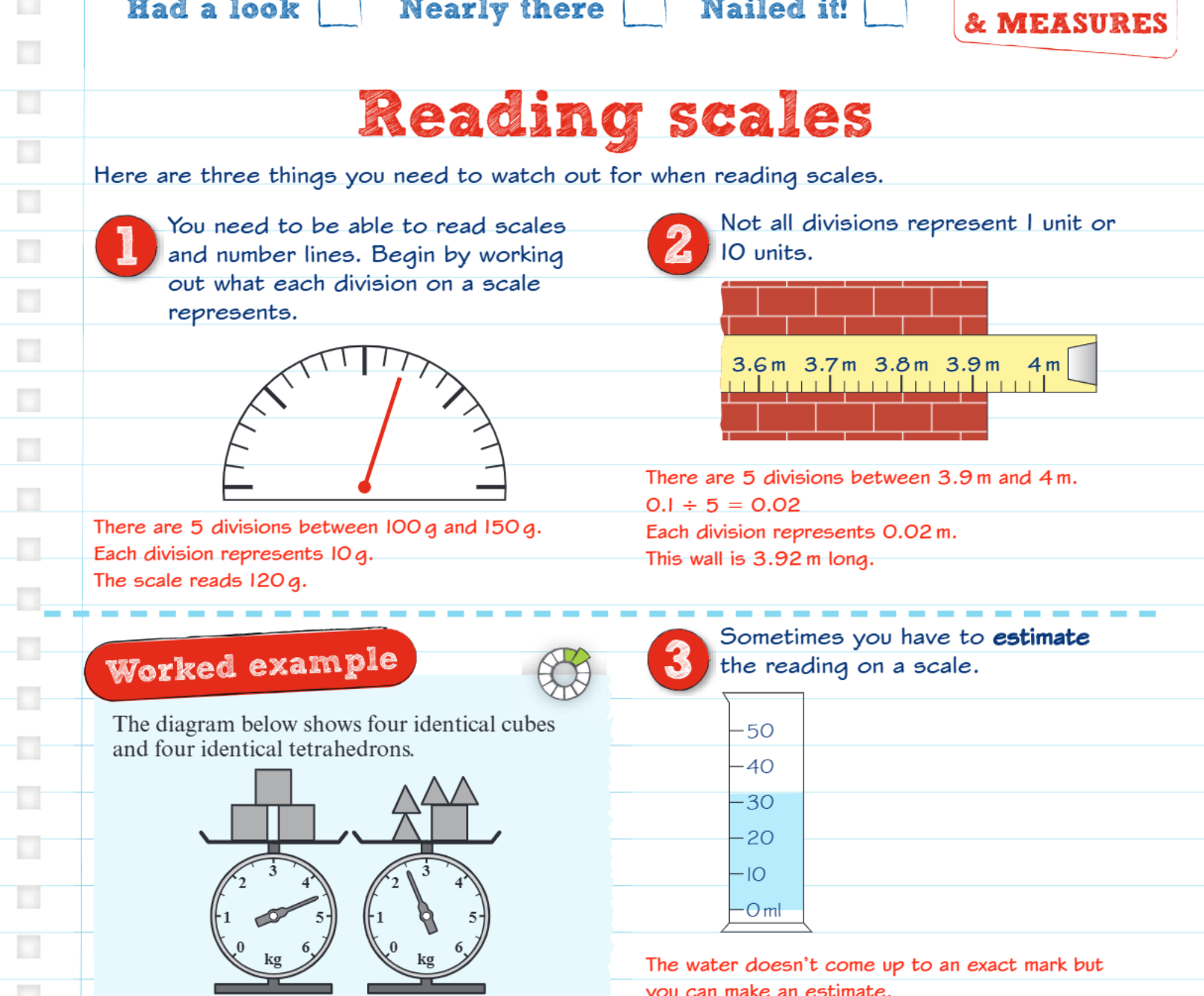
The first step in reading any scale is working out what each division represents. This requires you to identify the range between two marked values and count how many divisions fall within that range.
To calculate the value of each division:
- Find two marked values on the scale
- Calculate the difference between these values
- Count the number of divisions between them
- Divide the difference by the number of divisions
The mathematical formula is:
Example
Worked Example: Semicircular Gauge
On a semicircular gauge, there are 5 divisions between 100g and 150g.
Step 1: Find the range Range = 150g - 100g = 50g
Step 2: Apply the formula Division value =
Therefore, each division represents 10g.
Recognising non-standard division values
Important
Not all scale divisions represent convenient values like 1 unit or 10 units. Many measuring instruments have divisions that represent decimal values or unusual increments. This is a common source of errors in measurements.
Students often expect divisions to be "round numbers," but real measuring instruments frequently use non-standard increments. You must calculate the actual value rather than making assumptions.
Example
Worked Example: Measuring Tape
On a measuring tape showing a brick wall, there are 5 divisions between 3.9m and 4m.
Step 1: Calculate the range Range = 4.0m - 3.9m = 0.1m
Step 2: Find the division value Division value =
Step 3: Convert to practical units 0.02m = 2cm per division
This means each small division represents 2 centimetres, not a round number like 5cm or 10cm.
Making estimates between marked lines
Sometimes the measurement you're taking doesn't align exactly with a marked line on the scale. In these situations, you need to estimate the reading based on where it falls between two marks.
Note
Estimation Guidelines:
When the reading falls between marked lines, you can make reasonable estimates by:
- Identifying the two marked values the reading falls between
- Estimating what fraction of the way between these marks your reading lies
- Calculating the estimated value based on this fraction
Remember: Reasonable estimation is acceptable and often expected in practical measurements.
Example
Worked Example: Measuring Cylinder
In a measuring cylinder, if the liquid level appears to be about one-third of the way between 30ml and 40ml:
Step 1: Identify the range From 30ml to 40ml = 10ml range
Step 2: Calculate the fraction One-third of 10ml =
Step 3: Add to the lower value Estimated reading = 30ml + 3.3ml = approximately 33ml
Problem-solving with balance scales
Balance scales present unique challenges because you often need to work backwards from the total weights shown. The key is to plan your strategy systematically.
Note
Strategy for Balance Scale Problems:
- Identify what you know - Look at both scales and note the total weights
- Set up equations - Use the fact that identical objects have identical weights
- Solve step by step - Work out the weight of one type of object first
- Use substitution - Apply your answer to find the weight of other objects
- Check your work - Verify that your solution works for both scales
Example
Worked Example: Balance Scale Problem
Given:
- Scale 1: 4 cubes + 1 tetrahedron = 9kg
- Scale 2: 3 cubes = 6kg
Step 1: Find the weight of one cube From Scale 2: per cube
Step 2: Use substitution in Scale 1 4 cubes + 1 tetrahedron = 9kg + 1 tetrahedron = 9kg 8kg + 1 tetrahedron = 9kg
Step 3: Solve for tetrahedron 1 tetrahedron = 9kg - 8kg = 1kg
Step 4: Verify the solution
- Scale 1: ✓
- Scale 2: ✓
Summary
Key Points to Remember:
- Calculate division values by finding the range and dividing by the number of divisions:
- Not all divisions represent standard units like 1 or 10 - be prepared for decimal values
- Estimation is acceptable when readings fall between marked lines
- For balance scale problems, work systematically and show each step of your reasoning
- Always check that your final answer is reasonable for the context
- Show your working clearly, especially when calculating division values - examiners award marks for method as well as final answers