Rotations (AQA GCSE Maths): Revision Notes
📚Revision Notes
Rotations
What is a rotation?
Rotation is a transformation that turns a shape around a fixed point. The shape moves in a circular path, but its size and angles remain unchanged. This transformation is one of the key geometric transformations you need to understand for your GCSE exam.
When you rotate a shape, every point on the original shape moves the same distance around the centre of rotation. The rotated shape will be congruent to the original shape, meaning they are exactly the same size and shape, just in a different position.
Note
Understanding rotations is essential for GCSE mathematics as they frequently appear in transformation questions and coordinate geometry problems.
Describing rotations
To fully describe any rotation, you must provide three essential pieces of information:
Important
Three Essential Components of Any Rotation:
- Centre of rotation - the fixed point around which the shape turns
- Angle of rotation - how far the shape turns (usually 90°, 180°, or 270°)
- Direction of rotation - clockwise or anticlockwise
Centre of rotation
The centre of rotation is the fixed point that the shape rotates around. This is often the origin (0, 0) on a coordinate grid, but it can be any point. When the centre is not the origin, it will be given as coordinates such as (2, -1).
Angle of rotation
The angle of rotation tells you how far to turn the shape. Common angles include:
- 90° - a quarter turn
- 180° - a half turn
- 270° - three-quarter turn
Note
Always give the angle in degrees, not as fractions like "quarter turn" in your exam answers.
Direction of rotation
The direction can be either clockwise or anticlockwise. However, for 180° rotations, you don't need to specify the direction because the result is the same regardless of which way you turn.
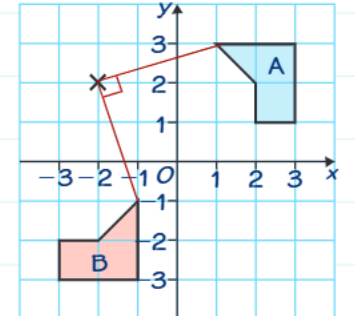
Performing rotations using tracing paper
The most reliable method for performing rotations in exams is using tracing paper. This technique helps ensure accuracy and allows you to check your work.
Example
Step-by-Step Method for Rotations:
- Mark the centre of rotation with a cross (×) on your grid
- Trace the original shape onto tracing paper
- Hold your pencil on the centre of rotation through the tracing paper
- Rotate the tracing paper by the required angle in the specified direction
- Mark the new position of the shape on your grid
This method is particularly useful for complex shapes or when the centre of rotation is not at a convenient grid point.
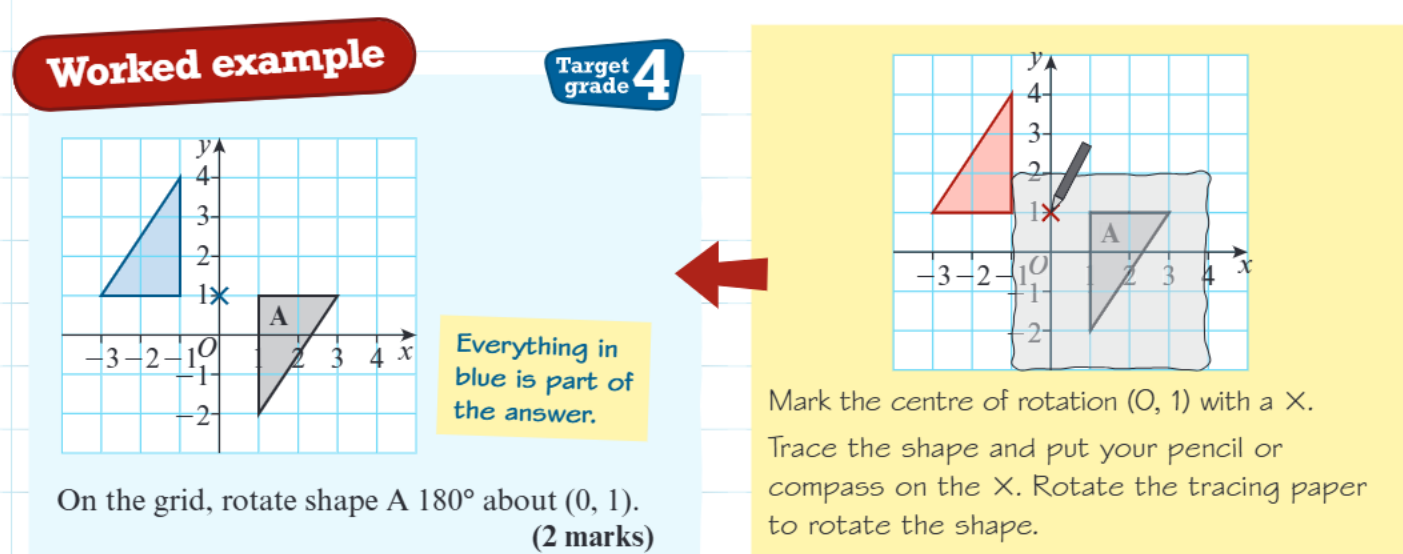
Worked example
Example
Worked Example: Rotating a Triangle 180°
Let's look at how to rotate a triangular shape 180° about the point (0, 1):
The example shows shape A being rotated 180° clockwise about the centre (0, 1). Since this is a 180° rotation, the direction doesn't matter - the result would be identical whether turning clockwise or anticlockwise.
Key steps in the solution:
- The centre of rotation (0, 1) is marked with a cross
- Each vertex of the triangle moves to a new position equidistant from the centre
- The rotated shape maintains the same size and angles as the original
Practice and exam technique
When answering exam questions about rotations, you must include all three pieces of information in your description. Look at the coordinate grid carefully to identify the key elements of the transformation.
Important
Exam Checklist for Rotation Questions:
- Where the centre of rotation is located
- How many degrees the shape has turned
- Which direction it has rotated (except for 180°)
Remember that you can request tracing paper during your exam, which makes rotation questions much more manageable and helps you avoid errors.
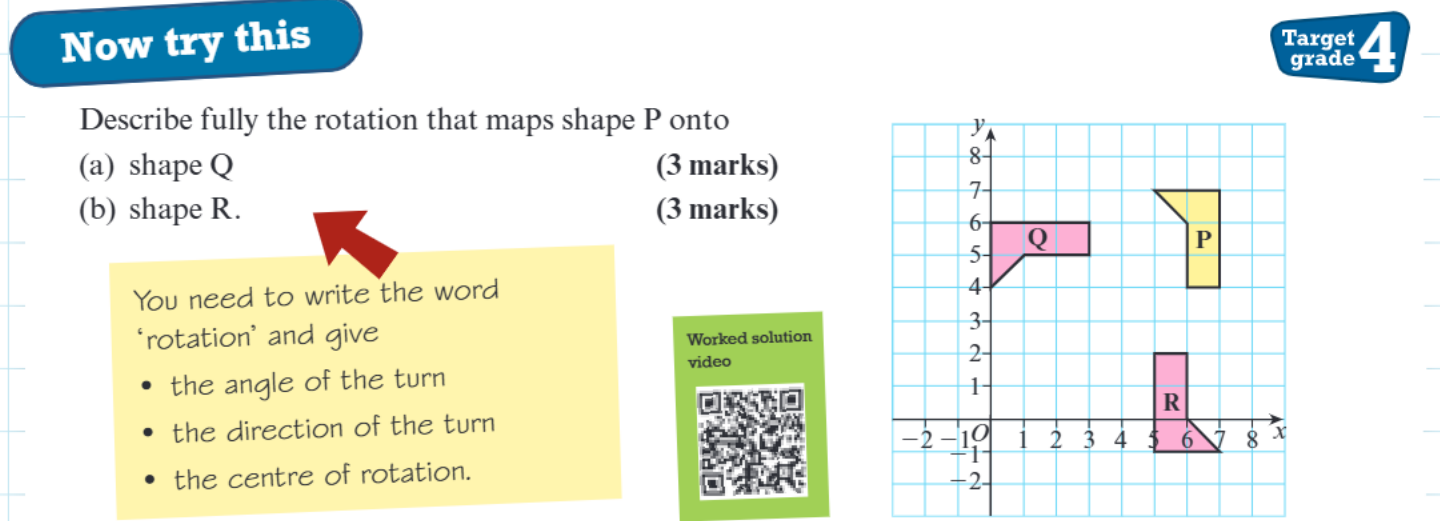
Properties of rotated shapes
Rotated shapes are always congruent to their original shape. This means that rotation is an isometry - a transformation that preserves distance and angle measurements. Understanding this property is crucial for solving geometric problems involving rotations.
The key properties include:
- All corresponding sides are equal in length
- All corresponding angles are equal in size
- The area and perimeter remain unchanged
- Only the position and orientation change
This congruence property is important for solving problems involving rotated shapes and understanding that rotation preserves all the shape's measurements.
Summary
Key Points to Remember:
- Always specify three things: centre, angle, and direction (except for 180° rotations)
- Use tracing paper in exams - it's allowed and makes rotations much easier
- Mark the centre clearly with a cross before starting your rotation
- Give angles in degrees, not as fractions or words like "quarter turn"
- Rotated shapes are congruent to the original - same size and shape, different position