Scale drawings and maps (AQA GCSE Maths): Revision Notes
📚Revision Notes
Scale drawings and maps
A scale drawing is a smaller representation of a real object or place that maintains accurate proportions. Scale drawings are essential for creating maps, architectural plans, and models where the actual size would be impractical to work with.
Understanding scale ratios
Scale ratios tell us the relationship between measurements on the drawing and measurements in real life. The scale shows how many times smaller the drawing is compared to the actual object.
Note
Scale ratio can be written in several different ways:
- As a ratio: 1:1000 (means 1 unit on the drawing represents 1000 units in real life)
- As a statement: 1cm represents 250m
- As a fraction: 1 to 25000
For example, if a ship has a scale of 1:1000:
- 1cm on the drawing represents 1000cm in real life
- If the drawing shows the ship as 34.5cm long, the actual ship is cm (or 345m) long
Converting between scale and real measurements
To find the real measurement from a scale drawing:
- Multiply the drawing measurement by the scale factor
- Always check your units and convert if necessary
To find the drawing measurement from a real measurement:
- Divide the real measurement by the scale factor
Example
Worked Example: Scale Conversion
If a map has a scale of 1:25,000 and two cities are 8cm apart on the map:
Step 1: Identify what we're finding Real distance = drawing distance × scale factor
Step 2: Apply the calculation Real distance = cm
Step 3: Convert to appropriate units 200,000cm = 2,000m = 2km
Working with different scale formats
Map scales can appear in various formats, and you need to understand what each means:
- 1 to 25000: 1 unit on the map = 25000 units in real life
- 1cm represents 25000cm: Direct measurement conversion
- 1cm represents 250m: Scale with unit conversion included
- 4cm represent 1km: Larger scale where more centimetres represent the distance
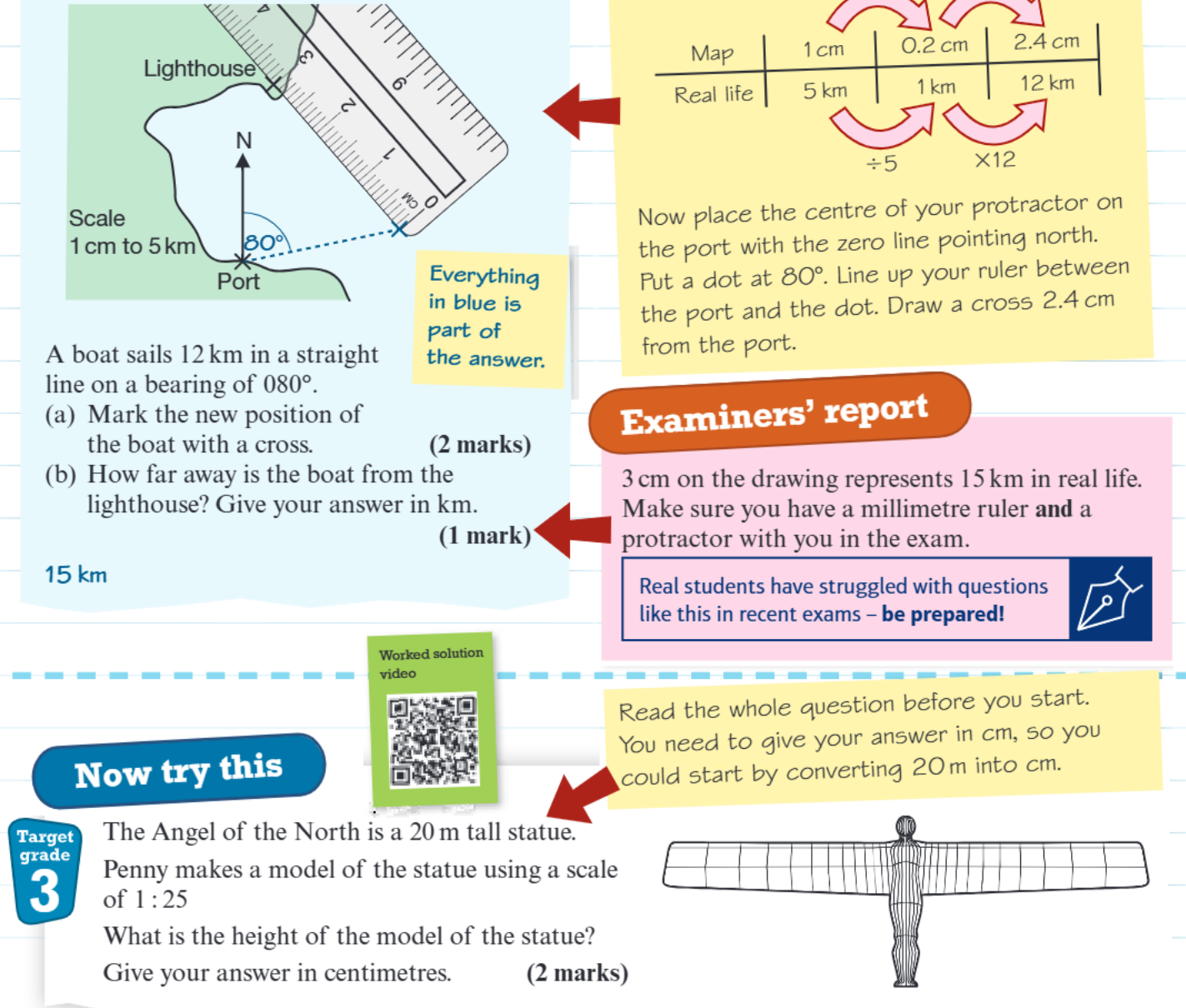
Using scale drawings with bearings
Scale drawings become particularly useful when combined with compass bearings for navigation problems. When working with bearings on scale drawings:
- Use a protractor to measure angles accurately
- Place the protractor centre on your starting point
- Align the zero line with north
- Measure the bearing angle clockwise from north
- Use the scale to convert drawing distances to real distances
Important
For navigation problems, you'll often need to:
- Measure distances on the scale drawing
- Convert these to real-life distances using the scale
- Use a protractor to measure or draw bearings
- Apply both measurements to solve the problem
Exam techniques and equipment
Essential equipment for scale drawing questions:
- Millimetre ruler for precise measurements
- Protractor for measuring and drawing angles
- Calculator for scale conversions
Important
Common mistakes to avoid:
- Forgetting to convert units in your final answer
- Using the wrong scale factor (dividing instead of multiplying)
- Measuring angles incorrectly with the protractor
- Not reading the scale format carefully
Exam tips:
- Always read the whole question before starting
- Check what units your final answer should be in
- Be prepared to convert between different units (cm to m, m to km)
- Show your working clearly for scale calculations
- Double-check that you're using the correct scale ratio
Practical applications
Scale drawings are used in many real situations:
- Maps for navigation and geography
- Architectural plans for buildings
- Engineering drawings for machinery
- Model making where objects are scaled down proportionally
When creating or interpreting scale drawings, always ensure you understand the scale being used and can convert confidently between drawing measurements and real-life measurements.
Summary
Key Points to Remember:
- Scale drawings maintain accurate proportions while showing objects at a manageable size
- Scale ratios can be written as ratios (1:1000), statements (1cm represents 250m), or fractions (1 to 25000)
- To find real measurements: multiply the drawing measurement by the scale factor
- Essential exam equipment: millimetre ruler, protractor, and calculator
- Always check units in your final answer and convert if necessary