Similarity and congruence (AQA GCSE Maths): Revision Notes
📚Revision Notes
Similarity and congruence
Note
Understanding similarity and congruence is fundamental in geometry. These concepts help us compare shapes, solve problems involving scale, and work with transformations. This topic frequently appears in GCSE mathematics exams.
Understanding similar shapes
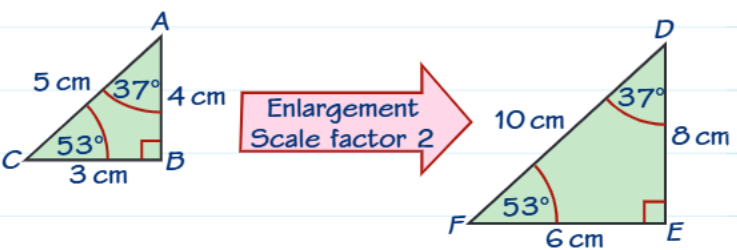
Similar shapes are shapes that have exactly the same angles but are different sizes. When one shape can be enlarged or reduced to create another shape, these two shapes are similar.
Important
Key Features of Similar Shapes:
- All corresponding angles are identical
- All corresponding sides are in the same ratio
- One shape is an enlargement or reduction of the other
- They have the same shape but different sizes
Scale factors in similar shapes
A scale factor tells us how many times bigger one shape is compared to another similar shape. When you enlarge a shape by scale factor 2, every length doubles while all angles stay exactly the same.
Example
Worked Example: Triangle Enlargement
If a triangle has sides measuring 3cm, 4cm and 5cm, enlarging it by scale factor 2 creates a triangle with sides of:
The angles of and remain unchanged.
Understanding congruent shapes
Congruent shapes are shapes that are exactly identical in both size and shape. They match perfectly when placed on top of each other.
Important
Essential Properties of Congruent Shapes:
- Exactly the same size and shape
- Same area and same perimeter
- All corresponding sides are equal in length
- All corresponding angles are equal
Transformations that create congruent shapes
Certain transformations produce congruent shapes:
- Rotations - turning a shape around a fixed point
- Reflections - flipping a shape over a line of symmetry
- Translations - sliding a shape to a different position
Important
Remember: Enlargements create similar shapes, not congruent shapes, because they change the size.
Worked examples
Identifying similar and congruent shapes
Example
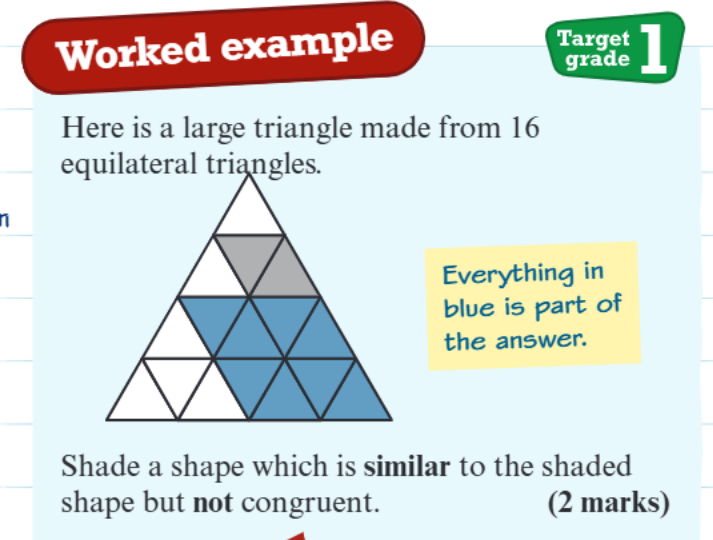
Worked Example: Shape Identification on Triangular Grid
In this triangular pattern, you need to identify shapes that are similar to the shaded shape but not congruent.
Method:
- Look for triangular arrangements that have the same angles
- Check proportions are the same as the original
- Ensure they are a different size from the original shaded area
- Remember that orientation doesn't affect similarity
Volume comparison in 3D shapes
Example
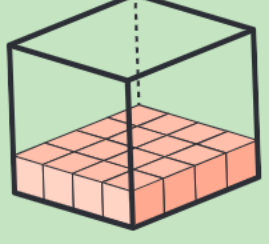
Worked Example: Cube Volume Comparison
When comparing similar 3D shapes, volume calculations become important. For cubes with edges of 2cm and 8cm:
Step 1: Find the scale factor
Step 2: Calculate how many small cubes fit in each dimension Along each dimension: 4 small cubes fit
Step 3: Calculate total volume
This demonstrates that volume increases by the cube of the scale factor.
Shape identification exercises
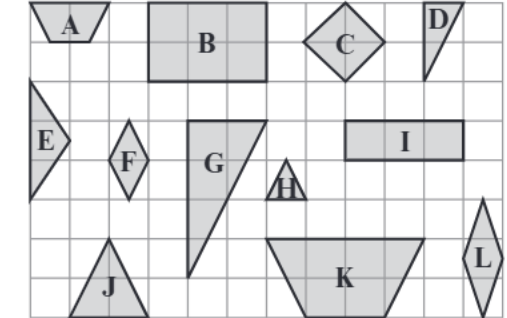
When identifying similar shapes on a grid, follow these steps:
- Look for shapes with the same angles
- Check if one shape can be enlarged to match another
- Remember that orientation doesn't matter - shapes can be rotated and still be similar
- Focus on proportional relationships between corresponding sides
Key differences summary
| Similar Shapes | Congruent Shapes |
|---|---|
| Same angles | Same angles AND size |
| Different sizes | Identical size |
| Proportional sides | Equal sides |
| Created by enlargement | Created by rotation, reflexion, translation |
Summary
Key Points to Remember:
- Similar shapes have identical angles but different sizes - they're enlargements or reductions of each other
- Congruent shapes are exactly the same in both size and shape - perfect copies
- Rotations, reflections and translations create congruent shapes, while enlargements create similar shapes
- In 3D similarity problems, volume increases by the cube of the scale factor
- All congruent shapes are also similar, but similar shapes are only congruent if the scale factor is 1
Note
Exam Tips:
- For similar shapes: Always check that angles match and sides are in proportion
- For congruent shapes: Look for exact matches in both size and shape
- Scale factor questions: Remember that area scales by and volume by
- 3D problems: Work systematically through each dimension when calculating how shapes fit together
- Grid problems: Count squares carefully and look for the same angles and proportional sides