Solving angle problems (AQA GCSE Maths): Revision Notes
📚Revision Notes
Solving angle problems
Understanding how to solve angle problems is essential for GCSE geometry. You need to know key angle facts and be able to apply them systematically, always showing clear working and giving reasons for each step.
Essential angle facts
These fundamental angle relationships form the foundation for solving all angle problems:
Angles around a point add up to 360°. When several angles meet at a single point, their total is always 360°.
Angles in a triangle add up to 180°. No matter what type of triangle, the three interior angles always sum to 180°.
Angles in a quadrilateral add up to 360°. Any four-sided shape has interior angles totalling 360°.
Angles on a straight line add up to 180°. When angles are positioned along a straight line, they form a total of 180°.
Note
These four basic angle facts are the building blocks for all angle problems. Make sure you can recall them instantly and recognise when to apply each one in different geometric situations.
Corresponding angles are equal when lines are parallel. These angles appear in matching positions when a line crosses two parallel lines.
Base angles of an isosceles triangle are equal. In an isosceles triangle, the two angles opposite the equal sides are identical.
Important
Always look for these special angle relationships in diagrams - they're often the key to solving the problem. Missing a parallel line relationship or isosceles triangle property is a common mistake that can throw off your entire solution.
Working with algebraic expressions
Many angle problems involve algebraic expressions rather than just numbers. You apply the same angle facts but work with variables like 'p', 'x', or 'y'.
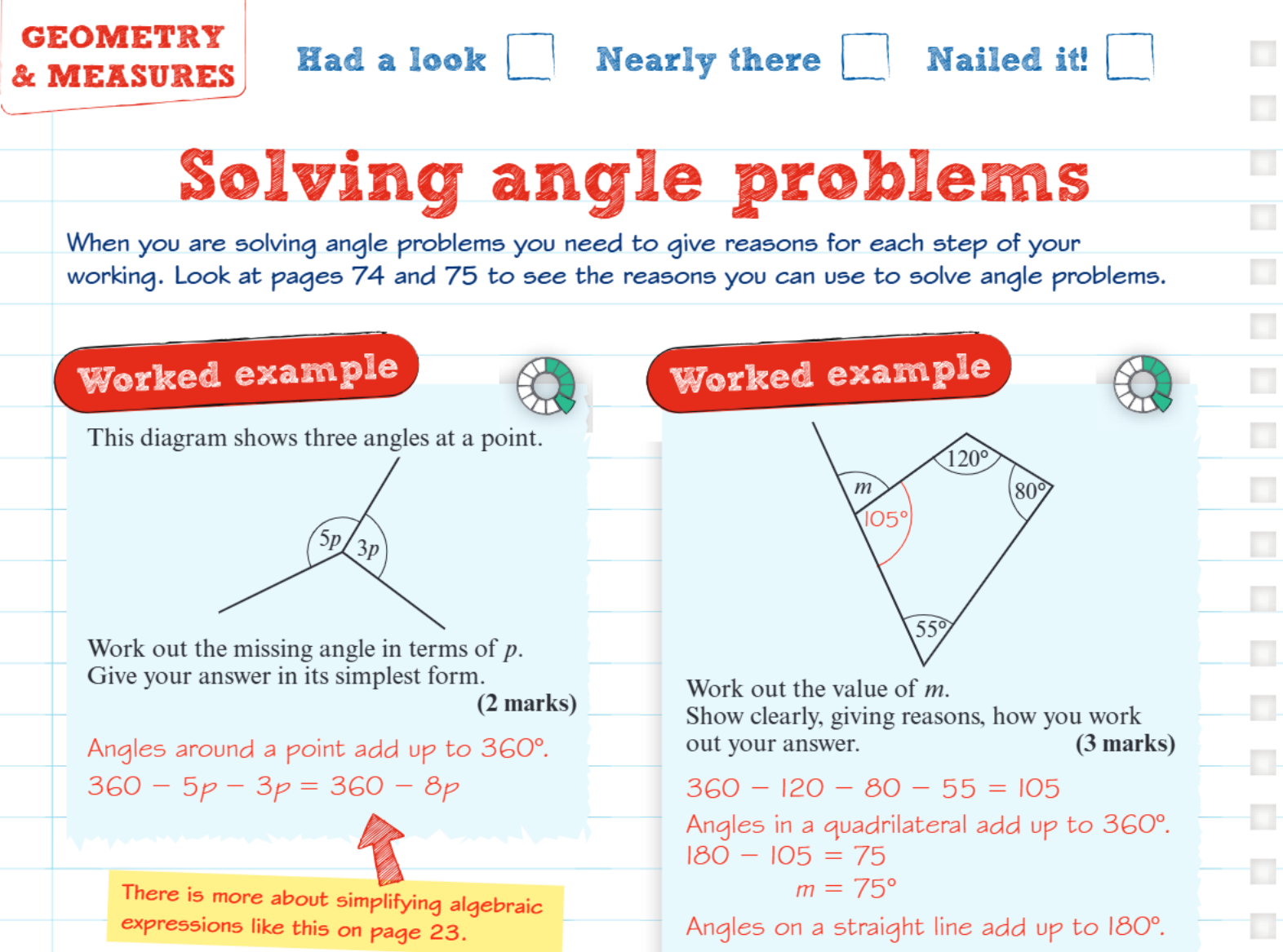
Example
Worked Example: Angles Around a Point with Algebra
When three angles around a point are given as 5p, 3p, and an unknown angle, you can set up the equation:
This simplifies to:
The key principle is to treat algebraic expressions just like numbers when applying angle facts, then solve the resulting equations systematically.
Solving complex problems step by step
More challenging problems combine multiple angle facts. You might need to use angles in a quadrilateral alongside angles on a straight line, or work with parallel lines and triangle properties together.
The key approach is to:
- Identify what angle facts apply to each part of the diagram
- Set up equations using these facts
- Solve systematically, showing each step
- Always give reasons for your working
Note
Don't try to solve everything at once. Break complex problems down into smaller parts, applying one angle fact at a time. This methodical approach prevents errors and makes your working clearer for exam marking.
Working with parallel lines
When dealing with parallel lines, corresponding angles become crucial. These are angles in matching positions when a transversal (crossing line) intersects two parallel lines.
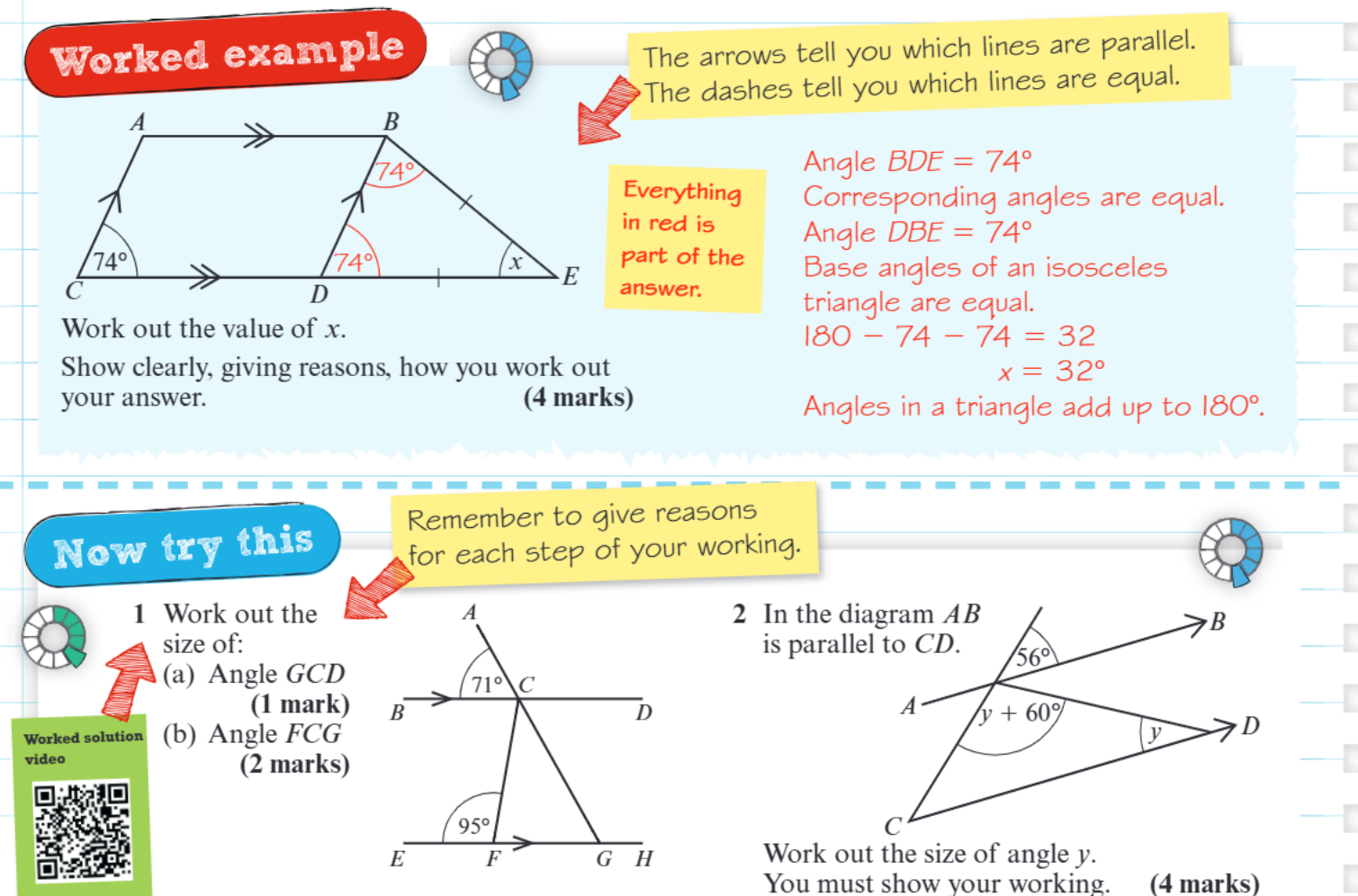
Combined with triangle properties, parallel line problems often require you to identify corresponding angles first, then apply triangle angle facts to find unknown values.
Important
Always look for parallel line markings in diagrams (arrows or identical markings). Corresponding angles being equal is often the breakthrough that unlocks the entire problem.
Exam technique tips
Always give reasons for each step of your working. The exam requires you to justify why you can use each angle fact.
Show clear working by writing down the angle fact you're using, then the calculation, then the answer.
Check your answer makes sense by ensuring all angles in triangles sum to 180° and angles around points sum to 360°.
Use proper notation by clearly labelling angles and showing which fact applies to each calculation.
Important
Common Exam Mistakes to Avoid:
- Forgetting to give reasons for each step (this costs marks even if your answer is correct)
- Not showing intermediate steps in your calculations
- Mixing up corresponding angles with alternate angles
- Forgetting to check if your final answer is reasonable
Summary
Key Points to Remember:
- Angles around a point = 360°, angles in triangles = 180°, angles in quadrilaterals = 360°
- Always give clear reasons for each step of your working - this earns you marks
- Corresponding angles are equal when lines are parallel
- Base angles of isosceles triangles are equal
- Set up equations when working with algebraic expressions, then solve step by step