Time and timetables (AQA GCSE Maths): Revision Notes
📚Revision Notes
Time and timetables
Understanding time formats
There are two main ways to write time: the 12-hour clock and the 24-hour clock. Understanding both formats is essential for reading schedules, timetables, and managing daily activities.
12-hour and 24-hour clocks
The 12-hour clock uses numbers 1-12 with am (morning) and pm (afternoon/evening) to show whether it's before or after midday. This format is commonly used in everyday conversation and informal settings.
The 24-hour clock uses numbers 00-23 and doesn't need am or pm because each time can only happen once in a day. This system is preferred for official timetables, military operations, and international communications.
Important
Key Conversion Rules:
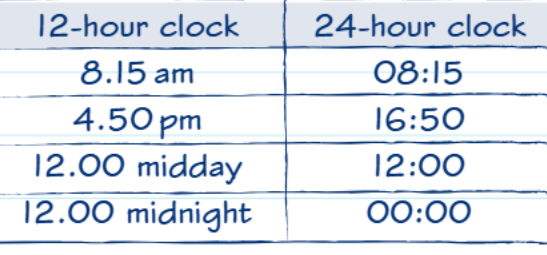
- Morning times (am): Write the same numbers but add a zero if needed (8:15 am becomes 08:15)
- Afternoon/evening times (pm): Add 12 to the hour number (4:50 pm becomes 16:50)
- Special cases:
- 12:00 midday stays as 12:00
- 12:00 midnight becomes 00:00
Note
The 24-hour clock eliminates confusion between morning and evening times. For example, 17:30 can only mean 5:30 in the evening, while 5:30 could be either morning or evening in 12-hour format without the am/pm indicator.
Converting time units
Hours to minutes
Remember that there are 60 minutes in 1 hour. This fundamental relationship is the basis for all time unit conversions.
To convert hours to minutes, multiply the number of hours by 60:
Example
Worked Example: Converting Hours to Minutes
- 2 hours = 2 × 60 = 120 minutes
- 3½ hours = 3.5 × 60 = 210 minutes
For mixed times:
- 2¼ hours = 2 hours and 15 minutes = (2 × 60) + 15 = 135 minutes
You can also express fractional hours in different ways. For instance, hour equals 15 minutes, hour equals 30 minutes, and hour equals 45 minutes.
Reading timetables
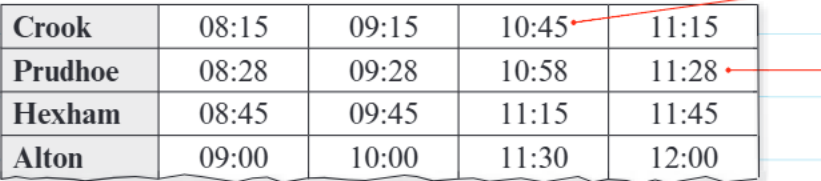
Timetables show departure and arrival times for transport services like buses and trains. They usually use the 24-hour clock format to avoid confusion and ensure precision in scheduling.
Note
How to Read Timetables Effectively:
- Find your starting point (departure station)
- Find your destination (arrival station)
- Look across the row to see what time the service leaves your station
- Look down the column to see what time it arrives at your destination
- Check for any footnotes or symbols that might indicate special conditions
When using timetables, always double-check the day of the week and any special service notes, as schedules often vary between weekdays and weekends.
Calculating journey times
To work out total journey time, add up all the separate parts of the journey. This method ensures you account for all waiting times and transfers.
Example
Worked Example: Calculating Total Journey Time
If someone:
- Drives to the train station: 15 minutes
- Waits for the train: 25 minutes
- Takes the train journey: 1½ hours = 90 minutes
Total time calculation: Total time = 15 min + 25 min + 90 min = 130 minutes = 2 hours 10 minutes
Alternative step-by-step method:
- Start time: 11:30 am
- Add 15 minutes → 11:45 am
- Add 25 minutes → 12:10 pm
- Add 1½ hours → 1:40 pm (final arrival time)
Important
Always allow extra time for unexpected delays, especially when making important appointments or catching connecting services.
Time zones
Different places around the world have different times due to time zones. This system exists because the Earth rotates, creating day and night at different times across the globe.
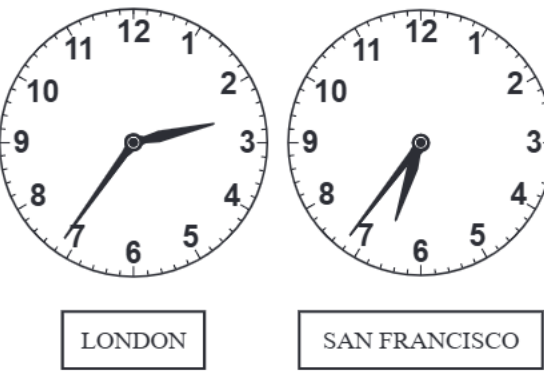
When it's afternoon in London, it's morning in San Francisco because San Francisco is several hours behind London. This concept is important for international travel and communication, especially in our globally connected world.
Note
The world is divided into approximately 24 time zones, roughly corresponding to the 24-hour day. However, political boundaries and local preferences mean some regions use half-hour or quarter-hour offsets from standard time zones.
To solve time zone problems:
- Work out the time difference between the two places
- Add or subtract this difference from the given time
- Check if the day changes (crossing midnight)
Summary
Summary
Key Points to Remember:
- There are 60 minutes in 1 hour - use this for all time conversions
- For 24-hour clock: add 12 to pm times (except 12:00 midday stays the same)
- Timetables usually use 24-hour format - practise reading these carefully
- Break journey time calculations into steps and add each part
- Time zones mean different places have different times at the same moment
- Always double-check your calculations and allow extra time for delays