Translations (AQA GCSE Maths): Revision Notes
📚Revision Notes
Translations
What is a translation?
A translation is a type of transformation that moves a shape from one position to another without changing its size, orientation, or shape. Think of it as sliding a shape across the page - the shape itself doesn't change, it just moves to a new location.
Note
The key concept here is that translation is like sliding a shape across paper - imagine pushing a book across a table. The book doesn't change its size or rotate, it simply moves to a new position.
You can describe any translation using a vector, which tells you exactly how far and in which direction the shape has moved.
How to use vectors for translations
When describing a translation, we use a vector written in the form:
The vector has two numbers:
- The top number tells you the horizontal movement (left or right)
- The bottom number tells you the vertical movement (up or down)
Direction rules
Understanding which direction is positive or negative is crucial:
Important
Direction Convention for Vectors:
Horizontal movement (top number):
- Positive number = movement to the right
- Negative number = movement to the left
Vertical movement (bottom number):
- Positive number = movement up
- Negative number = movement down
For example, the vector means:
- Move 4 units to the right (positive horizontal)
- Move 3 units down (negative vertical)
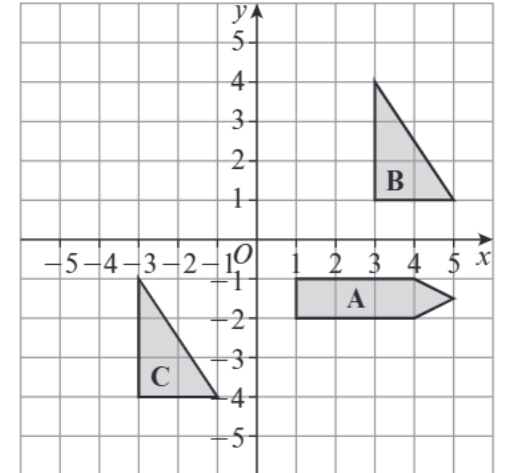
Looking at the coordinate grid above, you can see how shapes A, B, and C are positioned in different locations. Each could be the result of translating one of the others using an appropriate vector.
Properties of translated shapes
An important property of translations is that the original shape and the translated shape are congruent. This means:
Note
What congruent shapes have in common:
- They have exactly the same size
- They have exactly the same shape
- All corresponding lengths remain unchanged
- All corresponding angles remain unchanged
The only difference between the shapes is their position on the coordinate plane.
Describing translations in exams
When answering exam questions about translations, you need to be precise with your language:
Important
Essential Exam Technique:
- Always use the word "translation"
- Always include the vector
- Use positive numbers for movement right or up
- Use negative numbers for movement left or down
Good answer: "Translation by the vector "
Avoid saying: "Translation 4 squares across" - this doesn't clearly specify direction and could be ambiguous.
Working with translation problems
Example
Worked Example: Solving Translation Problems
Step 1: Identify the starting shape and the final position
Step 2: Count the horizontal movement (right = positive, left = negative)
Step 3: Count the vertical movement (up = positive, down = negative)
Step 4: Write your answer as "Translation by the vector "
Note: For translations moving down and to the left, both numbers in your vector will be negative.
Summary
Key Points to Remember:
- Translation is a sliding movement that preserves size and shape
- Use vectors in the form to describe translations
- Positive means right or up, negative means left or down
- Translated shapes are congruent - they're identical except for position
- Always state your answer as "Translation by the vector " in exams