Trigonometry 1 (AQA GCSE Maths): Revision Notes
📚Revision Notes
Trigonometry 1
What are trigonometric ratios?
Trigonometric ratios are mathematical relationships between the sides and angles in right-angled triangles. These ratios help us find missing angles when we know the lengths of two sides of a triangle.
Important
The key requirement is that you must have a right-angled triangle and know the lengths of two sides to calculate a missing angle.
The three trigonometric ratios
There are three main trigonometric ratios you need to know:
- Sine (sin): The ratio of the opposite side to the hypotenuse
- Cosine (cos): The ratio of the adjacent side to the hypotenuse
- Tangent (tan): The ratio of the opposite side to the adjacent side
Mathematical definitions
How to label triangle sides
Before using trigonometric ratios, you must correctly identify the sides of your triangle:
- Hypotenuse: Always the longest side, opposite the right angle
- Adjacent: The side next to the angle you're working with (not the hypotenuse)
- Opposite: The side across from the angle you're working with
Note
The labelling depends on which angle you're focusing on, so the adjacent and opposite sides can change depending on your chosen angle.
The SOH CAH TOA memory aid
Important
SOH CAH TOA is a helpful way to remember the trigonometric ratios:
- SOH: Sine = Opposite ÷ Hypotenuse
- CAH: Cosine = Adjacent ÷ Hypotenuse
- TOA: Tangent = Opposite ÷ Adjacent
This mnemonic only works for right-angled triangles.
Finding missing angles using inverse functions
When you know two sides of a right-angled triangle and need to find an angle, you use inverse trigonometric functions.
What are inverse trigonometric functions?
Inverse trigonometric functions reverse the normal trigonometric operations:
- (inverse sine)
- (inverse cosine)
- (inverse tangent)
Note
Instead of finding a ratio from an angle, these functions find an angle from a ratio.
Using your calculator
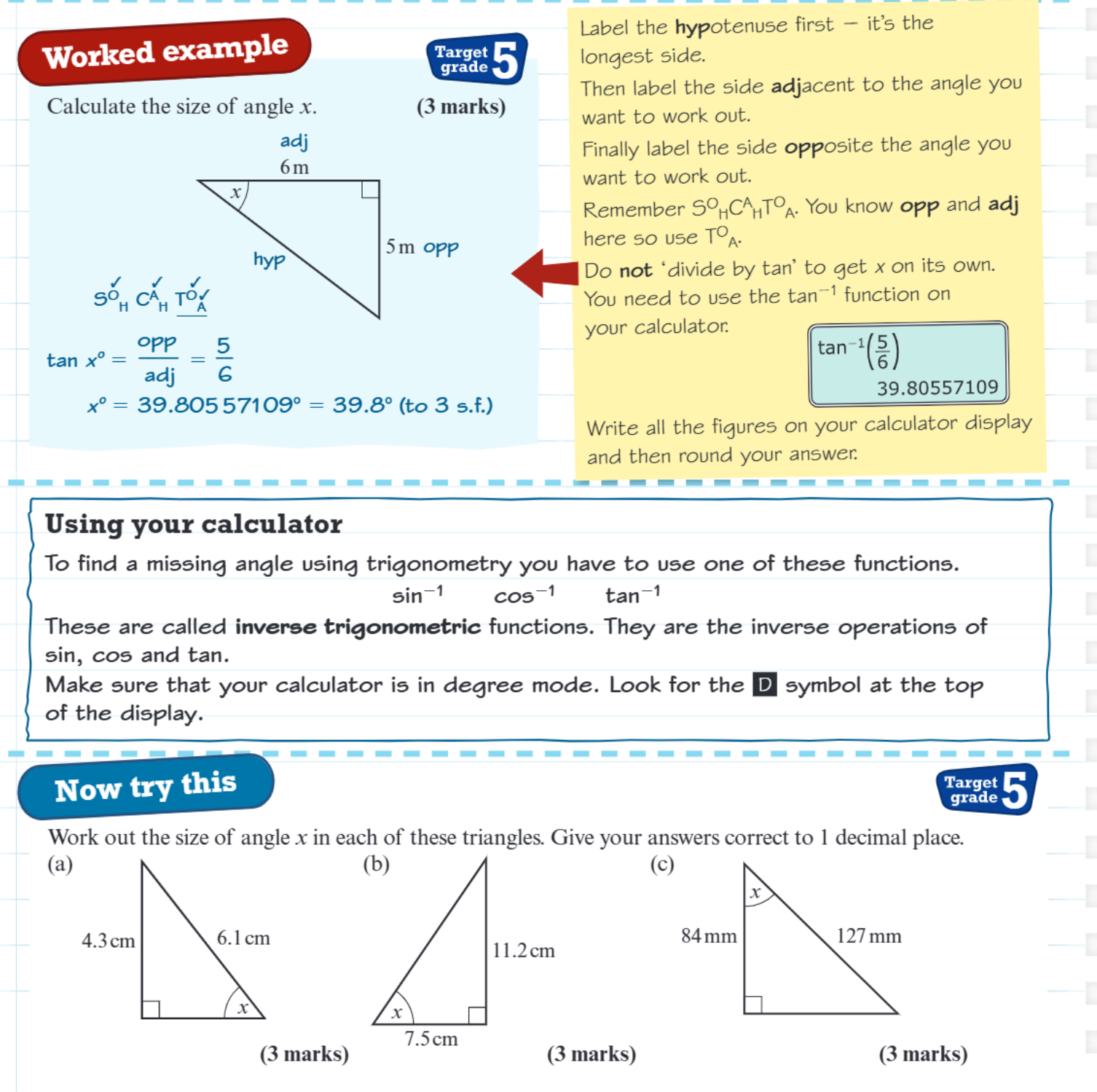
To find missing angles using trigonometry, follow this systematic approach:
- Check your calculator is in degree mode - look for the 'D' symbol on the display
- Identify which sides you know and which trigonometric function to use
- Calculate the ratio of the two known sides
- Use the appropriate inverse function (, , or )
- Write down all figures from your calculator display, then round as required
Step-by-step method
Example
Method for Finding Missing Angles:
Step 1: Label the hypotenuse first (the longest side) Step 2: Label the adjacent side (next to your angle) Step 3: Label the opposite side (across from your angle) Step 4: Use SOH CAH TOA to decide which ratio to use Step 5: Apply the inverse function to find your angle
For example, if you know the opposite and adjacent sides, use because you need TOA (tangent = opposite ÷ adjacent).
Worked example approach
When solving trigonometry problems, it's important to understand the correct process:
Important
Common Mistakes to Avoid:
- Don't divide by tan - this won't give you the angle
- Use function on your calculator instead
- Input the ratio (opposite ÷ adjacent) into the function
- Record the full calculator display before rounding
Note
The process transforms a ratio of sides into an actual angle measurement. This is the key concept that distinguishes finding angles from finding side lengths.
Exam tips
When working with trigonometry in exams, remember these essential points:
- Always check your calculator is in degree mode before starting
- Show your working clearly by writing the trigonometric ratio you're using
- Round to the required accuracy - often 1 decimal place or 3 significant figures
- Label your triangle sides before choosing which trigonometric function to use
Summary
Key Points to Remember:
- Trigonometric ratios only work in right-angled triangles
- Use SOH CAH TOA to remember which ratio relates to which sides
- Inverse functions (, , ) help you find angles when you know two sides
- Always ensure your calculator is in degree mode before calculating
- Label your triangle sides first: hypotenuse (longest), then adjacent and opposite relative to your angle