Units of area and volume (AQA GCSE Maths): Revision Notes
📚Revision Notes
Units of area and volume
Understanding how to convert between different units of area and volume is essential for GCSE maths. These conversions are more complex than simple length conversions because you need to apply different rules depending on whether you're working with area (2D) or volume (3D) measurements.
Why area and volume conversions are different
Converting units of area and volume requires special attention because the conversion factors change dramatically. Unlike length conversions where you simply multiply by a single factor, area and volume conversions involve squaring and cubing these factors respectively.
Important
Key Principle: When you change the dimensions of a shape, the effect on area and volume is much greater than the effect on length.
Area conversions
Area measures the amount of space inside a 2D shape and is expressed in square units such as mm², cm², m², and km².
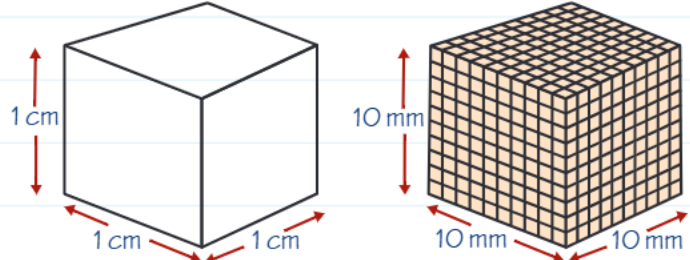
The diagram above shows two squares that have exactly the same area - one measured in centimetres and one measured in millimetres. This demonstrates that 1 cm² contains exactly 100 mm² .
Note
Understanding Area Conversion Factors
Each area conversion factor is the square of the corresponding length conversion factor. This is because area involves two dimensions, both of which must be converted.
Key area conversion formulas
- 1 cm² = 100 mm² (because 1 cm = 10 mm, so )
- 1 m² = 10,000 cm² (because 1 m = 100 cm, so )
- 1 km² = 1,000,000 m² (because 1 km = 1000 m, so )
Volume conversions
Volume measures the amount of space inside a 3D shape and is expressed in cubic units such as mm³, cm³, m³, as well as litres and millilitres.
The same principle applies to volume conversions, but now you must cube the length multiplier instead of squaring it.
Key volume conversion formulas
- 1 cm³ = 1000 mm³ (because 1 cm = 10 mm, so )
- 1 m³ = 1,000,000 cm³ (because 1 m = 100 cm, so )
- 1 litre = 1000 cm³
- 1 ml = 1 cm³
Note
Liquid Measurements
The relationship between litres and cubic centimetres is particularly important: 1 litre = 1000 cm³ and 1 ml = 1 cm³. These conversions appear frequently in exam questions involving density and fluid measurements.
The conversion multiplier rule
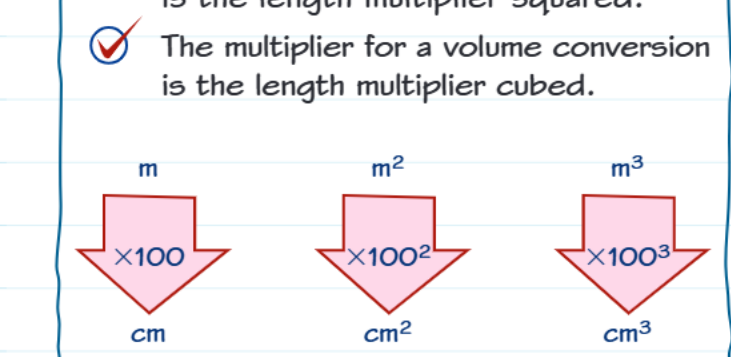
This diagram illustrates the fundamental rule for unit conversions across different dimensions:
Important
The Universal Conversion Rule
- For length: multiply by the conversion factor
- For area: multiply by the conversion factor squared
- For volume: multiply by the conversion factor cubed
For example, when converting from metres to centimetres:
- Length: × 100
- Area: × = × 10,000
- Volume: × = × 1,000,000
Working with density problems
Many exam questions combine volume conversions with density calculations. Remember that density = mass ÷ volume, which can be rearranged to mass = density × volume.
Example
Worked Example: Calculating Mass from Density
A lead model has a volume of 400 cm³. Lead has a density of 11,350 kg/m³. Calculate the mass in kg.
Step 1: Convert the volume to m³
Step 2: Calculate the mass
Notice how we divided by when converting from cm³ to m³ because we're going from a smaller unit to a larger unit.
Note
Unit Direction Rule
When converting to larger units, you divide; when converting to smaller units, you multiply. This applies the conversion factors in the correct direction.
Exam tips
Note
Essential Exam Strategies
- Always check your units carefully - are you working with area or volume?
- When converting to larger units, you divide; when converting to smaller units, you multiply
- Double-check whether you need to square or cube your conversion factor
- In density problems, make sure all units are consistent before calculating
- Show all working steps clearly, especially unit conversions
Summary
Key Points to Remember:
- Area conversions: Square the length multiplier ( for cm² to mm²)
- Volume conversions: Cube the length multiplier ( for cm³ to mm³)
- Essential conversions: 1 litre = 1000 cm³ and 1 ml = 1 cm³
- Density problems: Always convert units first before using mass = density × volume
- Sense check: Does your final answer make sense compared to the original measurement?