Volumes of cuboids (AQA GCSE Maths): Revision Notes
📚Revision Notes
Volumes of cuboids
What is volume?
Volume is the amount of space that a 3D shape takes up. When you think about volume, imagine how much water you could pour inside a box - that's its volume.
The most common units for measuring volume are:
- cm³ (cubic centimetres) for smaller objects
- m³ (cubic metres) for larger objects
- Litres for liquids
Note
Understanding volume as "how much space something takes up" helps you visualise what you're calculating. Think of it as the capacity of a container - how much it can hold inside.
Volume formula for cuboids
A cuboid is a 3D shape with rectangular faces (like a shoebox). To find the volume of any cuboid, you need to know three measurements: length, width, and height.
The formula is straightforward:
This formula works because you're essentially counting how many unit cubes fit inside the cuboid. If you have a length of 5 units, width of 3 units, and height of 2 units, you're fitting unit cubes inside.
Note
Why does this formula work?
Think of building the cuboid layer by layer. Each layer has length × width squares, and you stack height number of layers. So the total is length × width × height unit cubes.
Calculating volume step by step
When solving volume problems, follow these key steps:
- Identify the dimensions - find the length, width, and height
- Check the units - make sure all measurements use the same units
- Apply the formula - multiply length × width × height
- Write the correct units - if your measurements are in cm, your volume will be in cm³
Example
Worked Example 1: Basic volume calculation
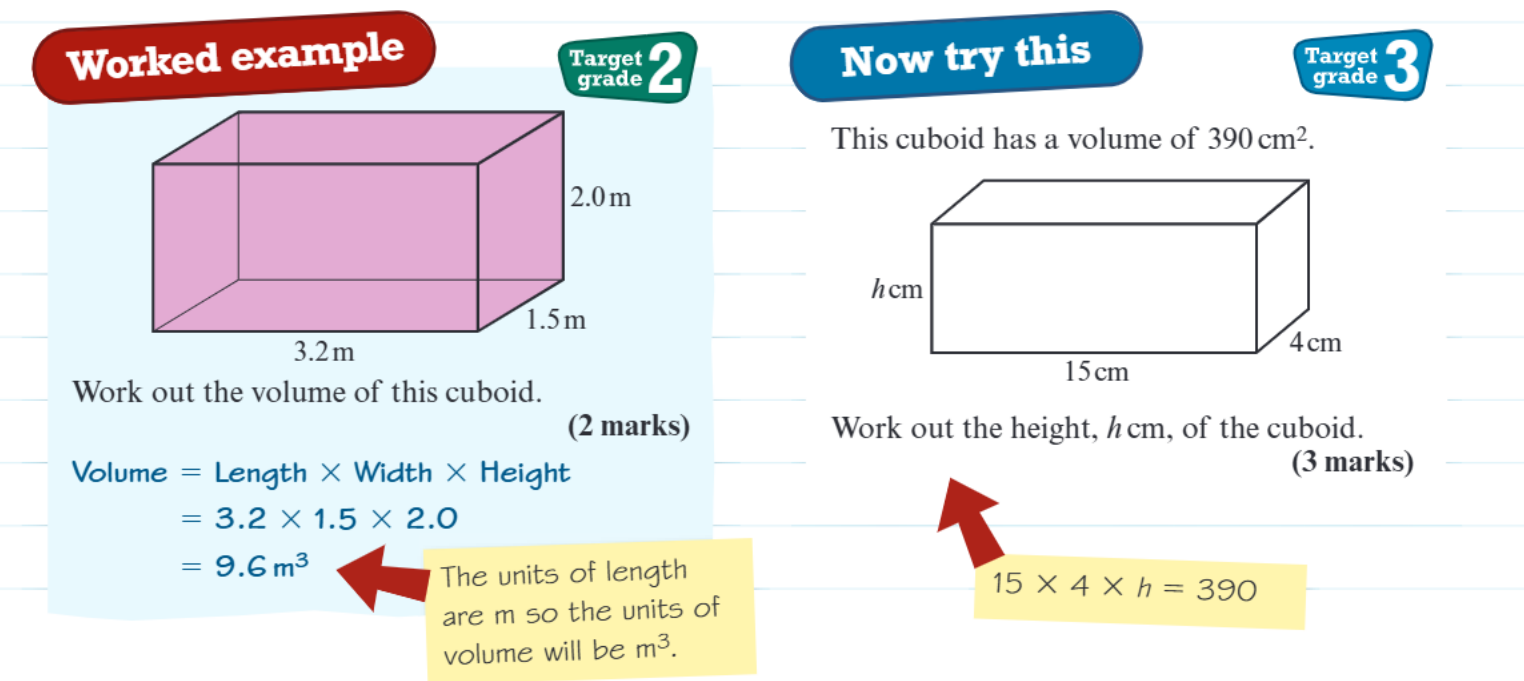
For a cuboid measuring 3.2m × 1.5m × 2.0m:
Step 1: Identify the dimensions
- Length = 3.2m
- Width = 1.5m
- Height = 2.0m
Step 2: Apply the formula Volume = Length × Width × Height Volume = 3.2 × 1.5 × 2.0 = 9.6 m³
Since the length measurements were in metres, the volume is measured in cubic metres (m³).
Converting units
Sometimes you need to convert between different units. A common conversion is from cm³ to litres:
So to convert cm³ to litres, divide by 1000.
Example
Worked Example 2: Converting units
If a volume is 168,000 cm³, convert to litres:
Step 1: Use the conversion factor 1 litre = 1000 cm³
Step 2: Divide by 1000 168,000 ÷ 1000 = 168 litres
Finding missing dimensions
If you know the volume and two dimensions, you can find the missing third dimension by rearranging the formula.
Example
Worked Example: Finding missing height
If a cuboid has:
- Volume = 390 cm³
- Length = 15 cm
- Width = 4 cm
- Height = ? cm
Step 1: Set up the equation
Step 2: Simplify
Step 3: Solve for h
Important
Common Mistake to Avoid
When rearranging the formula, make sure you divide the volume by the product of the two known dimensions, not by each dimension separately.
Incorrect: ❌
Correct: ✓
Exam tips
Important
Essential Exam Strategies
- Always show your working clearly - marks are awarded for method even if the final answer is incorrect
- Check your units match throughout your calculation - mixed units lead to wrong answers
- For real-world problems, read carefully to identify what the question is asking
- When buying items in whole numbers (like bags of compost), round up to the nearest whole number
- Double-check your arithmetic, especially when dealing with decimals
Summary
Key Points to Remember:
- Volume measures the space inside a 3D shape
- Volume of cuboid = Length × Width × Height
- Units must match - if dimensions are in cm, volume is in cm³
- 1000 cm³ = 1 litre for unit conversions
- Show all working clearly in exam questions