Stopping safely (Edexcel GCSE Physics Combined Science): Revision Notes
📚Revision Notes
Stopping safely
When driving, it's crucial for drivers to leave enough space between vehicles to stop safely and avoid accidents. Stopping distances are affected by both the speed of the vehicle and the driver's reaction time.
Note
Key Points:
- The faster you're going, the more space you need to stop safely.
- Speed limits are essential because they directly affect stopping distances.
- Stopping distance is the total distance it takes for a car to stop after the driver reacts to a hazard. It's made up of two components:
- Thinking Distance – The distance travelled during the driver's reaction time.
- Braking Distance – The distance travelled while the brakes are applied, and the car comes to a stop.
Note
So the stopping distance is:
Note
Say a car is driving along, and suddenly sees an obstacle ahead. The driver applies the brakes, and the car comes to a stop. This is an emergency stop. The stopping distance is the total distance the car travels between the driver seeing the hazard and the car coming to a stop.
Note
The higher the stopping distance, the more space you should leave between your vehicle and the vehicle in front of you.
Factors Affecting Braking Distance
Note
Braking distance depends on how effective the braking force is. Several factors can influence this distance:
- Speed of the vehicle: The faster the vehicle is travelling, the longer the distance it will cover while braking.
- Road and weather conditions: Wet, snowy, or icy roads decrease the friction between the tyres and the road, causing the vehicle to skid and increasing the braking distance.
- Tyre condition: Worn tyres with reduced tread also lower friction between the tyres and the road, causing the car to skid more and increasing the braking distance.
- Brake condition: If the vehicle's brakes are worn, the friction between the brakes and the wheels is reduced, decreasing the braking force and increasing the braking distance.
Some typical braking distances for cars at different speeds are:
| Speed of car | Braking Distance |
|---|---|
| 20mph | 6m |
| 30mph | 14m |
| 50mph | 38m |
| 70mph | 75m |
Example
EXAMPLE: A car travelling at 25 m/s makes an emergency stop to avoid a hazard. The braking force applied to the car is 5000 N. Estimate the total distance taken to stop.
-
Estimate the driver's reaction time.
-
Calculate the thinking distance.
-
To work out the braking distance, rearrange the equation above for d, and estimate the mass of the car. dd
-
Add the thinking distance and braking distance to give the stopping distance.
Reaction time is approximately ~1 s.
Thinking distance
Braking distance
Mass of a car is ~1000 kg
Stopping distance
Distance is approximately ~90 m.
Note:
Make sure you can estimate the mass of objects.
A car's mass is ~1000 kg.
A single-decker bus is ~10,000 kg.
A loaded lorry is ~30,000 kg.
How Speed Affects Stopping Distances:
- Thinking Distance:
-
Affected by factors like the driver's reaction time and the car's speed. Thinking distance is directly proportional to speed. As speed increases, thinking distance increases at the same rate.
-
This is because the driver's reaction time stays constant, but at higher speeds, the car covers more distance in the same time.
Note
Formula:
- Braking Distance:
- Affected by the car's speed, mass, and the force applied by the brakes. Thinking distance has a squared relationship with speed. As speed increases, braking distance increases much faster.
Note
If the speed doubles, the braking distance quadruples because:
This happens because more energy is required to stop the car as its speed increases.
Note
Formula:
Energy Transfer in Braking:
When a car slows down, the brakes do work on the wheels by applying a force that opposes motion.
This force transfers energy from the car's kinetic energy store (the energy due to the car's motion) to the thermal energy store of the brakes, causing them to heat up.
To stop the car, the brakes must transfer all of the car's kinetic energy to heat.
Understanding Stopping on Velocity-Time Graphs:
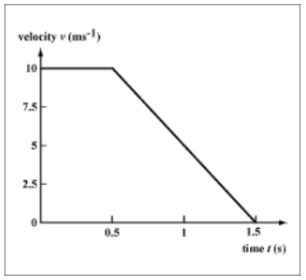
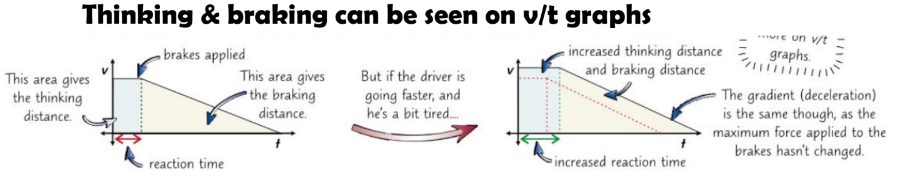
On a velocity-time graph, the thinking distance is represented by the horizontal portion (where the car continues moving at a constant speed while the driver reacts).
- The braking distance is represented by the sloped portion where velocity decreases as the brakes are applied. To avoid accidents, drivers must leave enough space between each other to stop safely.
There are typical stopping distances to follow (highway code): the faster you are going the more space you leave.