CRISPR-Cas9 (VCE SSCE Biology): Revision Notes
📚Revision Notes
CRISPR-Cas9
Introduction to CRISPR-Cas9
CRISPR-Cas9 represents one of the most significant advances in genetic engineering technology. This system allows scientists to edit genes with remarkable precision, opening up possibilities for treating genetic diseases, improving crop yields, and advancing our understanding of genetics. However, the technology also raises important ethical questions about the limits of genetic modification.
Note
The CRISPR-Cas9 system was originally discovered in bacteria, where it functions as a primitive immune system to protect against viral infections. Scientists have adapted this natural defence mechanism into a powerful tool for editing the genomes of various organisms.
CRISPR-Cas9 in bacteria
What is CRISPR?
Bacteria face constant threats from viruses called bacteriophages. A bacteriophage is a virus that infects prokaryotic organisms. Unlike a cold virus that leaves humans with temporary symptoms, bacteriophages can be deadly to bacteria. They inject their genetic material into bacterial cells, hijack the cellular machinery to produce more viruses, and eventually cause the bacterium to burst open (lyse) and die.
To defend against these viral attacks, bacteria evolved the CRISPR-Cas9 system. This system works like a molecular immune system, allowing bacteria to remember previous viral infections and quickly destroy the same virus if it attacks again.
Note
CRISPR stands for Clustered Regularly Interspaced Short Palindromic Repeats. It refers to a distinctive pattern of DNA sequences found in bacterial genomes. These sequences consist of short, repeated segments of DNA that read the same forwards and backwards (palindromic), separated by unique sequences called spacers.
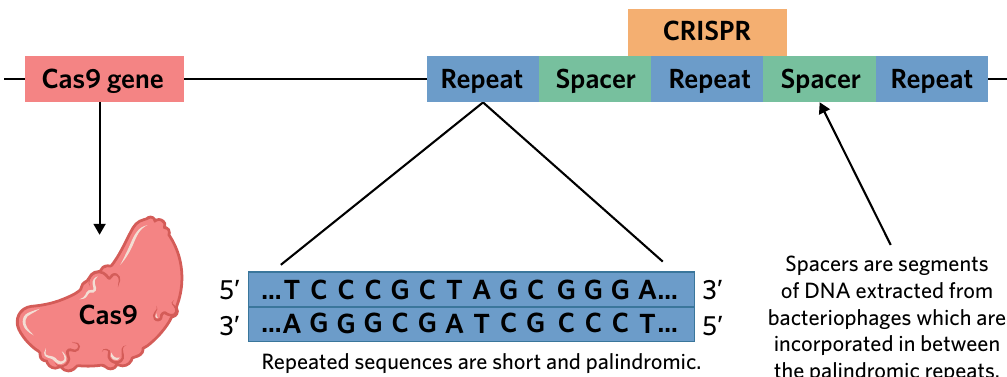
The CRISPR-Cas9 complex is formed between guide RNA (gRNA) and Cas9 protein. This complex can cut a target sequence of DNA. Bacteria use this complex for protection from viruses, whilst scientists have modified it to edit genomes.
Cas9 (CRISPR-associated protein 9) is an endonuclease - an enzyme that breaks the phosphodiester bond between two nucleotides in a polynucleotide chain. Specifically, Cas9 creates a blunt end cut at a site specified by guide RNA.
How the CRISPR-Cas9 defence system works
The bacterial CRISPR-Cas9 defence system operates through three key stages: exposure, expression, and extermination.
Stage 1: Exposure
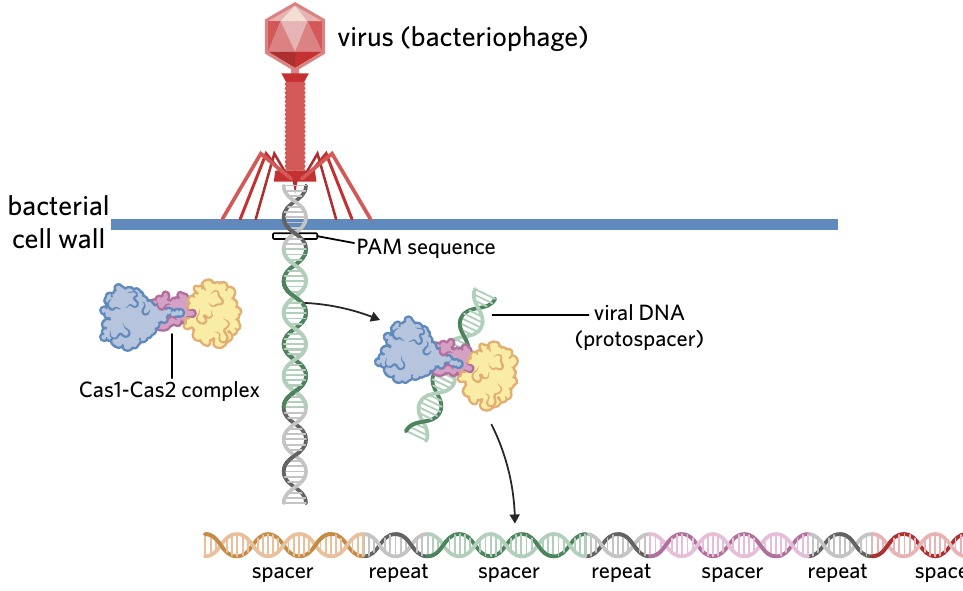
When a bacteriophage infects a bacterium, it injects viral DNA into the cell. The bacterium recognises this genetic material as foreign. Two enzymes called Cas1 and Cas2 work together to cut out a short section of the viral DNA, typically around 30 nucleotides long. This extracted segment is called a protospacer.
The protospacer is then integrated into the bacterium's CRISPR sequence, where it becomes a spacer. Spacers are short sequences of DNA obtained from invading bacteriophages that are added into the CRISPR sequence. Think of this process as the bacterium taking a "mugshot" of the virus - storing a genetic record of the infection for future reference.
Important
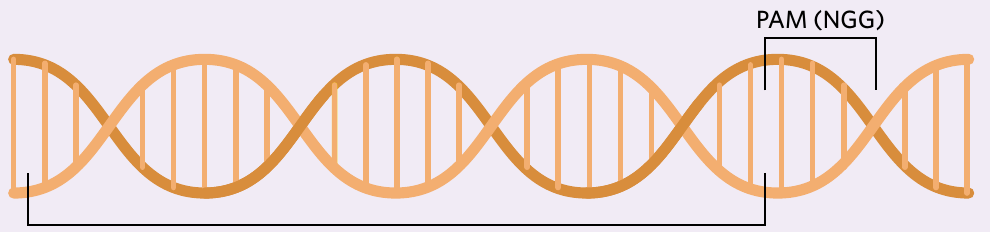
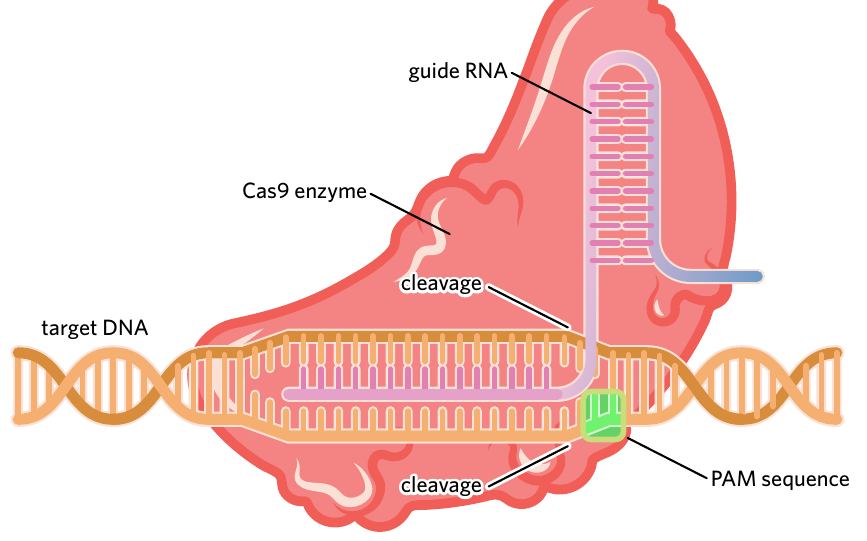
A crucial element in this process is the protospacer adjacent motif (PAM). The PAM is a sequence of two to six nucleotides that is found immediately next to the DNA targeted by Cas9. Cas1 and Cas2 enzymes search for PAM sequences to identify where to extract viral DNA. For example, in the bacterium Streptococcus pyogenes, the PAM sequence is NGG (any nucleotide followed by two guanine nucleotides). Importantly, the PAM itself is not included in the extracted protospacer.
Stage 2: Expression
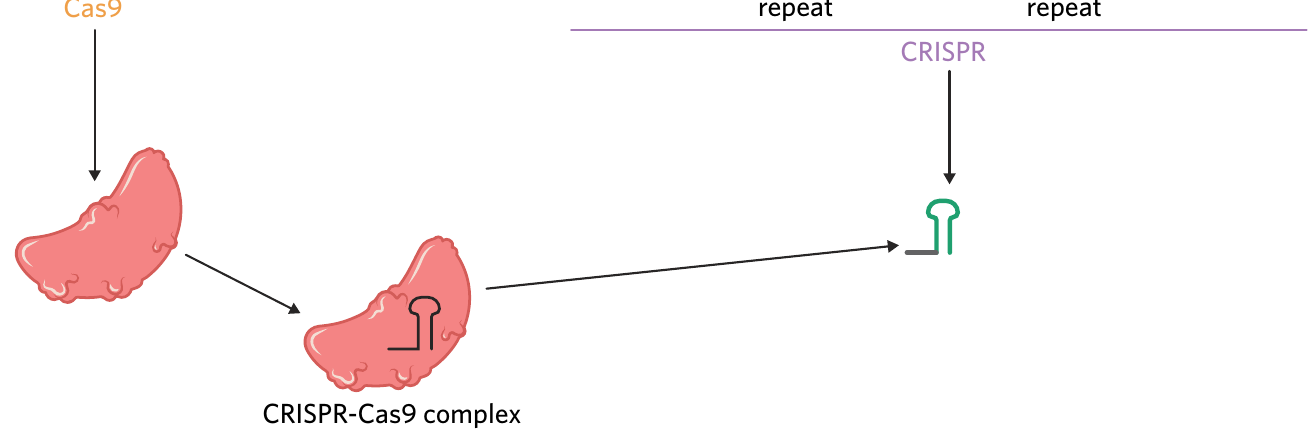
After the spacer has been integrated into the CRISPR sequence, the bacterium can use this information to defend against future infections. The CRISPR sequence is transcribed into RNA, including the spacer and parts of the palindromic repeats on either side of it. This RNA molecule is called guide RNA (gRNA).
Note
The gRNA molecule is actually formed by two smaller RNA molecules: CRISPR RNA (crRNA) and trans-acting CRISPR RNA (tracrRNA). The crRNA contains the spacer sequence that matches the viral DNA, whilst the tracrRNA helps bind the entire structure to the Cas9 protein. These two RNA molecules bind together through complementary base pairing to create the functional gRNA with characteristic hairpin loop structures.
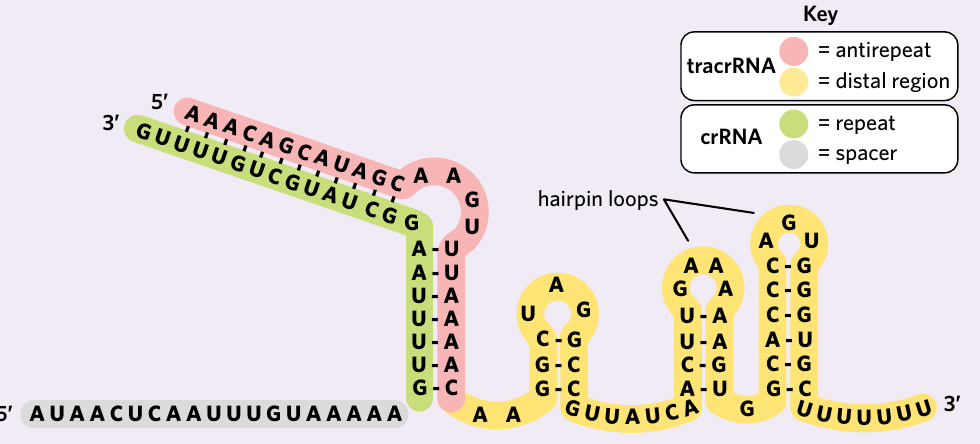
The gRNA then binds to Cas9 protein to create the CRISPR-Cas9 complex. This complex is now ready to search for and destroy any matching viral DNA inside the cell.
Stage 3: Extermination
The CRISPR-Cas9 complex scans the cell for DNA sequences that match the spacer on the gRNA. The PAM sequence plays a vital role in making this search efficient. Rather than checking every sequence in the cell, Cas9 only examines DNA near PAM sequences. This dramatically speeds up the search process.
When Cas9 finds a PAM sequence, it checks whether the adjacent DNA matches the spacer sequence on the gRNA. If there is a match, Cas9 cleaves both strands of the DNA using its two active sites, creating a blunt end cut - a straight cut across the double-stranded DNA resulting in no overhanging nucleotides.
After the viral DNA is cut, cellular repair mechanisms attempt to fix the break. However, these repair processes often introduce errors - adding, deleting, or changing nucleotides. These mutations typically render the viral genes non-functional, preventing the virus from replicating and protecting the bacterium.
Important
The PAM sequence also serves a protective function for the bacterium. Bacterial CRISPR sequences never contain PAM sequences, which prevents Cas9 from accidentally cutting the bacterium's own DNA.
CRISPR-Cas9 in gene editing
The power of CRISPR-Cas9
Scientists have adapted the bacterial CRISPR-Cas9 system to edit genomes with unprecedented precision. This represents a major advance in genetic modification - the manipulation of an organism's genetic material using biotechnology.
Traditional gene therapy techniques (repairing genetic mutations by replacing a defective gene with a healthy one) have faced significant challenges. Many earlier methods lacked precision and could accidentally insert DNA into the wrong location in the genome, potentially disrupting healthy genes. This lack of precision has limited the use of gene therapy in humans to mostly research and clinical trials.
Note
CRISPR-Cas9 overcomes many of these limitations by allowing scientists to target specific DNA sequences with great accuracy. This opens up possibilities for treating deleterious mutations (changes in DNA that negatively affect an individual), improving crops, and advancing genetic research.
How to use CRISPR-Cas9 for gene editing
When scientists use CRISPR-Cas9 for gene editing, they employ a modified version of guide RNA called single guide RNA (sgRNA). This is guide RNA utilised by scientists to instruct Cas9 to cut a specific site when using CRISPR-Cas9 in gene editing. Unlike the natural gRNA in bacteria (which is made from two separate RNA molecules), sgRNA is synthesised as a single strand in the laboratory.
Example
Worked Example: The Gene Editing Process
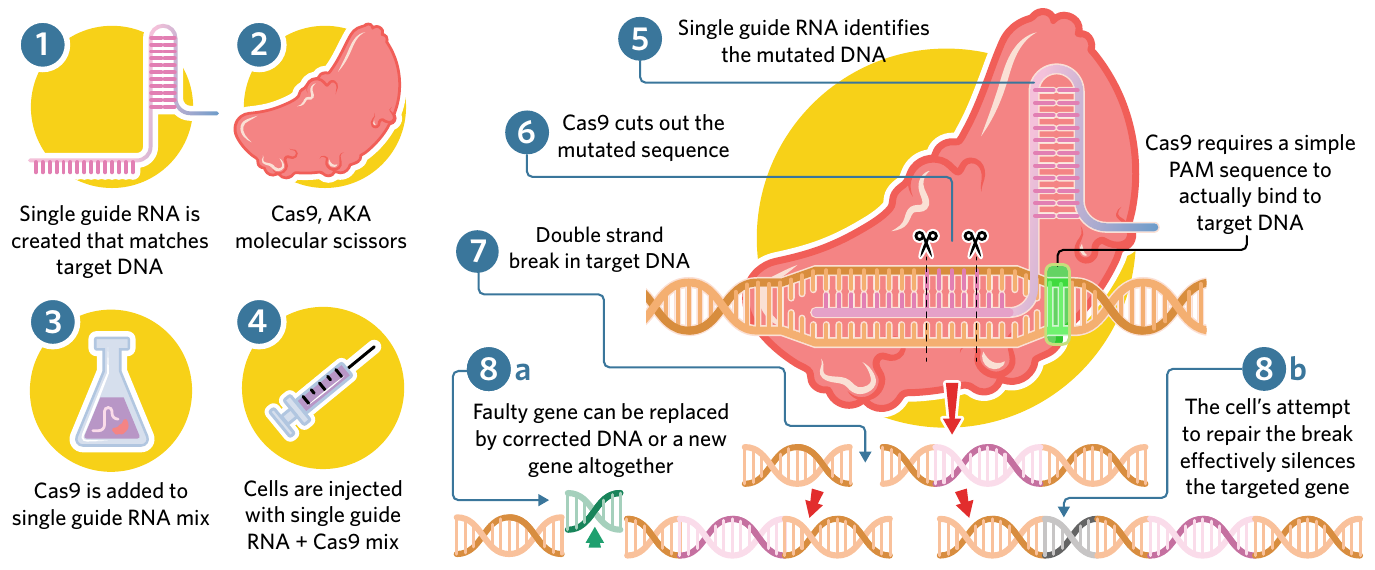
The gene editing process follows these steps:
Step 1: Design the sgRNA
- Synthetic sgRNA is created in a laboratory
- This sgRNA has a spacer sequence that is complementary to the target DNA that scientists wish to cut
Step 2: Obtain Cas9
- A Cas9 enzyme is obtained with an appropriate target PAM sequence
Step 3: Form the complex
- The Cas9 and sgRNA are mixed together and bind to form the CRISPR-Cas9 complex
Step 4: Deliver to cell
- The sgRNA-Cas9 mixture is injected into a specific cell
- For whole-organism modification, this is often done in a zygote (the diploid cell formed by the combination of two haploid gamete cells)
Step 5: Target recognition
- Inside the cell, Cas9 searches for the target PAM sequence and checks whether the sgRNA aligns with the adjacent DNA
Step 6: DNA cleavage
- When a match is found, Cas9 cuts both strands of the DNA, creating a blunt end cut
Step 7: Cellular repair
- The cell's repair mechanisms attempt to fix the break in the DNA
Step 8: Gene modification
- During repair, scientists can introduce specific changes by injecting desired nucleotide sequences into the cell
- The cellular machinery may incorporate these sequences into the gap, resulting in gene modification
This process can be used for several purposes:
- Gene knockout: preventing the expression of a target gene to understand its function in an organism
- Gene knock-in: substituting or add nucleotides in a gene to introduce new traits or correct mutations
- Gene enhancement: modifying genes to improve their function
Applications of CRISPR-Cas9
CRISPR-Cas9 technology has diverse applications across research, medicine, and agriculture:
| Uses | Examples |
|---|---|
| Research | - Attaching fluorescent proteins to Cas9 to locate specific genes in the genome - Disrupting gene expression to identify gene functions (gene knockout studies) |
| Dealing with diseases | - Replacing deleterious alleles with healthy versions - Adding genes that code for proteins decreasing susceptibility to diseases like HIV/AIDS - Modifying cancer-promoting genes to reduce their influence |
| Agriculture | - Introducing pest and herbicide-resistance genes to increase crop yields - Altering genes to promote faster growth rates in crops |
Limitations of CRISPR-Cas9
Despite its promise, CRISPR-Cas9 technology faces several important limitations:
Important
Technical limitations:
- CRISPR-Cas9 simply cuts DNA at a chosen location. To introduce specific changes, scientists must rely on cellular repair mechanisms to incorporate new DNA sequences, which is not always successful or precise.
- Animal studies have shown promising results (such as eliminating muscular dystrophy in mice), but these successes have not yet been reliably replicated in humans.
- Safety concerns include off-target cleavages (edits in unintended locations) and mosaics (some cells containing edited genomes whilst others do not).
Note
Timing constraints: To successfully alter an entire organism's genome, scientists must treat an embryo (an early stage of development - in humans, the first eight weeks) before cells undergo differentiation (the process in which cells develop specialised characteristics). This ensures every cell in the organism carries the modification. However, working with embryos raises significant ethical concerns.
Ethical considerations
CRISPR-Cas9 technology raises numerous ethical questions that must be carefully considered:
Sanctity of life: Some groups believe that scientific research on embryos does not respect the sanctity of human life. This concern is particularly relevant because effective genome editing requires treating embryos before they develop further.
Important
Legal restrictions: In many countries, including Australia, it is illegal to implant genetically modified embryos into human females and allow them to develop to birth. This law aims to prevent unforeseen consequences or potential harm to pregnant women and babies.
Informed consent: Scientists cannot obtain consent from embryos to edit their genes. If an edited embryo develops into a person who has children, those future generations will also carry the modifications without ever having consented to the genetic intervention.
Non-maleficence: This bioethical principle discourages causing harm. It can be applied to argue both for and against CRISPR-Cas9 use. On one hand, unknown risks to embryos and pregnant women suggest caution. On the other hand, preventing or treating serious genetic conditions could reduce suffering.
Note
Social justice concerns:
- Inequality: Only wealthy individuals may be able to afford CRISPR-Cas9 treatments, potentially creating genetic advantages for the rich.
- Discrimination: The technology may perpetuate negative judgements about people with genetic differences, when those individuals may not feel they need "fixing" at all.
Despite these limitations, CRISPR-Cas9 technologies hold immense potential. They are generally considered easier and more cost-effective than competing gene editing technologies. Research has produced particularly promising results in agriculture, demonstrating the practical value of this revolutionary technology.
Comparison: natural vs artificial CRISPR-Cas9
Understanding the differences between how CRISPR-Cas9 works naturally in bacteria versus how scientists use it for gene editing helps clarify both the natural biological process and the engineered applications:
| Aspect | Naturally in prokaryotes | Artificially in gene editing |
|---|---|---|
| Purpose | To attack and destroy invading viral DNA | Induce mutations to alter genomic DNA |
| Production of gRNA | Naturally through transcription and post-transcriptional modifications of the CRISPR gene | Synthetically produced in a laboratory (sgRNA) |
| PAM sequence | Specific to each host organism | Cas9 enzyme can be altered to suit a specific gene |
| What happens after the cut | DNA repair mechanisms often induce a mutation that inhibits viral function | DNA can mutate to knock out, enhance, or change the function of genes |
Note
The natural system evolved over millions of years as a bacterial defence mechanism, whilst the artificial system has been engineered to harness this natural process for precise genetic modification. Both rely on the same fundamental components - Cas9 enzyme and guide RNA - but with different sequences and purposes.
Remember!
Summary
Key Points to Remember:
-
CRISPR refers to short, palindromic, clustered repeats of DNA found in prokaryotes, separated by spacer sequences containing "mugshots" of viral DNA.
-
The bacterial defence system works through three stages: Exposure (capturing viral DNA), Expression (producing gRNA), and Extermination (cutting viral DNA).
-
Cas9 is an endonuclease with two active sites that creates blunt end cuts in DNA at locations specified by guide RNA.
-
PAM sequences help Cas9 efficiently locate target DNA and protect bacterial genomes from being cut.
-
Scientists use synthetic sgRNA to direct Cas9 to specific genes for editing, enabling gene knockout, knock-in, or enhancement.
-
CRISPR-Cas9 has diverse applications in research, medicine, and agriculture, but faces technical limitations and raises important ethical questions about embryo research, consent, and social justice.