Role of an Entrepreneur (Edexcel A-Level Business): Revision Notes
📚Revision Notes
Role of an Entrepreneur
An entrepreneur is someone who starts and runs their own business. They are the driving force behind new enterprises, taking on both risks and responsibilities to turn business ideas into reality. Understanding what entrepreneurs do is essential for appreciating how businesses are created and developed.
Creating and setting up a business
What is an entrepreneur?
Important
Entrepreneurs are people who have a business idea and want to make money working for themselves. They are the owners of a business, and without them the business would not exist. They risk their own capital (money and resources) when setting up and running their enterprise.
The four key roles of entrepreneurs
Entrepreneurs perform several critical functions in their businesses:
1. Innovators
Entrepreneurs identify and act on business opportunities. They try to make money from a business idea, which might come from:
- Spotting a gap in the market
- Developing a new invention
- Conducting market research
- Copying or adapting what another business does
2. Organisers of factors of production
Entrepreneurs are responsible for bringing together and coordinating all the resources needed to run the business. They:
- Buy or hire resources such as materials, labour and equipment
- Use these resources to make or deliver products
- Give instructions and make arrangements
- Set up systems to ensure smooth operations
3. Decision-makers
As business owners, entrepreneurs must make all key decisions, including:
- How to raise finance
- Product design choices
- Which production methods to use
- Pricing strategies
- Recruitment and wage decisions
4. Risk-takers
Entrepreneurs accept the financial risk of business ownership. If the business fails, they risk losing the money they invested. However, if the business succeeds, they are rewarded with profit.
Note
The four key roles form the foundation of entrepreneurship: Innovators, Organisers, Decision-makers, and Risk-takers. Together, these roles enable entrepreneurs to turn ideas into successful businesses.
Risks and rewards for entrepreneurs
Starting a business involves both potential rewards and significant risks.
Rewards:
- Profit: Successful entrepreneurs can earn substantial income from their businesses
- Independence: Working for yourself rather than someone else
- Personal satisfaction: The opportunity to do something different and pursue your own vision
- Wealth creation: Some entrepreneurs, like Richard Branson, have become very wealthy through their businesses
Risks:
- Business failure: Statistics show that less than half of new businesses survive beyond five years
- Financial loss: If the business fails, entrepreneurs may face debts to repay
- Opportunity cost: Entrepreneurs may leave well-paid jobs to start their business
- Difficulty returning to employment: Getting back into a normal job may be challenging, especially if a good position was left behind
Note
The risk of failure often serves as a strong motivator for entrepreneurs to persevere and work towards success, even during difficult times. Understanding both risks and rewards helps potential entrepreneurs make informed decisions about starting a business.
Opportunity cost
Important
Opportunity cost is the benefits lost from the next best alternative when making a choice.
For example, an entrepreneur who leaves a job earning $40,000 per year to start a business faces an opportunity cost. The money they would have earned is part of the opportunity cost, along with other job benefits such as job security, workplace relationships, and job satisfaction.
- For a successful entrepreneur, the opportunity cost is likely to be lower than the benefits of owning the business (they made the right choice)
- For an unsuccessful entrepreneur, the opportunity cost is likely to be higher than the benefits (they would have been better off staying in their job), which is why they may close the business and move on
Sources of business ideas
Entrepreneurs find business ideas from various sources:
Business experience
Most people starting small businesses get their ideas from their existing job. For example:
- A plumber working for a company might decide to set up independently
- A marketing consultant at an agency might start their own consultancy
Note
This is often the lowest-risk approach because the entrepreneur already has knowledge of the market, established skills, and understanding of customer needs.
Personal experience
Some entrepreneurs draw on experiences outside of work:
- Turning a hobby into a business (e.g., an amateur cyclist buying a cycle shop)
- Using customer experience to spot gaps in the market (e.g., a parent struggling to find a baby product creates a business to provide it)
Skills
Entrepreneurs may identify business opportunities based on their transferable skills:
- Someone with administration experience might recognize they have good people skills and move into sales
- A tradesperson might train in a different but related field where they can earn more (e.g., a plumber training as an electrician)
Lifestyle choices
Some business ideas arise from desired lifestyle changes:
- Moving to the countryside and starting a smallholding
- Fulfilling a dream such as running a pub
- Semi-retiring but continuing to work, perhaps running a seasonal bed and breakfast
Stages in setting up a business
Setting up a business in a methodical and carefully planned way is important for future success. The quality of preparation during the setup process can significantly affect whether the business thrives or fails. The typical stages are:
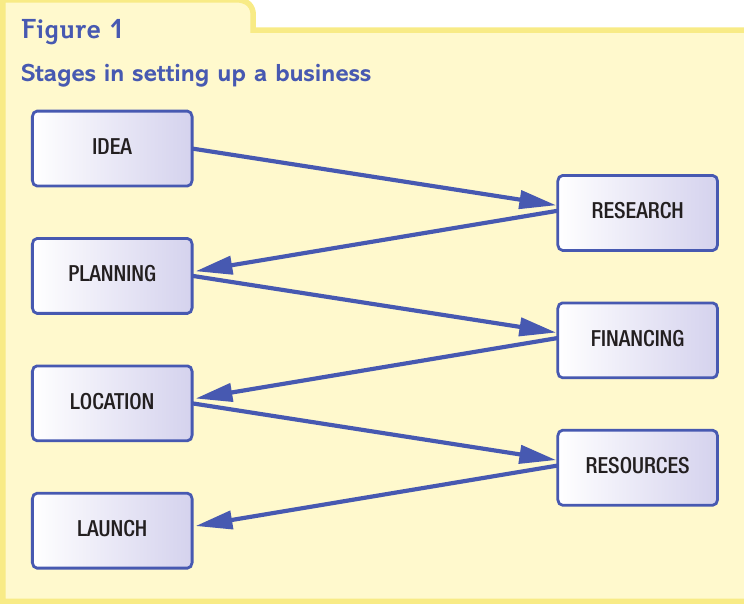
1. Idea
A business cannot start without an entrepreneur having a business idea. This comes from one of the sources discussed above.
2. Research
The viability of the business idea must be researched. This involves:
- Carrying out market research to assess demand
- Analyzing the competition
- Meeting with bankers and business advisors for guidance
- Possibly attending courses designed for new entrepreneurs
3. Planning
Planning is a crucial stage. Entrepreneurs need to develop a comprehensive business plan that outlines how the business will operate and achieve its objectives.
4. Financing
Entrepreneurs must decide:
- How much finance they will need to start and run the business
- Which sources of finance to use (personal savings, loans, investors, etc.)
5. Location
The choice of location depends on the nature of the business:
- Tradespeople and tutors may work locally or from home
- Website designers can work from home while serving national markets
- Restaurants and shops need to be close to their target customers
- Manufacturers must decide whether to locate near suppliers, customers, or transport links
- Some locations may require planning permission, which can take months to obtain
6. Resources
The entrepreneur must acquire all necessary resources, including:
- Suitable premises
- Equipment and furniture
- Computer systems and software
- Uniforms or protective gear
- Staff (through recruitment advertising)
- Suppliers of materials and utilities
7. Launch
This is when the business first starts trading. Some entrepreneurs organize special opening events to create good public relations and raise awareness. For example, a new restaurant might hold a special opening night with complimentary meals for invited guests. Some entrepreneurs keep their existing jobs initially until the business becomes established.
Important
Methodical vs Instinctive Approaches
While following these stages methodically helps reduce the risk of failure, some entrepreneurs bypass many steps and set up instinctively. These entrepreneurs are driven by entrepreneurial spirit and run their businesses in a responsive, instinctive way. While some succeed, the saying "failing to plan is planning to fail" serves as a warning about the risks of this approach.
Running and expanding/developing a business
Once launched, entrepreneurs become deeply involved in the day-to-day running of their business. Initially, much time is spent on production or service delivery (e.g., cutting hair in a salon, brewing beer in a microbrewery). However, running a successful business requires entrepreneurs to undertake various functional activities that are crucial for success.
Key functional activities
Financial management
The business needs sufficient money to fund operations. This involves:
- Producing cash-flow forecasts
- Arranging loans and overdrafts
- Making payments to suppliers
- Chasing debts from customers
- Monitoring cash movements in and out of the business
Administration
Accurate record-keeping is essential. Tasks include:
- Recording all transactions for profit and tax calculations
- Sending out invoices
- Keeping stock records
- Processing wage slips
- Dealing with tax authorities
- Complying with legislation
- Meeting requirements for limited companies
Marketing
Initially, marketing might involve:
- Getting Yellow Pages or online business listings
- Developing an attractive website
- Using email campaigns
- Distributing leaflets
- Placing newspaper advertisements
- Organizing promotions or special offers
- Developing customer relationships
Note
As the business develops, marketing becomes more sophisticated:
- Conducting market research
- Investigating new distribution channels
- Using social media to raise the business profile
- Investing in promotional campaigns
- Launching new products
- Penetrating new markets
Purchasing
Entrepreneurs must continually buy resources and commercial services (e.g., cleaning, printing, accountancy). Key objectives are to:
- Obtain the best quality resources at the lowest possible price
- Develop good relationships with suppliers
- Explore new opportunities in the supply chain
- Develop negotiating skills to reduce costs
Managing people
If the business is successful, it will likely need staff. This involves:
- Recruitment and selection
- Training new employees
- Managing and motivating staff
- Developing people management skills
Production
In manufacturing and construction, the production process is critical. Entrepreneurs must:
- Organize various manufacturing processes
- Monitor product quality and consistency
- Consider health and safety issues
- Ensure production levels match orders

How the entrepreneur's role changes
Running a business remains demanding after setup, and more than half of new businesses fail within five years. However, successful businesses that survive and grow see the entrepreneur's role change significantly:
- Less involvement in production: As the business expands, entrepreneurs spend less time on hands-on production work
- More time on functional activities: Greater focus on marketing, finance, administration, and strategic decisions
- Departmental organization: When cost-effective, entrepreneurs organize the business into departments
- Employing specialists: Hiring dedicated staff for marketing, finance, human resources, etc.
- Leadership role: The entrepreneur increasingly takes on the role of leader in the organization rather than doing everything themselves
Note
This transition from entrepreneur to leader is a natural part of business growth and development. It allows the business to scale effectively while freeing the entrepreneur to focus on strategic direction rather than day-to-day operations.
Innovation within a business (intrapreneurship)
What is intrapreneurship?
Important
Intrapreneurs are employees, usually in large businesses, who use entrepreneurial skills to find and develop initiatives that will have financial benefits for their companies. These initiatives might include new products, services, or systems.
Key difference from entrepreneurs:
- Entrepreneurs are business owners who risk their own personal finances when developing a business idea
- Intrapreneurs are employees who carry no financial risk - if their initiatives fail, the employer bears the financial burden
Some businesses actively encourage entrepreneurial spirit throughout their organization, embedding it in their culture. Companies like Google, Apple, and Zappos adopt this approach, believing it helps them grow and evolve rather than becoming stale and stagnant.
Advantages of intrapreneurship
Intrapreneurs are usually employed in product development roles. The benefits of employing intrapreneurial staff include:
Driving innovation and competitive advantage
Intrapreneurs can discover new commercial opportunities and drive innovation within the business. This helps the company gain a competitive edge and can significantly increase profits. In some cases, their discoveries and inventions have a huge positive impact on the business.
Satisfying employee needs
Intrapreneurship satisfies the self-actualization needs of employees. Self-actualization is the highest level of need according to Maslow's hierarchy of needs. When staff adopt intrapreneurial roles, they have opportunities to be creative and reach their full potential. This helps motivate staff and can raise productivity.
Note
Self-actualization represents the pinnacle of employee motivation, where individuals can be creative, experiment, and realize their full potential within the organization.
Winning awards and enhancing reputation
Businesses can win prestigious awards for developing unique or ground-breaking products. For example, the Queen's Award for Enterprise includes a category for innovation. These awards enhance the company's image and can attract free publicity, helping to promote the business.
Benefiting individuals
Individual employees benefit by getting opportunities to experiment and be creative without meeting the cost of failure. This improves job satisfaction and helps them develop entrepreneurial skills they might use in the future - perhaps by setting up their own business.
Barriers to entrepreneurship
Many argue that encouraging entrepreneurship is important for the economy because businesses are the main source of income, employment, and wealth for a country. However, despite this importance, numerous barriers exist that discourage potential entrepreneurs from starting businesses. While the specific barriers are not detailed in this unit, recognizing their existence is important for understanding the challenges faced by would-be entrepreneurs.
Remember!
Summary
Key points:
- Entrepreneurs are business owners who perform four key roles: innovators, organizers of factors of production, decision-makers, and risk-takers
- Starting a business involves risks (failure, debt, opportunity cost) but also potential rewards (profit, independence, personal satisfaction)
- Business ideas come from four main sources: business experience, personal experience, skills, and lifestyle choices
- Setting up a business follows seven stages: idea, research, planning, financing, location, resources, and launch
- Running a business requires managing six functional activities: financial management, administration, marketing, purchasing, managing people, and production
- As businesses grow, the entrepreneur's role shifts from hands-on production to strategic leadership
- Intrapreneurs are employees who use entrepreneurial skills within larger organizations without bearing financial risk
- Intrapreneurship drives innovation, motivates staff, and can bring competitive advantages to businesses
Key terms:
- Entrepreneur: A person who starts and runs their own business, risking their own capital
- Opportunity cost: The benefits lost from the next best alternative when making a choice
- Intrapreneur: An employee who uses entrepreneurial skills to develop initiatives within a larger organization
- Self-actualisation: The highest level of need where individuals reach their full creative potential