Growth to PLC and Stock Market Flotation (Edexcel A-Level Business): Revision Notes
📚Revision Notes
Growth to PLC and stock market flotation
Why businesses grow
Most business owners want to see their companies expand. Growth brings several benefits that make businesses more successful and competitive:
- Higher market profile – larger businesses gain more recognition and reputation
- Increased revenues – more sales and turnover from expanded operations
- Lower unit costs – economies of scale reduce costs per unit as production increases
- Higher profits – combining increased revenue with lower costs boosts profitability
- Greater security – larger businesses are more stable and resilient
- Easier access to finance – bigger companies find it simpler to raise capital
Note
Many entrepreneurs dream of building a major business from scratch. The journey typically starts with a sole trader or partnership, progresses to a private limited company, and may eventually culminate in becoming a public limited company.
Example
Example: Greggs plc Growth Journey
Greggs plc started as a single bakery in Newcastle upon Tyne in 1951. By 2015, it had expanded to nearly 1,700 shops employing 20,000 people, with turnover reaching $762.4 million in 2013.
This demonstrates how a small local business can grow into a major national PLC through sustained expansion.
What is a public limited company?
A public limited company (plc) is a business owned by shareholders where the company name ends in 'plc'. The company structure includes:
- Board of directors – manages day-to-day operations
- Chairperson – oversees the board and remains accountable to shareholders
- Shareholders – own the company and can trade shares freely
In the UK, just over one million limited companies exist, but only around 1% are PLCs. Despite being a small proportion, PLCs contribute significantly to national output and employment.
Important
Key feature: Shares in PLCs can be bought and sold on the stock market. This is a market for second-hand shares accessible to anyone through online share-dealing platforms.
This free transferability of shares is what distinguishes PLCs from private limited companies, where share transfer is restricted.
Example
Example: Sainsbury's Growth to PLC
Sainsbury's began as a small grocery shop in London in 1869, founded by John James Sainsbury and his wife Mary Ann as a partnership. The Sainsbury family owned the business entirely until 1973, when it became J Sainsbury plc through the largest flotation on the London Stock Exchange at that time.

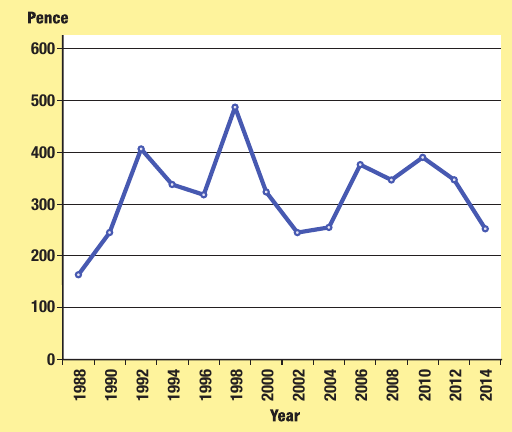
The chart shows Sainsbury's share price volatility between 1988 and 2014, reflecting various market conditions, competitive pressures, and company performance. Share prices can fluctuate based on economic factors, company results, market sentiment, and competitor actions.
By 2014, Sainsbury's had grown to 1,200 outlets employing 161,000 people, generating $23.9 billion turnover and holding approximately 16% market share.
Stock market flotation
Stock market flotation happens when a private company converts to a public limited company by offering shares to the public for the first time. This process is also called an initial public offering (IPO).
The flotation process
The IPO process is complex, time-consuming, and expensive. Companies typically hire specialists, such as investment banks, to manage the flotation. The main stages include:
- Preparing the prospectus – a detailed document advertising the company to potential investors
- Legal compliance – ensuring all documentation meets regulatory requirements
- Share pricing – determining the initial share price
- Marketing – promoting the share offer to potential investors
- Processing applications – handling investor purchases
- Underwriting – insuring against unsold shares
- Listing – getting shares quoted on the stock exchange or AIM
The prospectus
Note
The prospectus is a comprehensive document that serves as the primary advertisement to potential investors. It must provide complete transparency about the company's operations, finances, and risks.
The prospectus must contain:
- Company history – background and development of the business
- Key personnel – directors and senior management team
- Operations description – what the business does and how it operates
- Use of funds – how the company will spend money raised
- Future strategy – plans for growth and development
- Financial information – historic accounts and performance data
- Legal matters – details of any pending legal action
- Risk factors – potential risks facing investors
- Purchasing information – how to buy shares, key dates, and deadlines
- Application form – for investors to request shares
Costs of going public
Important
Flotation is expensive due to multiple requirements. Companies must carefully weigh the costs against the benefits of going public.
The main costs include:
- Legal fees – lawyers ensure the prospectus complies with all regulations
- Publication costs – producing high-quality prospectus documents
- Investment banking fees – for processing share applications
- Underwriting fees – insurance against unsold shares (the underwriter must purchase any unsold shares)
- Advertising expenses – marketing the share offer
- Administrative costs – managing the flotation process
- Minimum capital requirement – at least $50,000 share capital needed
Before trading begins, the company must receive payment for at least 25% of the share value. Once complete, the company receives a Trading Certificate and can start operating as a PLC.
Stock exchange vs AIM
Stock Exchange listing: A full listing requires compliance with strict rules and regulations designed to protect shareholders from fraud. This offers maximum investor protection but involves higher costs.
Alternative Investment Market (AIM): Designed for companies wanting to avoid high listing costs. However, shareholders receive less protection compared to fully-quoted shares.
Example
Example: Alibaba IPO
In September 2014, Chinese internet giant Alibaba floated on the New York Stock Exchange, controlling 80% of online commerce in China.
IPO Performance:
- Shares initially priced at $68
- Reached $100 during trading
- Settled at $93.89 (up 38% on the first day)
- Company valuation: $231 billion
High-profile flotations attract significant media attention. When heavily oversubscribed, share prices can rise sharply as investors who missed the initial offer compete to buy shares on the open market.
Example
Example: TSB Flotation

Sometimes established businesses divest (sell off) parts of their operations through IPOs. In 2014, Lloyds Bank sold TSB following European Commission orders after receiving a $20 billion taxpayer bailout.
TSB Operations:
- 631 branches employing 8,600 staff
IPO Details:
- Initial share price: 260p
- First-day closing price: 290p (up 30p)
- Demand: 60,000 applications from private investors
- Private investor allocation: 30% of shares offered
- Loyalty bonus: One free share for every 20 shares held for 12 months
- Staff incentive: $100 worth of free shares for each employee to create "TSB Partners" and boost motivation
Some private investors made $231 profit on their first day by selling at the higher price.
Advantages of public limited companies
PLCs share advantages with private limited companies, including:
- Limited liability – shareholders only risk their investment
- Continuity – the business continues if owners die
- Market power – size brings competitive advantages
Additional specific advantages of PLCs include:
Massive capital raising potential
PLCs can raise enormous sums through share sales. When Alibaba went public in 2014, the company raised approximately $20 billion. This capital enables major expansion, innovation, and competitive advantages.
Note
The ability to access public capital markets is one of the most significant advantages of becoming a PLC. This funding can be used for expansion, research and development, acquisitions, or reducing debt.
Economies of scale
As PLCs grow, production costs per unit typically fall due to:
- Bulk purchasing discounts – buying larger quantities at lower prices
- Operational efficiency – spreading fixed costs across more units
- Specialist equipment – investing in technology that reduces unit costs
- Marketing efficiency – advertising costs spread across larger sales volumes
Important
Lower unit costs improve competitiveness and generate higher profit margins. This cost advantage creates a virtuous cycle where PLCs can:
- Undercut competitors on price
- Invest more in quality and innovation
- Build stronger market positions
- Generate greater returns for shareholders
Market dominance
Due to their size and resources, PLCs often dominate their markets by:
- Creating barriers to entry – making it difficult for competitors to enter the market
- Controlling supply chains – securing favorable supplier relationships
- Building strong brands – using marketing power to establish market position
- Investing in innovation – funding research and development to stay ahead
This market control helps PLCs maintain and grow their position over time.
Summary
Key Points to Remember:
-
PLCs are owned by shareholders whose shares can be freely traded on the stock market, unlike private limited companies where share transfer is restricted
-
Stock market flotation (IPO) is the expensive and complex process of becoming a PLC, requiring a prospectus, legal compliance, underwriting, and at least $50,000 share capital with 25% paid
-
The prospectus is a detailed document containing company history, operations, financials, strategy, risks, and purchasing information for potential investors
-
Main advantages of PLCs include:
- Raising large amounts of capital
- Achieving economies of scale
- Potential market dominance
-
Companies can list on either the main Stock Exchange (full protection, higher costs) or AIM (lower costs, less protection)
Key Terms:
- Public limited company (plc) – company owned by shareholders with freely tradeable shares
- Initial public offering (IPO) – first sale of shares to the public
- Prospectus – detailed document advertising company to investors
- Underwriting – insurance against unsold shares
- Economies of scale – cost advantages from increased production scale
- Trading Certificate – permission to begin trading as a PLC
- Divestment – selling off part of business operations