Changes in Branding and Promotion to Reflect Social Trends (Edexcel A-Level Business): Revision Notes
📚Revision Notes
Changes in Branding and Promotion to Reflect Social Trends
Why businesses must adapt their marketing approach
Companies face constant pressure to keep pace with changing consumer trends, fashion, patterns, and technological developments. This pressure directly affects how businesses promote products and build brands. For example, the rise of the internet led most firms to establish business websites for information sharing, product promotion, and direct sales.
Note
More recently, three key developments have transformed promotional strategy: viral marketing, social media marketing, and emotional branding. Understanding these developments is essential for modern business success.
Viral marketing
Viral marketing is any promotional strategy that encourages people to pass on messages about a product or business electronically. The approach creates potential for exponential growth in message exposure.
How viral marketing works
Like a biological virus, viral marketing strategies exploit rapid multiplication. Consumers send marketing messages to family, friends, and colleagues, who then forward them onwards. Messages can include text, photographs, and video clips, all easily shared across digital platforms.
Example
Case Study: Volvo's Viral Success
Volvo's viral marketing campaign featured Jean-Claude Van Damme performing the splits between two moving Volvo trucks. The video demonstrated the stability and precision of Volvo's steering system.
Results: At the time of publication, the clip had generated over 76 million views, demonstrating the exponential reach possible through viral marketing.

Advantages of viral marketing
The benefits of viral marketing include:
- Low-cost distribution once initial content is created
- Potential for massive reach through organic sharing
- Builds brand awareness rapidly
- Can target specific demographics through platform choice
Important
While viral marketing offers significant advantages, businesses must remember that viral success cannot be guaranteed. Not all campaigns achieve viral status, regardless of quality or budget invested.
Social media marketing
Social media platforms such as Facebook and Twitter play an increasingly important role in brand building. However, many businesses now go beyond simply using existing platforms.
The growth of social media marketing spend
Marketing budgets allocated to social media continue to rise significantly. In 2013, marketing leaders devoted approximately 9.4% of their budgets to social media. Data from 2015 showed this trend continuing:
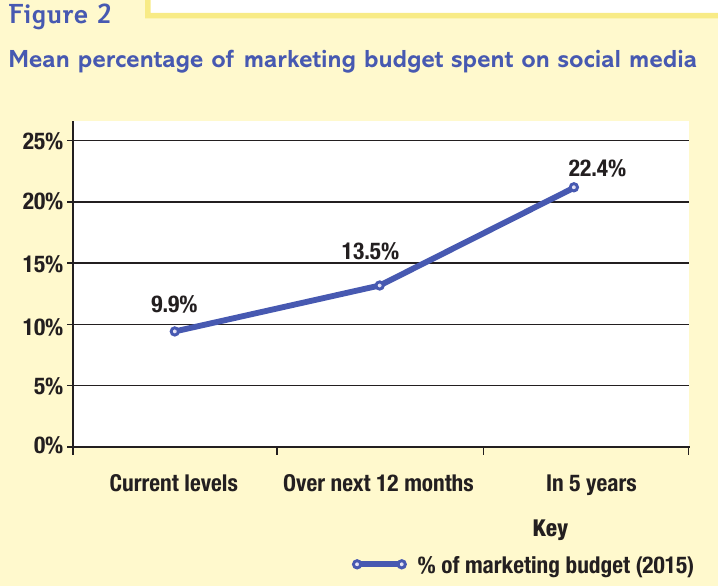
- Current levels (2015): 9.9% of marketing budget
- Projected (next 12 months): 13.5% of marketing budget
- Projected (5 years): 22.4% of marketing budget
This represents a 126% increase over five years, highlighting social media's growing importance in promotional strategy.
Creating bespoke social networks
While Facebook provides a useful platform for finding customers and raising brand awareness, analysts note a limitation: most people who 'like' a brand page never revisit it. As a result, businesses increasingly develop their own social networks linked to major platforms.
Example
Case Study: Virgin Atlantic's Social Hub
Virgin Atlantic exemplifies the bespoke social network approach by creating its own social hub. This allows the airline to maintain direct engagement with customers rather than relying solely on third-party platforms where interaction is limited.
This strategy gives Virgin Atlantic greater control over the customer experience and enables more meaningful, ongoing relationships with their audience.
Why businesses create their own networks
Companies invest in creating proprietary social networks for several strategic reasons:
- Greater control over customer data and engagement
- Direct communication channel with consumers
- Ability to tailor content specifically to brand identity
- Reduced dependence on algorithm changes by major platforms
Note
Creating a bespoke social network requires significant investment in technology and content creation. However, for established brands with loyal customer bases, this investment can provide long-term competitive advantages that third-party platforms cannot offer.
Emotional branding
Emotional branding refers to using consumer emotions to build a brand. This approach appeals to customers' emotions, human needs, or perceived aspirations rather than purely functional product benefits.
The psychology behind emotional branding
The strategy rests on two key principles:
- Emotion drives action more than reason: Consumers make purchasing decisions based on feelings rather than purely logical evaluation
- Emotional attachment creates loyalty: Businesses aim to develop the same unbreakable bond that football supporters have with their clubs
Note
The football analogy is particularly powerful. Supporters worldwide maintain loyalty to their club even during poor performance – the emotional bond is simply too strong. Businesses seek to replicate this level of attachment.
Example
Case Study: Apple's Emotional Branding Success
Apple demonstrates highly effective emotional branding. The company has built powerful bonds with customers by:
- Connecting with younger demographics: Creating a 'cool' product image that resonates with youth culture
- Aligning with design innovation: Positioning products as cutting-edge and aspirational
- Creating event-driven releases: New product launches become anticipated events with customers queuing for hours
- Moving beyond commerce: Building emotional attachment not defined by transactional relationships
Apple's success shows that emotional branding can create customer loyalty that transcends product features or price comparisons.
Developing emotional brand connections
To implement emotional branding effectively, businesses should:
- Identify core emotions that resonate with target customers
- Create consistent brand narratives that reinforce these emotions
- Use storytelling in marketing communications
- Build communities around the brand
- Focus on customer experience beyond the product itself
Important
Emotional branding requires authenticity. Consumers can quickly detect inauthentic attempts to manipulate emotions, which can damage brand reputation. Businesses must ensure their emotional appeals align with genuine brand values and customer experiences.
Exam focus: Evaluating modern promotional strategies
Important
Critical Exam Guidance
When answering exam questions on this topic, consider:
For analysis questions:
- Explain the mechanisms through which each strategy works
- Link to specific business objectives (awareness, loyalty, sales)
- Use appropriate examples to illustrate points
For evaluation questions:
- Consider effectiveness relative to cost
- Assess suitability for different business types or target markets
- Discuss potential limitations (e.g., viral campaigns cannot be guaranteed to succeed)
- Compare traditional vs. modern promotional approaches
- Consider short-term impact vs. long-term brand building
Command word guidance:
- Analyse: Break down how these strategies work and their impacts
- Evaluate: Weigh the benefits and drawbacks, reach a supported judgement
- Assess: Measure the significance of these changes against business objectives
Summary
Key Points to Remember:
Core concepts:
- Businesses must continuously adapt branding and promotional strategies to reflect social trends and technological change
- Viral marketing exploits rapid electronic message-sharing for exponential reach at relatively low cost
- Social media marketing investment is growing rapidly, with budgets projected to more than double over five years
- Businesses increasingly create bespoke social networks to maintain direct customer engagement beyond major platforms
- Emotional branding builds customer loyalty by creating emotional connections rather than relying on functional product benefits
- Successful emotional branding can create bonds as strong as football supporters have with their clubs
Key terms:
- Viral marketing: Promotional strategy encouraging electronic message-sharing to create exponential exposure
- Emotional branding: Using consumer emotions to build brand connections and loyalty
- Social media marketing: Promotional activity conducted through social media platforms
- Brand awareness: Consumer recognition and familiarity with a brand
- Exponential growth: Rapid, accelerating increase in reach or impact
Critical examples:
- Volvo: Viral marketing success through Jean-Claude Van Damme video (76m+ views)
- Apple: Emotional branding creating strong customer bonds through innovation and 'cool' image
- Virgin Atlantic: Bespoke social hub for direct customer engagement