Organisational Design (Edexcel A-Level Business): Revision Notes
📚Revision Notes
Types of Organisational Structure
What is organisational structure?
Organisational structure refers to how a business arranges its workforce, defines authority relationships, and organises decision-making. Different businesses adopt different structures based on their size, objectives, and the nature of their operations.
The three main types of organisational structure you need to know are tall structures, flat structures, and matrix structures. Each has distinct characteristics and implications for business performance.
Key structural concepts
Before examining each structure type, you need to understand several key concepts:
Note
Chain of command – the line of authority that runs from top to bottom in an organisation. A long chain means information and decisions must pass through many levels. A short chain means fewer levels between top management and front-line employees.
Span of control – the number of subordinates a manager directly supervises. A narrow span means few subordinates per manager. A wide span means many subordinates per manager.
Hierarchy – the levels of authority within an organisation, from lowest to highest. More hierarchical levels mean a taller structure.
Delegation – when a manager passes authority down to subordinates to make decisions. The manager usually retains overall responsibility even when authority is delegated.
These concepts interact differently in each structure type, creating distinct advantages and disadvantages.
Tall structures
A tall structure features many levels in the hierarchy, creating a long chain of command and a narrow span of control.
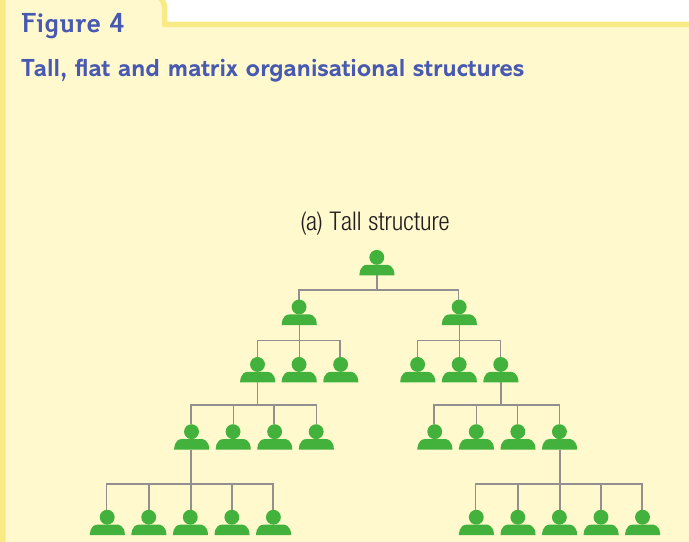
Key characteristics:
- Multiple management layers (typically five or more levels)
- Long chain of command from top to bottom
- Narrow span of control (few subordinates per manager)
- High degree of management supervision
- Clear promotion routes through the hierarchy
Note
Some management experts suggest hierarchies should not exceed eight levels, as beyond this point the disadvantages typically outweigh any benefits. Tall structures are common in traditional manufacturing businesses and large bureaucratic organisations where close supervision is needed to maintain quality standards.
Advantages of tall structures
Tight managerial control – the narrow span of control allows managers to supervise subordinates closely. This can be essential in environments where quality, safety, or compliance are critical. Managers can monitor performance more effectively and provide detailed guidance.
Clear lines of authority – employees know exactly who they report to and who is responsible for decisions. This reduces confusion and helps establish accountability throughout the organisation.
Defined career progression – multiple management levels create clear promotion opportunities. Employees can see a structured path for advancement, which may improve motivation and retention.
Close supervision – useful in roles requiring high technical skill or where mistakes carry significant consequences. Managers can provide regular feedback and training to less experienced workers.
Disadvantages of tall structures
High management costs – employing many managers across multiple levels is expensive. Salary costs for supervisory roles can significantly increase operational expenses.
Poor communication – messages must pass through numerous levels, increasing the risk of distortion or delay. By the time information reaches the bottom of the hierarchy, it may be misinterpreted or outdated. Similarly, feedback from front-line employees takes longer to reach senior decision-makers.
Slow decision-making – decisions often require approval at each management level, creating bottlenecks. In fast-moving markets, this lack of agility can be a serious competitive disadvantage.
Demotivation – close supervision can feel stifling to employees. Workers may resent micromanagement and feel they lack autonomy, reducing job satisfaction and potentially harming productivity.
Important
Exam tip: When evaluating tall structures, consider the business context. They may suit traditional manufacturing or highly regulated industries but struggle in dynamic, customer-focused sectors requiring quick responses.
Flat structures
A flat structure has few hierarchical levels, creating a short chain of command and a wide span of control.
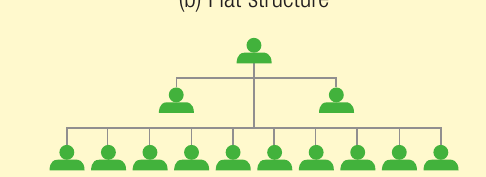
Key characteristics:
- Few management layers (often just two or three levels)
- Short chain of command
- Wide span of control (many subordinates per manager)
- Greater employee autonomy and empowerment
- Less direct supervision
Flat structures are increasingly common in modern businesses, particularly in service industries, creative sectors, and technology companies. They align well with contemporary management thinking that emphasises employee empowerment and rapid decision-making.
Advantages of flat structures
Improved communication – with fewer levels, messages travel faster and more accurately between top management and employees. There is less opportunity for distortion, and communication becomes more direct and open.
Lower management costs – fewer managers mean reduced salary expenses. Resources can be redirected toward front-line operations or other value-adding activities.
Faster decision-making – decisions do not require approval through multiple management layers. Employees often have authority to make decisions themselves, enabling quick responses to customer needs or market changes. This agility can provide competitive advantage.
Employee empowerment – workers have more responsibility for organising their work and solving problems. This autonomy can make work more interesting and challenging, improving motivation. Links to motivational theories such as McGregor's Theory Y, which assumes employees are self-motivated and seek responsibility.
Better motivation – employees feel trusted and valued when given autonomy. Job satisfaction increases when workers can use initiative rather than simply following instructions. This can reduce staff turnover and improve productivity.
Disadvantages of flat structures
Loss of control – with a wide span of control, managers may struggle to supervise all subordinates effectively. Discipline problems may emerge if oversight is insufficient, potentially harming productivity.
Co-ordination difficulties – managers responsible for many subordinates may find it hard to co-ordinate activities effectively. Important tasks may be overlooked or duplicated.
Manager overload – supervising numerous subordinates can be overwhelming. Managers may become stressed and unable to provide adequate support to their teams.
Unclear career paths – fewer management levels mean limited promotion opportunities. This may demotivate ambitious employees who seek career advancement.
Important
Exam tip: Flat structures work well in businesses where employees are skilled and self-motivated. Consider whether employees have the experience and capability to handle increased autonomy before recommending this structure.
Matrix structures
A matrix structure organises employees into temporary, cross-functional teams drawn from different departments to work on specific projects.
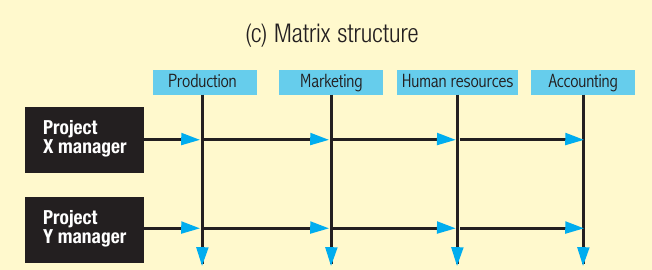
Key characteristics:
- Project-based teams combining specialists from various functions
- Employees report to both their functional manager and project manager (dual authority)
- Fluid teams that form, adapt, and dissolve as needed
- Emphasis on expertise and skills rather than hierarchy
- Common in businesses requiring multi-disciplinary problem-solving
Matrix structures differ fundamentally from tall and flat structures because they overlay a project-based system onto the existing functional organisation. An employee might work in the Marketing department but also participate in a project team alongside colleagues from Production, HR, and Finance.
How matrix structures work
Example
Worked Example: New Product Development Project
Consider a business developing a new product. A project manager leads a team including:
- A designer (from the Design department)
- A production specialist (from Manufacturing)
- A marketing expert (from Marketing)
- A financial analyst (from Finance)
- An HR representative (from Human Resources)
Each team member brings specialist knowledge to the project while maintaining their position in their functional department. When the project concludes, the team dissolves and members return fully to their departments or join new project teams.
Advantages of matrix structures
Utilises expertise effectively – draws on specialist skills from across the organisation. The right people work on projects that need their particular knowledge, regardless of departmental boundaries.
Flexibility and adaptability – teams form quickly to address specific business needs, then dissolve when no longer required. This agility suits businesses operating in dynamic, changing markets.
Empowers employees – gives workers at all levels opportunities to contribute their talents meaningfully. Even junior employees can participate in important projects, using their expertise in ways a rigid hierarchy might not allow.
Improved motivation – participating in varied projects makes work more interesting. Employees develop new skills, build relationships across departments, and see how their contributions support business objectives. Aligns with motivational theories emphasising challenge and achievement.
Better problem-solving – complex business problems often require input from multiple disciplines. Matrix structures facilitate the collaboration needed for sophisticated, multi-faceted solutions.
Disadvantages of matrix structures
Dual authority confusion – employees report to both their functional manager and project manager, which can create conflicts. If priorities clash, workers may receive contradictory instructions and feel uncertain about whose demands take precedence.
High support costs – matrix structures typically require additional administrative support, such as extra secretarial staff, project co-ordinators, and communication systems. These overhead costs can be substantial.
Co-ordination challenges – bringing together people from different departments with different working cultures can be difficult. Establishing effective teamwork takes time and effort.
Slow decision-making – gaining agreement from various specialists and reconciling different departmental perspectives can delay decisions. Debates over the best approach may become protracted.
Potential for conflict – functional managers may resist releasing their best employees to project teams. Competition for resources between projects can create tension.
Important
Exam tip: Matrix structures suit businesses facing complex, multifaceted problems requiring specialist knowledge from various areas. They are less appropriate for routine, stable operations or small businesses with limited functional specialisation.
Comparing organisational structures
The table below summarises the key differences between the three structure types:
| Feature | Tall Structure | Flat Structure | Matrix Structure |
|---|---|---|---|
| Hierarchy levels | Many (5+) | Few (2-3) | Varies (overlays existing structure) |
| Chain of command | Long | Short | Dual (functional and project) |
| Span of control | Narrow | Wide | Varies by role |
| Decision-making | Centralised, slow | Decentralised, fast | Collaborative, potentially slow |
| Communication | Poor (many layers) | Good (few layers) | Complex (multiple channels) |
| Management costs | High | Low | Medium-high (support systems) |
| Employee autonomy | Low | High | High (within projects) |
| Best suited for | Manufacturing, routine operations | Service industries, skilled workforce | Project-based work, complex problems |
Choosing the right structure
No structure is universally "best" – the appropriate choice depends on several contextual factors:
Nature of the work – routine, standardised work may suit tall structures where close supervision ensures consistency. Creative, knowledge-based work typically benefits from flatter structures that allow autonomy. Complex projects requiring diverse expertise favour matrix structures.
Size of business – small businesses naturally have flat structures. As businesses grow, they often develop taller hierarchies, though some deliberately maintain flat structures through delayering (removing management layers).
Employee skills and experience – highly skilled, self-motivated employees thrive in flat or matrix structures with greater autonomy. Less experienced workers may need the closer supervision provided by tall structures.
Market conditions – dynamic, fast-changing markets reward the agility of flat or matrix structures. Stable markets where efficiency and consistency matter most may suit tall structures.
Business strategy – businesses competing on innovation and customer responsiveness benefit from structures enabling quick decisions and cross-functional collaboration. Cost-focused strategies may prioritise the efficiency gains from standardised, tightly controlled operations in tall structures.
Links to other business concepts
Centralisation and decentralisation – structure type influences where authority resides. Tall structures often accompany centralisation (decisions at the top), while flat structures typically involve decentralisation (decisions pushed down). Matrix structures usually require significant decentralisation to function effectively.
Motivation – structure profoundly affects employee motivation. Flat and matrix structures align with Theory Y assumptions that employees seek responsibility and autonomy. Tall structures reflect Theory X assumptions about the need for close supervision and control.
Communication – structure determines communication patterns. Tall structures create formal, vertical communication channels that can be slow and prone to distortion. Flat structures facilitate faster, more direct communication. Matrix structures require sophisticated communication systems to manage multiple reporting relationships.
Exam application: How to use this knowledge
Note
For "explain" questions (4-6 marks):
- Define the structure type clearly
- Identify relevant characteristics (chain of command, span of control)
- Explain how these characteristics lead to specific outcomes
- Use business terminology accurately
For "analyse" questions (8-10 marks):
- Explain the structure type and its characteristics
- Develop a chain of reasoning showing cause and effect
- Consider both advantages and disadvantages
- Apply analysis to the specific business context given in the case study
- Use connective phrases like "this leads to...", "as a result...", "consequently..."
For "evaluate/assess" questions (16-20 marks):
- Analyse multiple implications of the structure
- Make judgements about significance ("most important...", "critical factor...")
- Consider counterarguments and limitations
- Apply context from the case study throughout
- Weigh up different factors before reaching an overall conclusion
- Consider both short-term and long-term implications
- Your conclusion should be supported by your analysis and context-specific
Important
Common command word - "Assess the impact of...":
When asked to assess the impact of switching from one structure to another (e.g., from tall to flat), consider:
- Effects on costs (management, training, redundancy)
- Communication changes (speed, accuracy, employee voice)
- Motivation implications (empowerment vs. insecurity)
- Decision-making speed and quality
- Short-term disruption vs. long-term benefits
- Whether employees have skills/experience to cope with change
- How change fits business strategy and market conditions
Remember!
Summary
Key points:
- Tall structures have many management levels, long chains of command, and narrow spans of control – offering tight supervision but risking slow communication and high costs
- Flat structures have few management levels, short chains of command, and wide spans of control – enabling fast decisions and empowerment but potentially losing control
- Matrix structures use cross-functional project teams with dual reporting lines – maximising expertise and flexibility but creating complexity and potential conflicts
- Choose structure based on business context: work type, employee skills, market dynamics, and strategic priorities
- Structure profoundly affects communication, motivation, decision-making speed, and costs
Key terms to remember:
- Chain of command – line of authority from top to bottom
- Span of control – number of subordinates a manager supervises directly
- Hierarchy – levels of authority within an organisation
- Delegation – passing authority from superior to subordinate
- Empowerment – giving employees autonomy to make decisions
- Delayering – removing management layers to create flatter structures
For exam success:
- Always apply your answer to the specific case study context
- Consider both positive and negative implications of any structural change
- Use business terminology precisely
- Develop analytical chains of reasoning, not just lists of points
- Support evaluative judgements with evidence and logic