Carbonyl Compounds (OCR A-Level Chemistry A): Revision Notes
📚Revision Notes
Carbonyl Compounds
Introduction to the carbonyl group
The carbonyl functional group is one of the most important groups in organic chemistry. It consists of a carbon atom double-bonded to an oxygen atom, represented as . This functional group is present in two major classes of organic compounds: aldehydes and ketones.
Note
Both aldehydes and ketones share this carbonyl group, but they differ in where this group is positioned within the carbon chain. This difference in position leads to significant differences in their chemical properties and reactivity.
Aldehydes
Structure and properties
In aldehydes, the carbonyl functional group is located at a terminal carbon position in the molecule. This means the carbon atom of the carbonyl group is attached to one or two hydrogen atoms (in the simplest case) and to the rest of the carbon chain.
Note
The aldehyde functional group is represented in structural formulas as or .
The simplest aldehyde: methanal
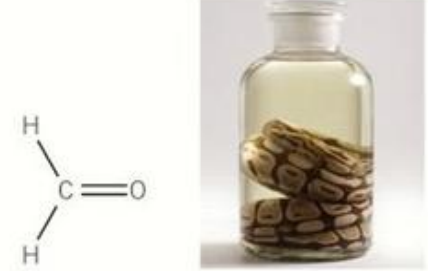
The simplest member of the aldehyde family is methanal, with the molecular formula . This compound is more commonly known by its traditional name, formaldehyde.
Formaldehyde has important practical applications. It is used in solution to preserve biological specimens, preventing decay and maintaining tissue structure for scientific study and education.
Ketones
Structure and properties
In ketones, the carbonyl functional group is positioned between two carbon atoms within the carbon chain, rather than at the end. This means the carbonyl carbon is bonded to two other carbon atoms.
Note
The ketone functional group is represented in structural formulas as or .
The simplest ketone: propanone
The simplest ketone is propanone, with the molecular formula . This compound contains three carbon atoms in total.
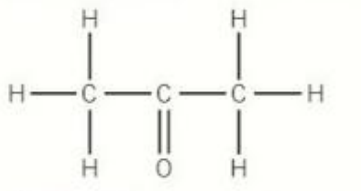
Propanone is better known by its common name, acetone. It serves as an important industrial solvent with many applications, including use in nail varnish removers and various chemical processes.
Naming carbonyl compounds
IUPAC nomenclature rules
The International Union of Pure and Applied Chemistry (IUPAC) system provides systematic rules for naming aldehydes and ketones. The carbonyl functional group is indicated by adding a specific suffix to the stem name of the longest carbon chain:
- Aldehydes: suffix -al
- Ketones: suffix -one
Numbering the carbon chain
For aldehydes, the carbonyl carbon is always located at carbon-1 (C-1). Because of this fixed position at the chain terminus, the number is not included in the name.
For ketones, the carbonyl group needs to be numbered because it can be at different positions within the chain. The carbon chain is numbered to give the carbonyl carbon the lowest possible number.
Note
When the suffix begins with a vowel (such as -one), the final 'e' in the alkane stem name is removed. For example, 'pentane' becomes 'pentan-' before adding '-one'.
Worked example: naming an aldehyde
Example
Worked Example: Naming an Aldehyde
Consider a compound with eight carbon atoms in the longest chain, where the carbonyl functional group is at the end of the chain:
Step 1: Count the carbons in the longest chain
- Eight carbons means the stem is "oct-"
Step 2: Identify the functional group position
- The group is at the chain terminus, making this an aldehyde
- Suffix:
Step 3: The aldehyde carbon is always C-1
- This is not included in the name
Step 4: Remove the final 'e' from the alkane name
- "octane" becomes "octan-"
Step 5: Combine to get the final name
- octanal
Worked example: naming a ketone
Example
Worked Example: Naming a Ketone
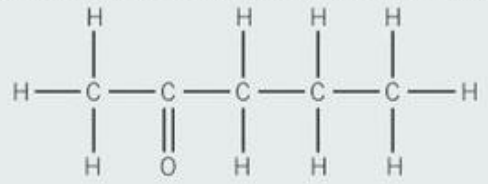
Consider a compound with five carbon atoms in the longest chain, where the carbonyl functional group is between two carbons:
Step 1: Count the carbons in the longest chain
- Five carbons means the stem is "pent-"
Step 2: Identify the functional group
- There is a functional group, so suffix is
Step 3: Number the carbonyl carbon position
- The group is at carbon-2, giving the lowest number
- Suffix:
Step 4: Remove the final 'e' from the alkane name
- "pentane" becomes "pentan-"
Step 5: Combine to get the final name
- pentan-2-one
Note that numbering could be from either end of the molecule, but the systematic name uses the lowest number possible. Here, numbering from the left gives position 2, which is lower than position 4 if numbered from the right.
Oxidation of aldehydes
Aldehydes can be oxidised
Aldehydes undergo oxidation reactions to form carboxylic acids when heated under reflux with acidified dichromate(VI) ions. The oxidising agent is typically a mixture of:
- Potassium dichromate(VI),
- Dilute sulfuric acid,
The general equation for aldehyde oxidation can be written using to represent the oxidising agent:
Example: oxidation of butanal
Example
Worked Example: Oxidation of Butanal
The oxidation of butanal to butanoic acid proceeds under reflux conditions:

In balanced equation form:
Observable colour change
During the oxidation reaction, a characteristic colour change occurs. The acidified potassium dichromate(VI) solution changes colour from orange to green as the dichromate(VI) ions are reduced to chromium(III) ions.
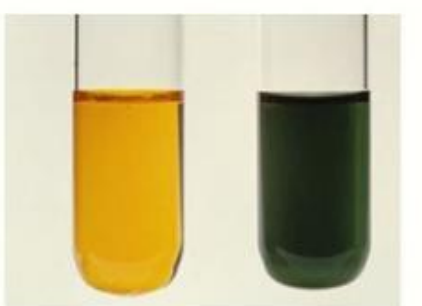
This colour change serves as a chemical test to distinguish aldehydes from ketones.
Ketones do not undergo oxidation
Important
Unlike aldehydes, ketones do not undergo oxidation reactions under these conditions. This fundamental difference in reactivity provides chemists with a reliable method to distinguish between aldehydes and ketones.
The lack of oxidation in ketones relates to their molecular structure. For oxidation to occur, a carbon-hydrogen bond adjacent to the carbonyl group must be present, which is available in aldehydes but not in ketones.
Nucleophilic addition reactions of the carbonyl group
The carbon–oxygen double bond
The reactivity of aldehydes and ketones is determined by the nature of the carbon–oxygen double bond. This double bond consists of two components:
- A σ-bond (sigma bond): formed by direct overlap of orbitals along the bond axis
- A π-bond (pi bond): formed by sideways overlap of p-orbitals above and below the plane of the carbon and oxygen atoms
Polarity of the bond
The carbon–oxygen double bond in carbonyl compounds is polar, which contrasts significantly with the non-polar carbon–carbon double bond in alkenes.
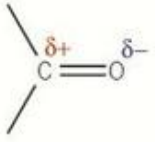
This polarity arises because oxygen is more electronegative than carbon. The electron density in the double bond lies closer to the oxygen atom than to the carbon atom. This unequal distribution creates:
- A partially positive charge () on the carbon atom
- A partially negative charge () on the oxygen atom
Why nucleophilic addition occurs
Due to the polarity of the double bond, aldehydes and ketones undergo reaction with nucleophiles. A nucleophile is an electron-rich species that is attracted to and attacks electron-deficient atoms.
The nucleophile is attracted to and attacks the slightly positive carbon atom of the carbonyl group. This results in addition across the double bond.
Note
The reaction type is called nucleophilic addition.
Comparison with alkenes
Important
This reaction behaviour differs from alkenes, where:
- The double bond is non-polar
- Alkenes react with electrophiles (electron-deficient species)
- The reaction is electrophilic addition
The polarity difference explains why carbonyl compounds and alkenes, despite both containing double bonds, undergo fundamentally different types of reactions.
Reaction of carbonyl compounds with
Sodium tetrahydridoborate(III) as a reducing agent
Sodium tetrahydridoborate(III), , functions as a reducing agent that converts aldehydes and ketones to alcohols. The reduction typically takes place when the aldehyde or ketone is warmed with the reducing agent in aqueous solution.
Note
In equations, the reducing action of is represented by or to show hydrogen being added.
Reducing an aldehyde to a primary alcohol
Example
Worked Example: Reduction of an Aldehyde
Aldehydes are reduced to primary alcohols by . For example, the reduction of butanal produces butan-1-ol:
Reducing a ketone to a secondary alcohol
Example
Worked Example: Reduction of a Ketone
Ketones are reduced to secondary alcohols by . For example, the reduction of propanone produces propan-2-ol:
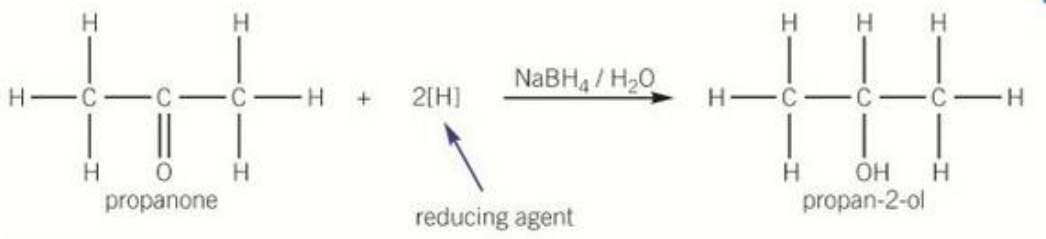
The classification of the alcohol product (primary or secondary) depends on the number of carbon atoms bonded to the carbon bearing the hydroxyl group.
Reaction of carbonyl compounds with
Formation of hydroxynitriles
Hydrogen cyanide, , adds across the bond of aldehydes and ketones to form compounds containing two functional groups: a hydroxyl group () and a nitrile group (). These products are classified as hydroxynitriles or cyanohydrins.
Importance of the reaction
This reaction provides a valuable synthetic method for extending the carbon chain of a molecule. The addition of the molecule increases the length of the carbon skeleton by one carbon atom, which is useful in building more complex organic molecules.
Reagents and conditions
Important
Safety Warning
Hydrogen cyanide is a colourless, extremely poisonous liquid that boils slightly above room temperature. Due to its extreme toxicity, cannot be used safely in an open laboratory environment.
Instead, the hydrogen cyanide required for the reaction is generated in situ using:
- Sodium cyanide ()
- Sulfuric acid ()
Although the reaction is still potentially very hazardous, this method is safer than using pure .
Example reaction: propanal with hydrogen cyanide
Example
Worked Example: Reaction of Propanal with HCN
The reaction of propanal with hydrogen cyanide produces a hydroxynitrile:
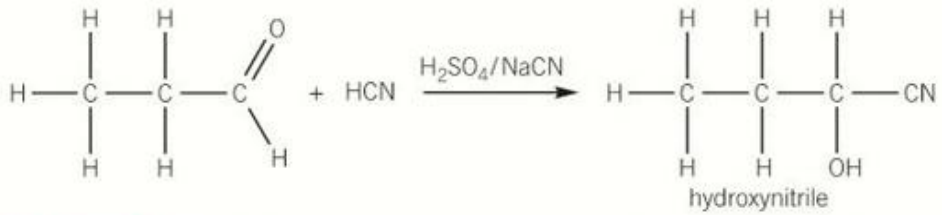
The product contains both a hydroxyl group and a nitrile group attached to the same carbon atom.
Mechanism for nucleophilic addition to carbonyl compounds
General mechanism overview
Addition reactions to carbonyl groups typically proceed through a two-step mechanism:
Step 1: Nucleophilic attack on the carbonyl group to form a negatively charged intermediate
Step 2: Protonation of the intermediate to form an alcohol product
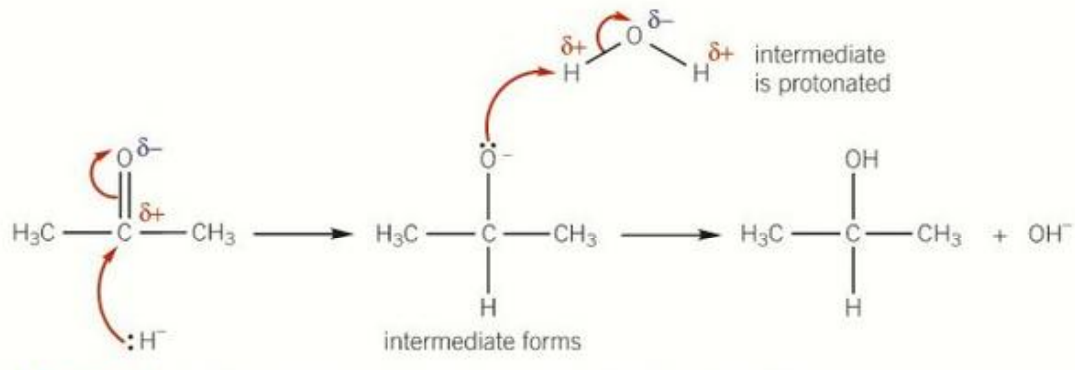
The mechanism for the reaction with
In this nucleophilic addition reaction, can be considered as containing the hydride ion, , which acts as the nucleophile.
Note
Mechanism Steps:
Step 1: The lone pair of electrons from the hydride ion, , is attracted and donated to the carbon atom in the aldehyde or ketone double bond. A dative covalent bond forms between the hydride ion and the carbonyl carbon.
Step 2: The π-bond in the double bond breaks by heterolytic fission, forming a negatively charged intermediate. The pair of electrons from the π-bond moves to the oxygen atom.
Step 3: The oxygen atom of the intermediate donates a lone pair of electrons to a hydrogen atom in a water molecule. The intermediate is protonated to form an alcohol product.
The mechanism shows curved arrows to represent the movement of electron pairs during bond formation and breaking.
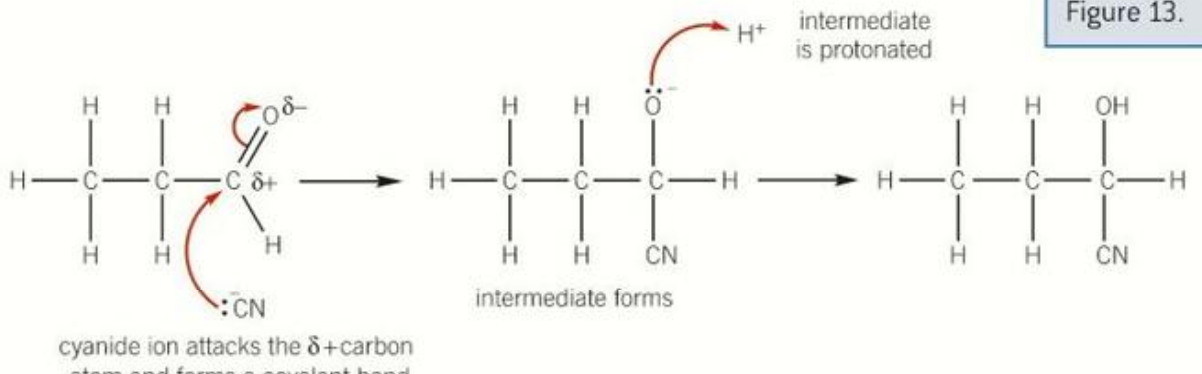
The mechanism for the reaction with
In the first stage of the reaction of an aldehyde or ketone with , the cyanide ion, , attacks the electron-deficient carbon atom in the aldehyde or ketone.
Note
Mechanism Steps:
Step 1: The lone pair of electrons from the cyanide ion, , is attracted and donated to the carbon atom in the aldehyde or ketone double bond. A dative covalent bond forms between the cyanide ion and the carbonyl carbon.
Step 2: The π-bond in the double bond breaks by heterolytic fission, forming a negatively charged intermediate.
Step 3: The intermediate is protonated by donating a lone pair of electrons to a hydrogen ion to form the product. This gives a hydroxynitrile.
Important
An important point to note: although the cyanide ion is usually written as , the negative charge is actually located on the carbon atom. In the mechanism, it is important to show this negative charge on the carbon atom, as , to correctly represent which atom carries the charge.
Remember!
Summary
Key Points to Remember:
- The carbonyl group () is found in aldehydes and ketones
- Aldehydes have the carbonyl group at a terminal position (suffix: -al), while ketones have it between two carbons (suffix: -one)
- Aldehydes can be oxidised to carboxylic acids using acidified (orange to green colour change), but ketones cannot be oxidised
- The bond is polar ( on C, on O), making carbonyl compounds reactive towards nucleophiles
- reduces aldehydes to primary alcohols and ketones to secondary alcohols via nucleophilic addition
- reacts with carbonyl compounds to form hydroxynitriles (cyanohydrins), which extends the carbon chain by one carbon atom
- Nucleophilic addition mechanisms involve: (1) nucleophilic attack forming a negative intermediate, then (2) protonation to form the product
Exam Focus Checklist:
- Be able to draw and name aldehyde and ketone structures
- Know oxidation conditions and colour change for aldehydes
- Understand why ketones don't oxidise
- Write balanced equations for reduction and HCN addition reactions
- Draw complete mechanisms with curly arrows, charges, and intermediates
- Explain the polarity of and why it undergoes nucleophilic addition
- Remember to show the negative charge on the carbon in