Carbon-13 NMR Spectroscopy (OCR A-Level Chemistry A): Revision Notes
📚Revision Notes
Carbon-13 NMR Spectroscopy
Introduction to carbon-13 NMR spectroscopy
Carbon-13 NMR spectroscopy is a powerful analytical technique that provides crucial structural information about organic molecules. When you analyse a C NMR spectrum, you can determine two essential pieces of information:
- The number of distinct carbon environments in the molecule - this is determined by counting the peaks in the spectrum
- The types of carbon atoms present - this is identified from the chemical shift values () of each peak
Understanding how to interpret C NMR spectra allows you to deduce possible structures for unknown organic compounds and distinguish between structural isomers that may be difficult to tell apart using other methods.
Note
The ability to interpret C NMR spectra is fundamental to organic chemistry. This technique is particularly valuable because it can distinguish between structural isomers that might appear identical using other analytical methods.
Understanding chemical shifts in C NMR
The chemical shift () is a measure of the position of a peak in the NMR spectrum. All chemical shifts in C NMR are measured relative to a reference compound called tetramethylsilane (TMS), which is assigned a chemical shift of ppm.
The chemical shift scale in C NMR extends to approximately 220 ppm, which provides sufficient separation to distinguish between carbon atoms in slightly different chemical environments. This wide range makes C NMR particularly useful for identifying different types of carbon atoms within a molecule.
Important
Important exam note: You do not need to memorise specific chemical shift values for different groups - these will be provided to you in the Data Sheet during examinations.
Types of carbon environments and their chemical shift ranges
The chemical environment of a carbon atom refers to its position and bonding within the molecule. Carbon atoms bonded to different atoms or groups will have different chemical environments and therefore appear at different chemical shifts.
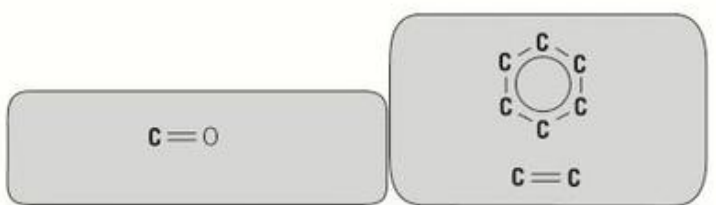
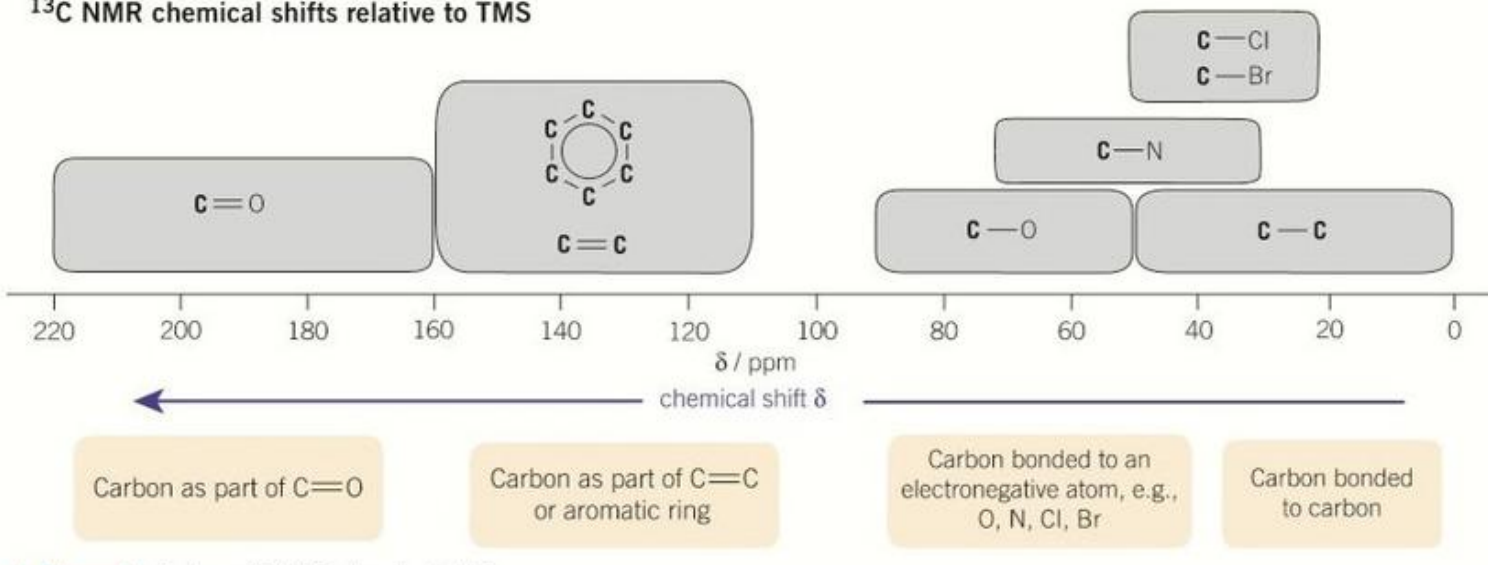
There are four main categories of carbon environments, each absorbing in a characteristic chemical shift range:
1. Carbonyl carbons (C=O)
Carbon atoms that are part of a carbonyl group (C=O) appear in the range ppm. This is the highest chemical shift region and is characteristic of aldehydes, ketones, carboxylic acids, esters, and amides.
2. Aromatic and alkene carbons (C=C)
Carbon atoms that form part of an aromatic ring (such as benzene) or are involved in carbon-carbon double bonds appear in the range ppm. This intermediate-high region helps identify unsaturated carbon systems.
3. Carbons bonded to electronegative atoms
Carbon atoms directly bonded to electronegative elements such as oxygen, nitrogen, chlorine, or bromine (C-O, C-N, C-Cl, C-Br) typically appear in the range ppm. The electronegative atom withdraws electron density from the carbon, shifting its signal to higher values.
4. Saturated carbon-carbon bonds (C-C)
Carbon atoms bonded only to other carbon atoms and hydrogen atoms appear in the lowest range, ppm. This region is characteristic of alkyl groups and saturated carbon chains.
Note
The exact chemical shift within these ranges depends on several factors including the solvent used, concentration of the sample, and the specific substituents attached to the carbon atom.
Equivalent carbon atoms and symmetry
A crucial concept in interpreting C NMR spectra is understanding when carbon atoms are equivalent. Two or more carbon atoms are considered equivalent when they are positioned symmetrically within a molecule, meaning they can be described in an identical way.
Important
Key principle: Equivalent carbon atoms:
- Have the same chemical environment
- Absorb radiation at the same chemical shift
- Contribute to the same peak in the spectrum
This means that the number of peaks in a C NMR spectrum equals the number of different carbon environments, not necessarily the total number of carbon atoms in the molecule.
Molecules with high symmetry will have fewer peaks than carbon atoms because multiple carbons share the same environment. For example, if a molecule contains six carbon atoms but only three different environments due to symmetry, the C NMR spectrum will show only three peaks.
Comparing structural isomers: Propanal and propanone
A detailed comparison of propanal and propanone demonstrates how C NMR can distinguish between structural isomers. Both compounds have the molecular formula , but their different structures result in distinctly different NMR spectra.
Propanal ()
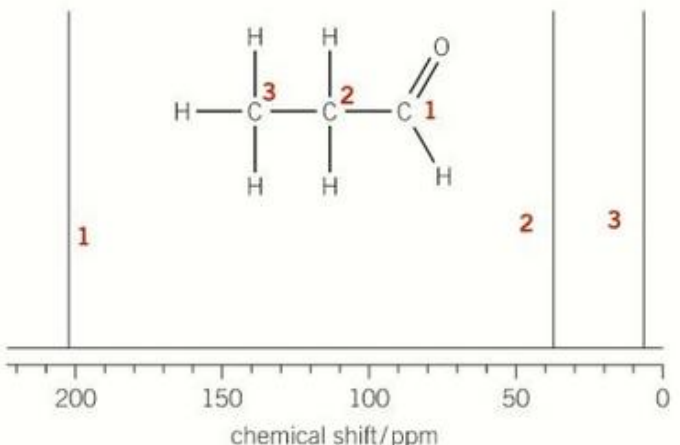
Propanal contains three carbon atoms in three different chemical environments:
- Carbon-1: Part of the aldehyde functional group (CHO) - appears at ppm
- Carbon-2: Part of a group positioned between a group and an aldehyde group - appears at ppm
- Carbon-3: Part of a group bonded to - appears at ppm
Because all three carbons are in different environments, the C NMR spectrum shows three distinct peaks.
Propanone ()
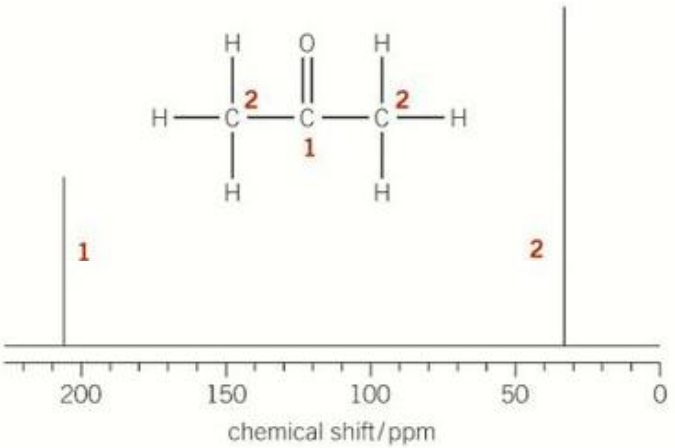
Propanone also contains three carbon atoms, but due to its symmetrical structure, there are only two different chemical environments:
- Carbon-1: Part of the ketone carbonyl group (C=O) - appears at ppm
- Carbon-2 and Carbon-3: Both are groups bonded to the carbonyl carbon () - these are equivalent due to symmetry and both appear at ppm
Because the two methyl groups are equivalent, the C NMR spectrum shows only two peaks, even though there are three carbon atoms.
Note
An important observation from the propanal spectrum: Carbon-2 (the group) appears at ppm, which is slightly higher than Carbon-3 despite both falling into the same broad C-C environment category. This is because Carbon-2 is closer to the electronegative oxygen atom of the carbonyl group, which shifts its signal to a higher chemical shift value.
Step-by-step interpretation of C NMR spectra
Worked example: Identifying alcohol isomers
When presented with an unknown C NMR spectrum, follow this systematic approach to identify the structure:
Example
Worked Example: Identifying Alcohol Isomers from C NMR Spectra
Step 1: Determine the number of carbon environments
First, draw out all possible structural isomers of the given molecular formula. For each structure, carefully identify how many different carbon environments exist by looking for symmetry. Number each carbon atom and identify which ones are equivalent.
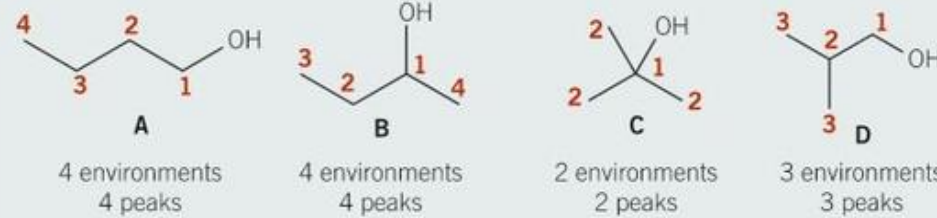
For example, with alcohols:
- Structure A: 4 different environments → 4 peaks expected
- Structure B: 4 different environments → 4 peaks expected
- Structure C: 2 different environments → 2 peaks expected (high symmetry)
- Structure D: 3 different environments → 3 peaks expected
Step 2: Match the number of peaks
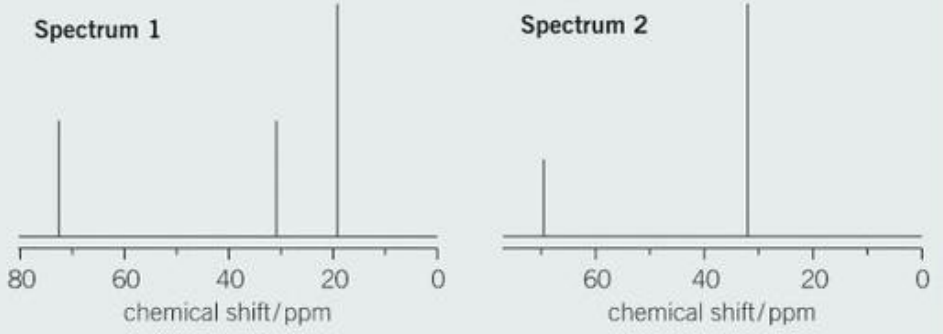
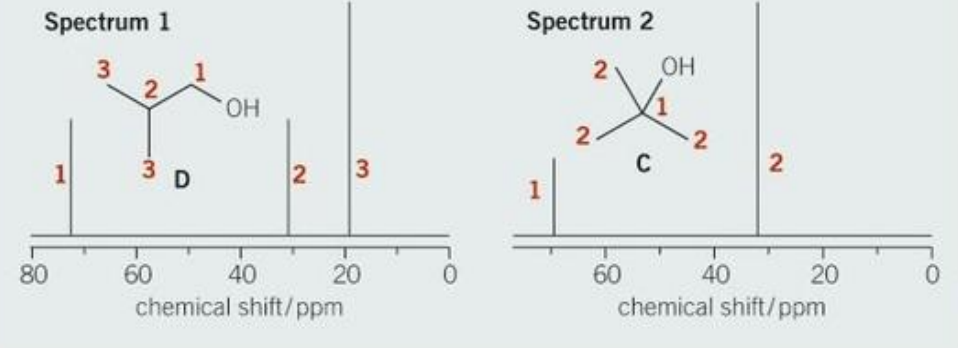
Count the peaks in the spectrum and match this to the structures that have the corresponding number of environments:
- Spectrum 1 has three peaks → matches Structure D (3 environments)
- Spectrum 2 has two peaks → matches Structure C (2 environments)
Step 3: Assign peaks using chemical shift data
Once you've identified the structure, use the chemical shift ranges to assign each peak to specific carbon atoms in the molecule. Refer to the chemical shift chart to determine which carbons should appear where.
Worked example: Aromatic compound isomers
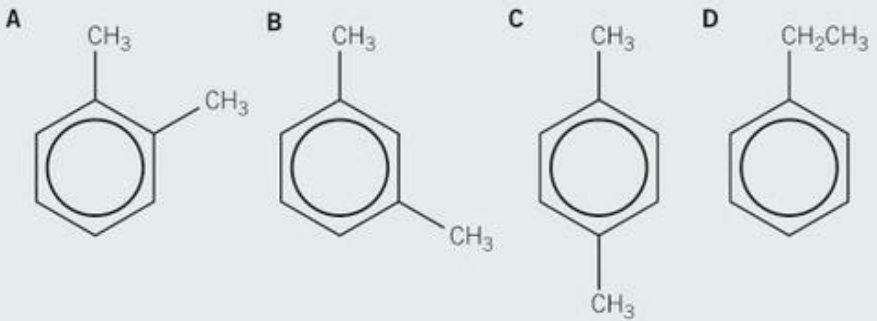
Aromatic compounds present a more complex challenge because benzene rings contain multiple carbon environments. Let's examine four isomers with molecular formula :
Example
Worked Example: Distinguishing Aromatic Isomers
Step 1: Identify carbon environments
For each structure, carefully number all carbon atoms, paying special attention to the symmetry of the benzene ring:
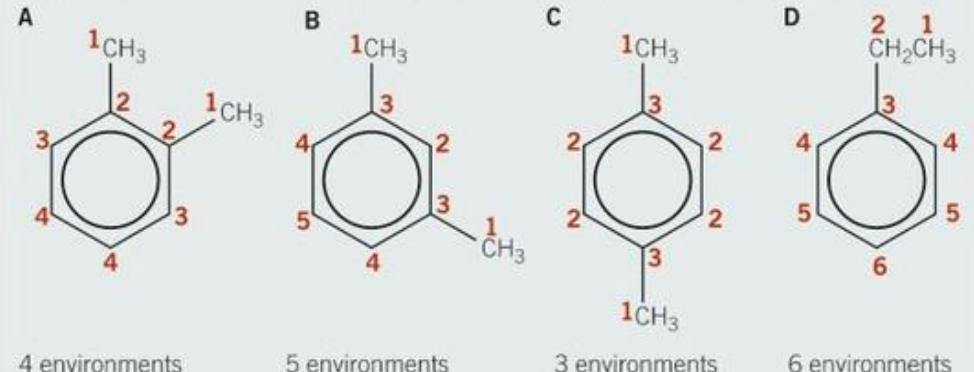
- Structure A (ortho-dimethylbenzene): 4 different environments → 4 peaks
- Structure B (meta-dimethylbenzene): 5 different environments → 5 peaks
- Structure C (para-dimethylbenzene): 3 different environments → 3 peaks (highest symmetry)
- Structure D (ethylbenzene): 6 different environments → 6 peaks
Step 2: Predict approximate chemical shifts
For each structure, determine what types of carbon environments are present:
Structure A - four peaks expected:
- One peak at ppm for the two equivalent C- carbon atoms (environment 1)
- Three peaks at ppm for the aromatic carbon atoms in environments 2, 3, and 4
Structure B - five peaks expected:
- One peak at ppm for the two equivalent C- carbon atoms (environment 1)
- Four peaks at ppm for the aromatic carbon atoms in environments 2, 3, 4, and 5
Structure C - three peaks expected:
- One peak at ppm for the two equivalent C- carbon atoms (environment 1)
- Two peaks at ppm for the aromatic carbon atoms in environments 2 and 3
Structure D - six peaks expected:
- Two peaks at ppm: one for the C- carbon (environment 1) and one for the carbon (environment 2)
- Four peaks at ppm for the aromatic carbon atoms in environments 3, 4, 5, and 6
This example demonstrates how C NMR spectroscopy is exceptionally useful for distinguishing between aromatic isomers that may be very difficult to tell apart using other analytical methods. Simply counting the number of peaks can often identify which isomer you have, and even when different isomers produce the same number of peaks, the specific pattern and chemical shifts can help distinguish them.
Factors affecting chemical shifts
While the four main chemical shift ranges provide a useful guide, the exact chemical shift of a carbon atom can be influenced by several factors:
Proximity to electronegative atoms
Carbon atoms positioned closer to electronegative elements (such as oxygen, nitrogen, or halogens) experience greater electron withdrawal. This deshielding effect causes the peak to shift to higher chemical shift values (further downfield).
Note
For instance, in propanal, the group (Carbon-2) appears at a higher chemical shift ( ppm) compared to the group (Carbon-3 at ppm), even though both are formally in the C-C environment range. This is because Carbon-2 is directly adjacent to the oxygen-containing carbonyl group.
Multiple bonds
The presence of multiple bonds (double or triple bonds) can also influence chemical shifts. Carbon atoms involved in or near multiple bonds may experience different magnetic environments that affect their chemical shift position.
Other factors
The chemical shift can also be influenced by:
- The solvent used for the NMR analysis
- The concentration of the sample
- Interactions between molecules in solution
Note
While it's helpful to be aware of these factors, predictions based on the four main chemical shift ranges and the structural features of the molecule are usually sufficient for A-Level exam purposes. The ability to predict the general chemical shift range and recognise patterns is more important than calculating exact values.
Remember!
Summary
Key Points to Remember:
-
C NMR provides two key pieces of information: the number of different carbon environments (from counting peaks) and the types of carbon present (from chemical shift values)
-
Number of peaks equals number of different carbon environments - not necessarily the number of carbon atoms, due to symmetry creating equivalent carbons
-
Four main chemical shift ranges to recognise: C=O (160-220 ppm), aromatic/C=C (110-160 ppm), C bonded to electronegative atoms (40-80 ppm), and C-C (0-40 ppm)
-
Chemical shifts are referenced to TMS at ppm and chemical shift values will be provided in your exam Data Sheet
-
Equivalent carbon atoms are symmetrically positioned within the molecule, have identical chemical environments, and contribute to the same peak