Product (AQA GCSE Business): Revision Notes
📚Revision Notes
Product - Marketing mix
Understanding product in marketing
In today's rapidly changing business environment, companies must continuously innovate to meet evolving customer needs. The product element of the marketing mix focuses on developing goods and services that satisfy consumer demands whilst generating profit for the business. This involves careful consideration of design, features, quality, and timing to ensure market success.
Note
The product is often considered the most fundamental element of the marketing mix, as without a product that meets customer needs, no amount of promotion, pricing, or distribution can ensure business success.
Product development process
Creating a successful product requires a systematic approach that balances business objectives with customer requirements. The development process follows eight key stages that help minimise risks and maximise the chances of market success.
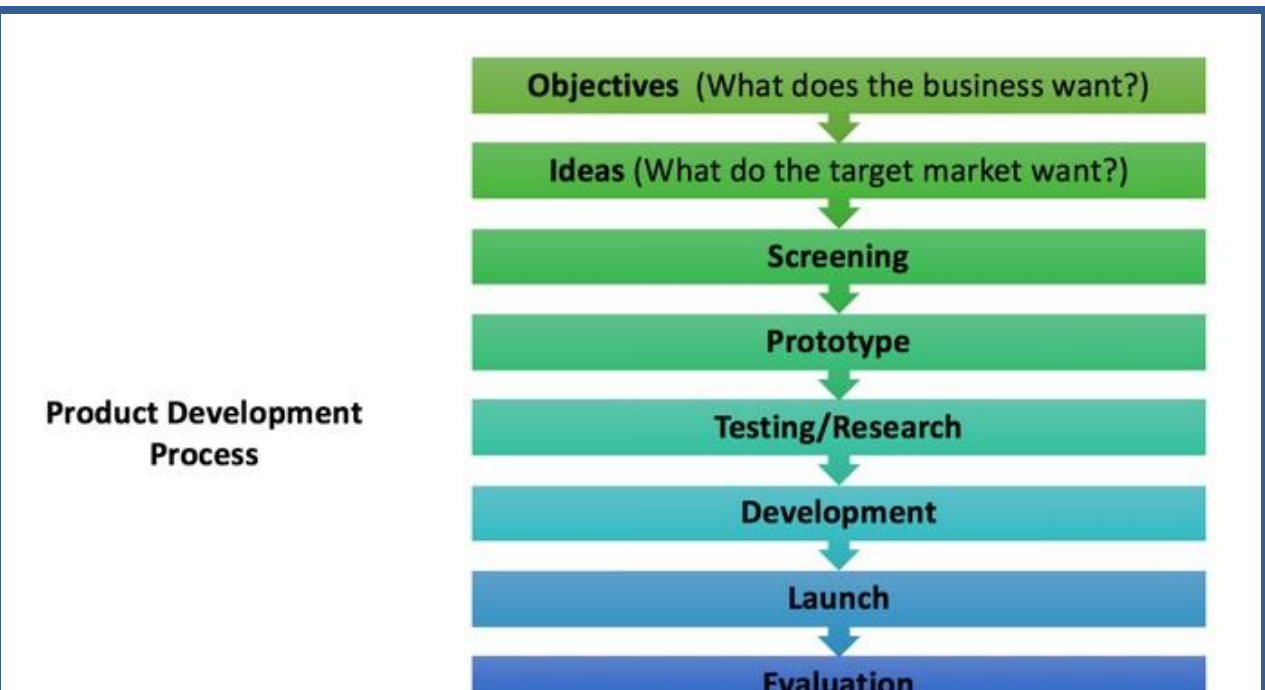 This structured approach ensures that businesses carefully consider each stage before moving forwards. As companies progress through these stages, they typically face increasing costs whilst the number of viable ideas decreases. This funnel effect helps businesses focus their resources on the most promising opportunities.
Important
The systematic eight-stage process is crucial because it helps businesses avoid costly mistakes by thoroughly evaluating ideas before committing significant resources to development and launch.
Risks and benefits of product development
Developing new products involves significant risks that businesses must carefully consider. Research and development costs can be substantial, and there's always the possibility that a product may fail to launch or prove unsuccessful in the marketplace. Additionally, businesses face the risk that competitors may develop similar products, leading to reduced sales and market share.
However, the potential benefits can be considerable. Companies that successfully launch innovative products ahead of their competitors often enjoy the advantage of charging premium prices. They may also be able to protect their ideas through legal means such as patents, creating barriers for competitors and enabling higher profit margins.
Market needs and product development
Understanding why businesses choose to develop new products is crucial for appreciating the product development process. Companies typically identify several key drivers that motivate product innovation.
Businesses may spot gaps in the market where customer needs aren't being met by existing products. They might also respond to new inventions or technological advances that create opportunities for innovation. Sometimes, existing products begin to show declining sales, prompting companies to develop replacements or improvements. Changes in fashion trends and evolving customer requirements also drive product development decisions.
Note
Market gaps represent untapped opportunities where customer needs exist but aren't being adequately met by current products. Identifying these gaps early can provide significant competitive advantages.
When deciding whether to develop a new product, businesses must consider several factors. They need to evaluate whether the product aligns with their business objectives and whether they have the necessary resources, including financial capacity and management expertise. Industries like pharmaceuticals provide excellent examples of sectors with numerous potential products that may require high development costs but offer significant profit potential.
Companies must also consider how a new product might affect their brand image. For instance, a premium car manufacturer might identify demand for a budget vehicle, but they must carefully consider how this could impact their luxury brand positioning and affect pricing and profitability of their existing product range.
Product design features
Creating a successful product requires careful attention to several fundamental design considerations. These features work together to ensure the product meets customer expectations whilst remaining viable for the business.
Functional design ensures the product performs its intended purpose effectively. This is the most basic requirement - customers expect products to work as advertised and deliver the promised benefits.
Reliability focuses on consistent performance over time. Products must continue functioning properly throughout their expected lifespan, maintaining customer satisfaction and reducing warranty costs for the business.
Aesthetic appeal considers how the product looks and feels to customers. This visual and tactile appeal contributes significantly to the brand image customers associate with the product and can influence purchasing decisions.
Quality standards ensure the product meets or exceeds customer expectations. This involves using appropriate materials, maintaining consistent manufacturing standards, and delivering value that justifies the price point.
Economic efficiency examines the cost-effectiveness of production. This includes considering the availability and cost of components and materials, as well as ensuring the product can be manufactured repeatedly without excessive costs.
Example
Worked Example: Smartphone Design Features
Consider how a smartphone manufacturer applies these five design features:
- Functional: Reliable calling, messaging, and internet capabilities
- Reliable: Battery life lasting a full day with consistent performance
- Aesthetic: Sleek design with premium materials and attractive interface
- Quality: Durable construction with high-resolution display and camera
- Economic: Efficient production using readily available components
Product differentiation
In competitive markets, businesses must find ways to distinguish their products from those offered by rivals. This differentiation strategy involves creating unique features or characteristics that set the product apart from alternatives.
When a product offers something that competitors cannot provide, this creates a unique selling point (USP). A strong USP enables businesses to charge premium prices and build customer loyalty. This competitive advantage encourages customers to choose their product over alternatives and return for repeat purchases.
Successful differentiation also enables businesses to develop strong brand recognition. When customers associate a brand with quality and reliability, they're more likely to purchase other products from the same brand family, creating opportunities for cross-selling and brand extension.
Important
A truly effective USP must be:
- Genuinely unique to your product
- Valued by your target customers
- Difficult for competitors to replicate
- Clearly communicated in your marketing
Brand image
A brand represents much more than just a product name - it encompasses the entire customer experience and perception associated with a company's offerings. The definition of a brand includes any name, term, design, symbol, or feature that distinguishes one seller's goods or services from those of competitors.
Note
According to the American Marketing Association, a brand is "a name, term, design, symbol, or any other feature that identifies one seller's good or service as distinct from those of other sellers."
Effective branding creates lasting impressions in consumers' minds, influencing their perceptions and purchasing behaviour. These impressions can be positive or negative, making brand management crucial for business success. Companies invest heavily in marketing and advertising campaigns to shape and reinforce their desired brand image.
Strong brands enjoy several advantages, including reduced price sensitivity among customers. When customers trust a brand, they're often willing to pay higher prices without significantly reducing their purchase volumes. This loyalty is demonstrated by premium brands like Heinz, whose products command higher prices than supermarket alternatives despite serving similar functions.
The product life cycle
The product life cycle represents a fundamental marketing concept that describes the journey products experience from initial development through to market withdrawal. Understanding these stages helps businesses plan appropriate strategies for each phase.
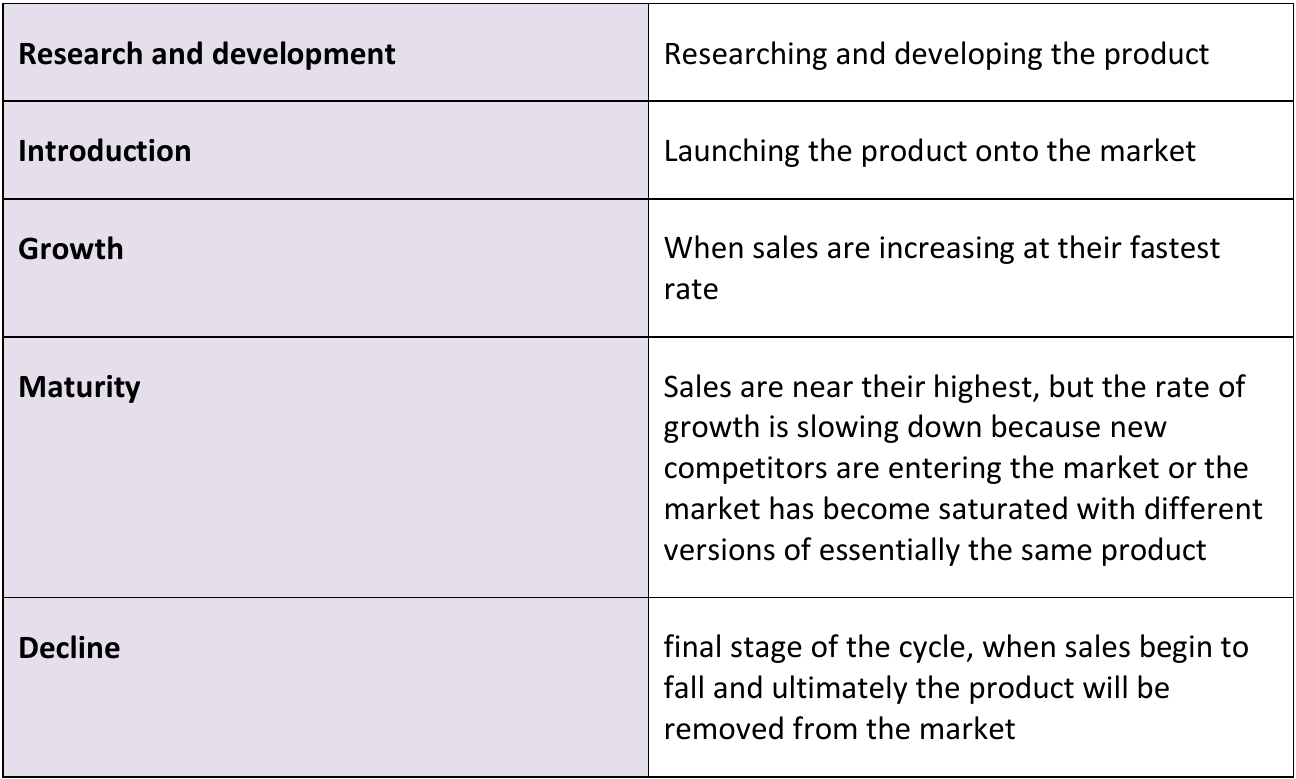 This cycle shows how products typically progress through distinct phases, each requiring different marketing approaches and business strategies. Not all products follow this exact pattern - some may skip stages or experience different timing - but the framework provides valuable guidance for strategic planning.
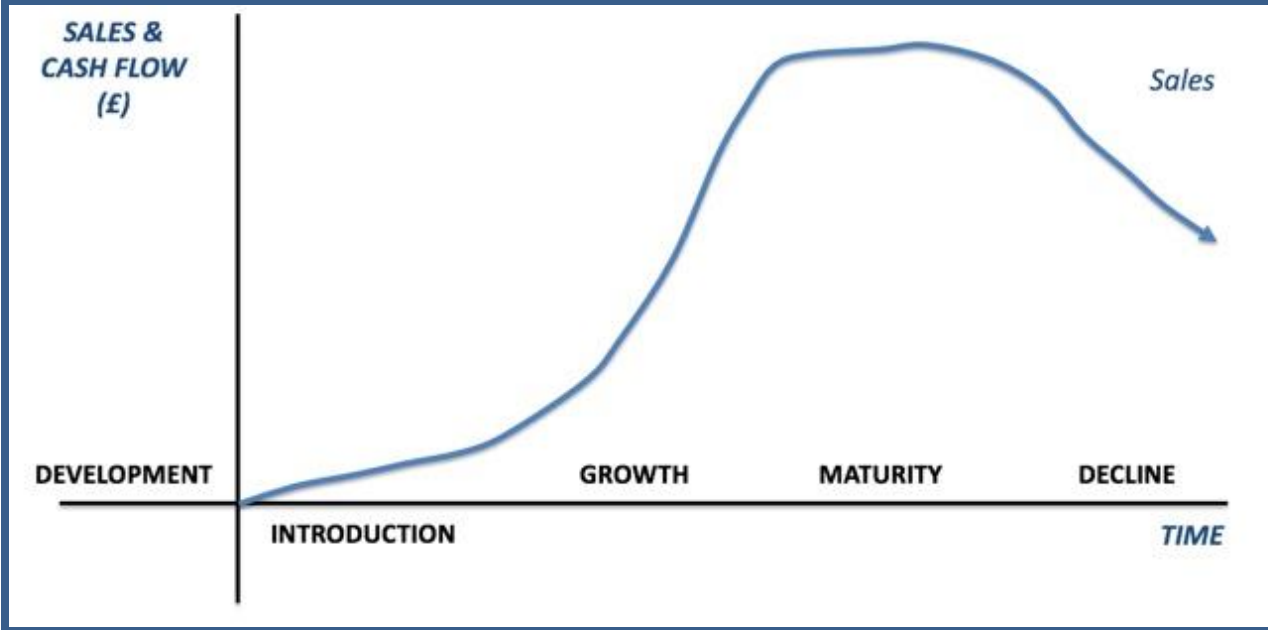 The visual representation of the product life cycle demonstrates how sales typically change over time. During the development phase, sales are non-existent whilst costs accumulate. The introduction phase sees slow initial sales growth as the product enters the market. Growth phase brings rapid sales increases as the product gains market acceptance. Maturity represents peak sales levels, though growth rates begin to slow. Finally, decline sees falling sales as the product becomes obsolete or loses market relevance.
Note
The five stages of the product life cycle are:
- Research and development - Product creation and testing
- Introduction - Market launch with slow initial sales
- Growth - Rapid sales increase and market acceptance
- Maturity - Peak sales with slowing growth rates
- Decline - Falling sales due to obsolescence or competition
Extension strategies
Businesses often implement extension strategies to prolong product life and delay the decline phase. These techniques aim to rejuvenate sales and maintain market relevance through various marketing approaches.
Advertising campaigns can help reach new audiences or remind existing customers about the product's benefits. This renewed marketing focus can stimulate demand and extend the product's market life.
Price reductions make products more accessible to price-sensitive customers, potentially expanding the customer base and increasing sales volumes.
Adding value through new features or improvements can refresh the product offering. For example, adding video messaging capabilities to smartphones created new reasons for customers to upgrade.
Market expansion involves selling products in new geographical regions or targeting different customer segments, opening up additional revenue streams.
New packaging can refresh the product's appearance and appeal. Simple changes like updated graphics or more convenient packaging formats can renew customer interest.
Important
Despite these strategies, businesses must recognise that extension techniques have limitations. Eventually, technological advances or changing customer preferences may make products obsolete. Historical examples include black and white televisions, video cassettes, and audio tapes - products that no amount of marketing could save from technological obsolescence.
Example
Worked Example: Coca-Cola Extension Strategies
Coca-Cola has successfully used multiple extension strategies:
- New packaging: Introduced different bottle sizes and designs
- Market expansion: Entered new countries and demographics
- Product variants: Created Diet Coke, Coke Zero, and flavoured versions
- Advertising campaigns: Refreshed marketing with new slogans and celebrity endorsements
- Added value: Introduced new formulations and seasonal flavours
Summary
Key Points to Remember:
- Product development follows a systematic eight-stage process from objectives setting through to final evaluation
- Businesses develop new products to fill market gaps, respond to declining sales, or capitalise on new opportunities
- Successful products must be functional, reliable, aesthetically pleasing, high-quality, and economically viable
- Product differentiation through unique selling points enables premium pricing and customer loyalty
- Strong brands create customer loyalty and reduce price sensitivity
- The product life cycle consists of five stages: development, introduction, growth, maturity, and decline
- Extension strategies can prolong product life but cannot prevent eventual obsolescence