Angles 2 (AQA GCSE Maths): Revision Notes
📚Revision Notes
Angles 2
When working with angles in geometry, there are several important rules that help you solve problems involving triangles, quadrilaterals, and parallel lines. Understanding these relationships is essential for success in your GCSE exam.
Triangles and quadrilaterals
These shapes have predictable angle properties that you need to memorise and apply in your calculations.
Interior angles in triangles
The most fundamental rule in triangle geometry is that interior angles always add up to . This means when you add all three angles inside any triangle, regardless of its shape or size, the total will always equal . This rule works for right-angled triangles, isosceles triangles, equilateral triangles, and scalene triangles.
Important
Fundamental Triangle Rule
In any triangle:
This is one of the most important rules in geometry and applies to ALL triangles, no matter their shape or size.
Interior angles in quadrilaterals
For any four-sided shape (quadrilateral), the interior angles always add up to . This applies to squares, rectangles, parallelograms, rhombuses, trapeziums, and irregular quadrilaterals. You can remember this because a quadrilateral has four angles, and is exactly twice the triangle total of .
Note
Memory Tip
- Triangle = (both start with 't')
- Quadrilateral = (four sides, bigger number)
Exterior angles in triangles
An important relationship exists between exterior and interior angles in triangles. The exterior angle of a triangle equals the sum of the two interior angles at the other vertices. This means if you extend one side of a triangle, the angle formed outside the triangle equals the total of the two angles inside the triangle that are not next to it.
Note
This relationship is particularly useful for solving complex angle problems where you can't immediately see all the interior angles of a triangle.
Opposite angles in parallelograms
In parallelograms (including rectangles, squares, and rhombuses), opposite angles are always equal. This property helps you find missing angles when you know just one angle in the parallelogram.
Parallel and perpendicular lines
Understanding the relationship between parallel lines and the angles they create is crucial for solving many geometry problems.
Key definitions
Parallel lines are lines that remain exactly the same distance apart and never meet, no matter how far you extend them. They are marked with arrows pointing in the same direction.
Perpendicular lines meet at exactly (a right angle).
Angle relationships with parallel lines
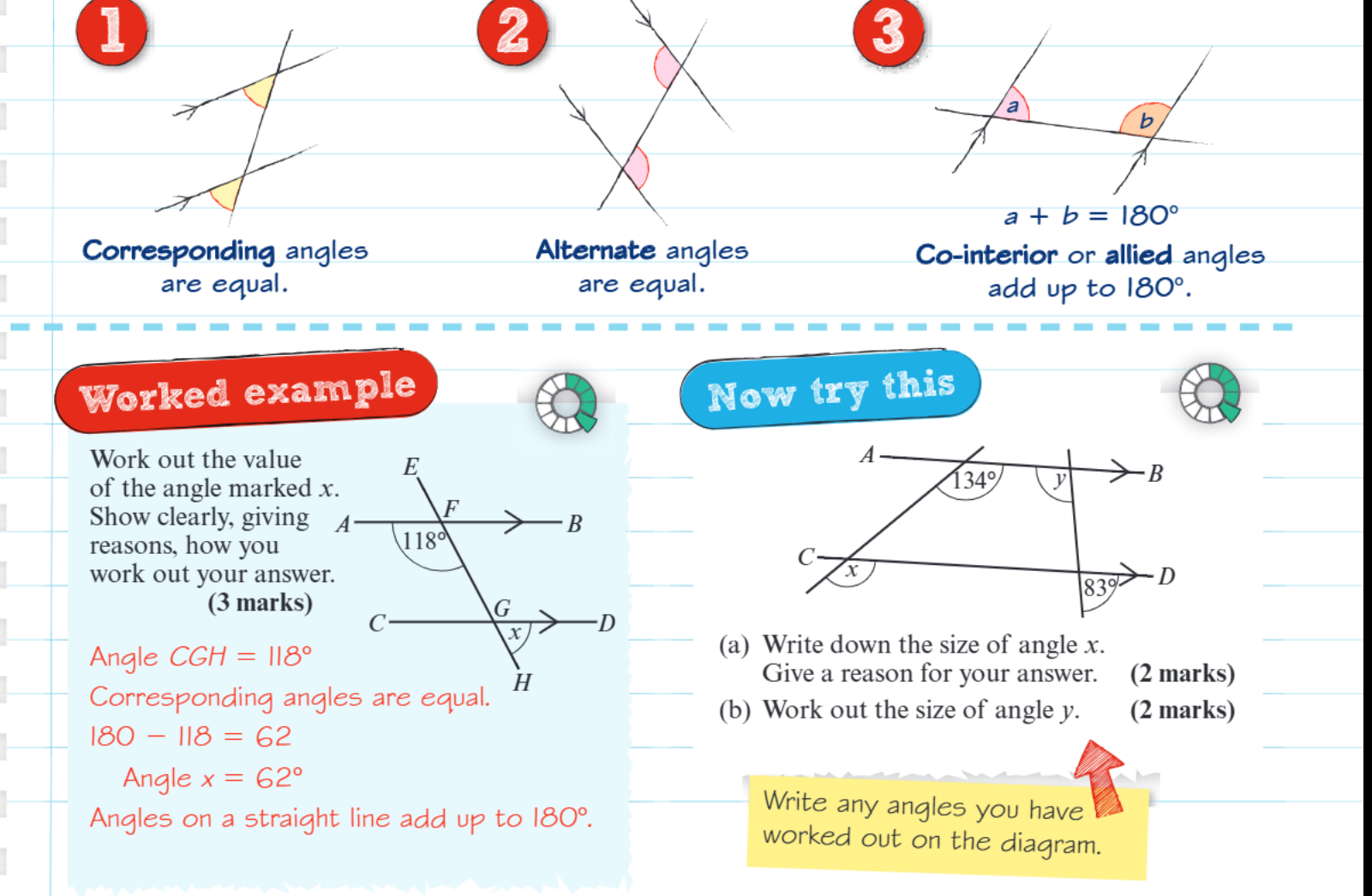
When a straight line (called a transversal) crosses two parallel lines, it creates several angle relationships that are always true.
Corresponding angles
Important
Corresponding angles are equal
These are angles that appear in matching positions where the transversal crosses each parallel line. Think of them as being in corresponding positions - if one is at the top-left of an intersection, its corresponding angle is also at the top-left of the other intersection.
Alternate angles
Important
Alternate angles are equal
These angles appear on opposite sides of the transversal and are positioned alternately along the parallel lines. They form a 'Z' pattern when you trace from one angle to its alternate angle.
Co-interior angles
Important
Co-interior angles add up to
These angles (also called allied angles) appear on the same side of the transversal between the parallel lines. They always form supplementary pairs, meaning they complete a straight line when added together.
Working with angle problems
Exam strategy
When solving angle problems, always write your calculated angles directly on the diagram as you work them out. This helps you keep track of your progress and makes it easier to spot the next step in your solution.
Note
Problem-Solving Steps:
- Start by identifying what type of angle relationship you can use
- Apply the appropriate rule
- Show your working clearly by stating which rule you used
- Look for angles you can calculate immediately
- Use these to find other angles step by step
Start by identifying what type of angle relationship you can use, then apply the appropriate rule. Show your working clearly by stating which rule you used (such as "corresponding angles are equal" or "angles on a straight line add up to ").
Look for angles you can calculate immediately, then use these to find other angles step by step. Most angle problems require you to use multiple rules in sequence to reach the final answer.
Summary
Key Points to Remember:
- Triangle interior angles always add to
- Quadrilateral interior angles always add to
- Corresponding angles are equal when parallel lines are cut by a transversal
- Alternate angles are equal when parallel lines are cut by a transversal
- Co-interior angles add to when parallel lines are cut by a transversal
- Always show your working and state which angle rules you use in exam answers