Perimeter and area (AQA GCSE Maths): Revision Notes
📚Revision Notes
Perimeter and area
What is perimeter
Perimeter is the total distance that goes around the outside edge of a shape. To find the perimeter of any shape, you need to add up the lengths of all its sides.
Note
Finding Perimeter - The Basic Method:
- Measure or identify the length of each side
- Add all the side lengths together
- Include the correct units in your answer
Example
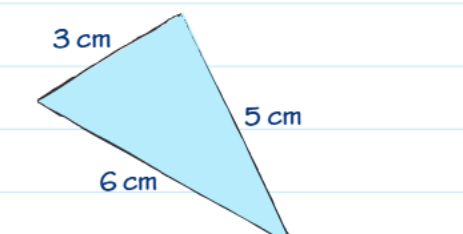
Worked Example: Triangle Perimeter
For the triangle shown above: Perimeter = 3 cm + 5 cm + 6 cm = 14 cm
Sometimes you may need to measure a shape yourself to find the missing lengths before you can calculate the perimeter.
Working with parallelograms
When calculating the perimeter of parallelograms, remember that opposite sides are equal. This means you can work out missing lengths using the sides you already know.
Example
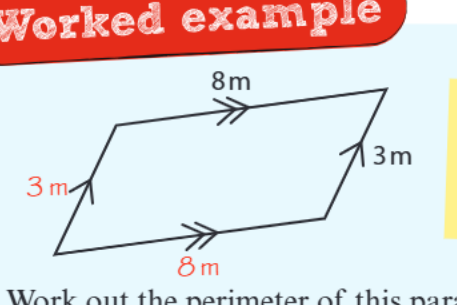
Worked Example: Parallelogram Perimeter
For this parallelogram:
- The opposite sides are equal (8 m and 8 m, 3 m and 3 m)
- Perimeter = 8 + 3 + 8 + 3 = 22 m
What is area
Area measures the amount of space inside a shape. Area is always measured in square units such as cm² (square centimetres).
Calculating area using squared paper
When a shape is drawn on squared paper, you can find its area by counting the squares inside it.
Each small square represents 1 cm² (one square centimetre). You count how many of these squares fit inside your shape.
Example
Simple Area Calculation
If a shape covers 9 complete squares on squared paper, its area is 9 cm².
Estimating area
For irregular shapes or shapes that don't fit neatly into whole squares, you need to estimate the area by counting both whole squares and part squares.
The estimation method
Note
Area Estimation Process:
- Count 1 cm² for every whole square that fits completely inside the shape
- Count ½ cm² for every part square (squares that are partially covered)
- Add the totals together
Example
Worked Example: Estimating Irregular Shape Area
Looking at an irregular shape on squared paper:
- Whole squares: 10
- Part squares: 6
- Estimated area = (10 × 1) + (6 × ½) = 10 + 3 = 13 cm²
This estimation method gives you a reasonable approximation of the actual area.
Important
Exam Tips:
- Always include units in your final answer (cm, m, cm², m²)
- For perimeter questions, make sure you've added all the sides
- When estimating area, be systematic in counting squares to avoid missing any
- Remember that area uses square units (cm²) while perimeter uses linear units (cm)
Summary
Key Points to Remember:
- Perimeter is the distance around the edge of a shape - add all the side lengths
- Area is the space inside a shape - count squares on squared paper
- Opposite sides of parallelograms are always equal
- When estimating area: whole squares = 1 cm², part squares = ½ cm²
- Always include the correct units in your answer