Reflections (AQA GCSE Maths): Revision Notes
📚Revision Notes
Reflections
What is a reflexion?
A reflection is a transformation where a shape is flipped over a mirror line. When you reflect a shape, you create an image that appears as if the original shape is looking into a mirror.
To describe a reflexion properly, you must give the equation of the mirror line. This line acts as the axis where the reflexion occurs.
Note
The mirror line is the most crucial element when describing any reflexion transformation. Without specifying this line, the reflexion cannot be properly defined or reproduced.
Key properties of reflections
Reflected shapes are congruent. This means the original shape and its reflexion are exactly the same size and shape - only their position has changed.
The mirror line is also called a line of symmetry because it divides the original shape and its reflexion equally.
Important
Congruence is Key: Remember that reflections preserve all measurements - lengths, angles, and areas remain unchanged. Only the position and orientation change.
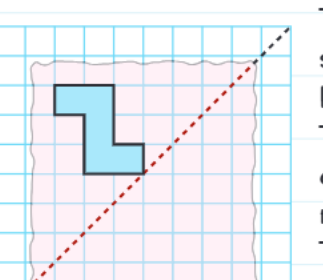
How to reflect a shape
Example
Step-by-Step Reflexion Method:
- Identify the mirror line - this could be a vertical line, horizontal line, or diagonal line
- Find key points on the original shape
- Measure the distance from each point to the mirror line
- Mark the reflected point the same distance away on the opposite side of the mirror line
- Connect the reflected points to complete the reflected shape
Reflecting in coordinate axes
When working with coordinate grids, common mirror lines include:
- x-axis: The horizontal line where
- y-axis: The vertical line where
- Other lines: Such as , , or
For example, if you reflect shape A to create shape B using the line , you would write: "The transformation A → B is a reflexion in the line ."
Note
When working with coordinate reflections, always double-check that corresponding points are equidistant from the mirror line. This is your key verification method.
Quick reflections using tracing paper
Example
Practical Tracing Paper Method:
- Trace the original shape including the mirror line on tracing paper
- Turn the diagram so the mirror line becomes vertical
- Flip the tracing paper over and line up the mirror lines
- Trace the shape in its new position
- Turn back to the original orientation to see your reflexion
This practical method helps you check your work and is particularly useful for complex shapes or unusual mirror lines.
Exam tips
Important
Essential Exam Requirements:
When describing reflections in exams, you must write the word "reflexion" and specify the mirror line. If the mirror line is one of the coordinate axes, it's safer to write this out fully rather than give its equation.
For example, write "reflexion in the y-axis" rather than "reflexion in the line ."
Common exam questions
You may be asked to:
- Reflect a shape in a given mirror line
- Identify the mirror line used for a reflexion
- Describe the single transformation that maps one shape onto another
- Label reflected shapes with appropriate letters
Each of these question types requires you to demonstrate your understanding of both the geometric concept and the proper mathematical language for describing reflections.
Remember!
Summary
Key Points to Remember:
- Reflections create congruent shapes - same size and shape, different position
- Always state the mirror line when describing a reflexion
- The mirror line is equidistant from corresponding points on the original and reflected shapes
- Use tracing paper to check your reflections quickly
- In exams, write "reflexion in the y-axis" rather than using equations for coordinate axes