Solving area problems (AQA GCSE Maths): Revision Notes
📚Revision Notes
Solving area problems
Understanding composite shapes
Composite shapes are complex shapes made up of simpler shapes like rectangles, triangles, and circles. When you need to find the area or perimeter of these shapes, you can break them down into smaller, easier-to-calculate parts.
Note
The key approach is to split the shape into recognisable parts by drawing extra lines on your diagram. You can then either add areas together or subtract areas from each other, depending on the shape's structure.
Methods for calculating area
There are three main approaches you can use when working with composite shapes, each suited to different types of problems.
Important
Three Main Methods for Composite Shapes:
- Addition method - for shapes made of separate parts
- Subtraction method - for shapes with cutouts or holes
- Combination method - mixing both approaches as needed

Addition method
This method works when you can divide a shape into separate parts and add their areas together.
- Draw dotted lines to separate the composite shape
- Calculate the area of each simple shape
- Add all the areas together
- Formula: (or other combinations)
Subtraction method
This method works when you have a shape with parts cut out or removed from it.
- Identify the larger shape and any cutouts or holes
- Calculate the area of the large shape
- Calculate the area of the parts to be removed
- Subtract the smaller areas from the larger area
- Formula:
Worked example analysis
Example
Worked Example: Garden Bed Area and Fencing
A garden bed needs grass seed coverage. Each packet covers 10 m², and Adrian also wants to build a fence around the edge.
Step 1: Find missing lengths Before calculating anything, you must find any missing dimensions. Use the given measurements to work out unknown lengths:
- Missing horizontal length: 8.5 m - 4.5 m = 4 m
- Missing vertical length: 6 m - 3 m = 3 m
Step 2: Calculate the area
Split the L-shaped garden bed into two rectangles:
- Rectangle 1:
- Rectangle 2:
- Total area:
Step 3: Answer the question Adrian needs packets, so he must buy 4 packets of grass seed.
Step 4: Calculate perimeter (if asked) Add up all the outer edges:
Exam techniques and tips
Understanding how to approach these problems systematically will help you avoid common pitfalls and maximise your marks.
Reading the question carefully
Always start by analysing what the question is actually asking for:
- Identify whether you need area or perimeter - they are different things
- Look for key words like "cover", "paint", "carpet" (area) or "fence", "border", "frame" (perimeter)
- Write missing lengths on your diagram before starting calculations
Common mistakes to avoid
Important
Critical Exam Mistakes to Avoid:
- Don't measure diagrams with a ruler - they are not drawn to scale
- Always check you've answered the actual question being asked
- Make sure you find missing lengths first before attempting area calculations
- Show your working clearly for full marks
Exam preparation
Note
Many students struggle with these problems in exams, so practice is essential. Focus on identifying the method needed and finding missing dimensions systematically. The key is developing a consistent approach that you can apply under exam pressure.
Practice problems
Here's a typical exam-style question to test your understanding:
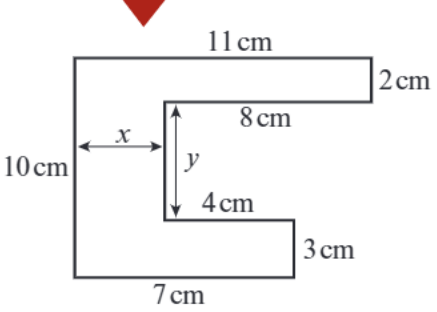
The diagram shows a composite shape made of rectangles. You need to:
(a) Work out the distance marked x on the diagram (1 mark)
(b) Work out the distance marked y on the diagram (1 mark)
(c) Work out the area of this shape (3 marks)
(d) Work out the perimeter of this shape (2 marks)
Approach:
- Use the given dimensions to calculate missing lengths x and y
- Split the shape into rectangles using dotted lines
- Calculate each rectangle's area and add them together
- Add up all the outer edges for the perimeter
Summary
Key Points to Remember:
- Split composite shapes into simpler rectangles, triangles, or circles
- Choose addition or subtraction method based on the shape's structure
- Always find missing lengths first before calculating areas
- Read questions carefully to identify whether you need area or perimeter
- Show clear working and check your final answer makes sense