Surface area (AQA GCSE Maths): Revision Notes
📚Revision Notes
Surface area
Surface area calculations are essential for finding how much material is needed to cover 3D shapes. Different shapes have different formulas, and it's crucial to understand when and how to apply each one.
Cone surface area
A cone has two types of surface area that you need to understand.
Curved surface area of a cone
The curved surface area only includes the slanted side of the cone, not the circular base. The formula is:
Where:
- = radius of the base
- = slant height (not the vertical height!)
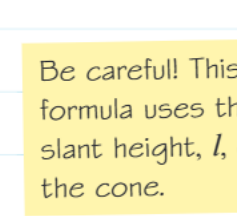
Important
This warning is critical - the formula uses the slant height, which is the distance from the apex (top) of the cone down the slanted side to the edge of the base.
Total surface area of a cone
To find the complete surface area, you must add the area of the circular base:
This combines the base area () with the curved surface area ().
Finding the slant height
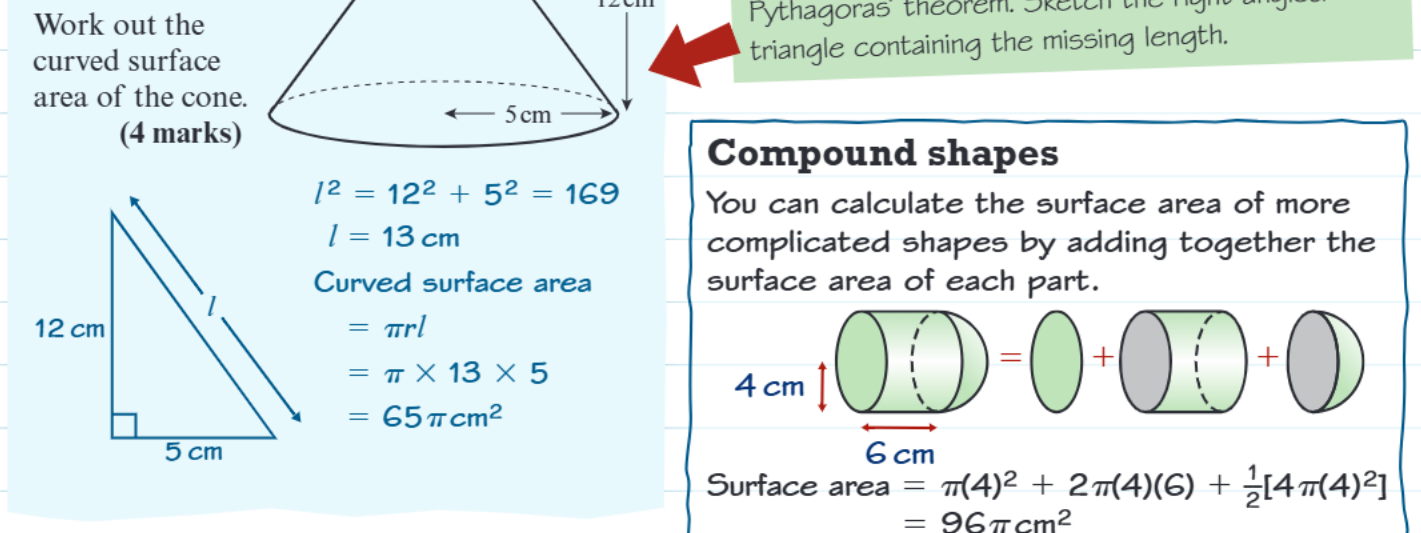
When you're given the vertical height and radius, you can find the slant height using Pythagoras' theorem.
Note
The cone, its vertical height, and radius form a right-angled triangle. This creates a perfect opportunity to use Pythagoras' theorem to find the missing slant height.
Using Pythagoras:
Where:
- = slant height
- = vertical height
- = radius
Sphere surface area
The surface area of a sphere uses this formula:
Note
This formula will be provided in exam questions when needed, so focus on understanding how to apply it rather than memorising it.
Hemisphere surface area
A hemisphere is exactly half a sphere. The curved surface area is:
Important
Remember that if you need the total surface area of a hemisphere, you must also add the area of the flat circular base ().
Compound shapes
Complex 3D shapes can often be broken down into simpler parts. The key strategy is:
Note
Strategy for Compound Shapes:
- Identify each component shape
- Calculate the surface area of each part separately
- Add all the surface areas together
- Subtract any areas where shapes join together (these are hidden)
For compound shapes made from cylinders and hemispheres, break them into individual components and calculate each surface area before combining the results.
Exam tips
Note
Essential Exam Tips:
- Always check whether you need curved surface area or total surface area
- When finding slant height, sketch the right-angled triangle to visualise the problem
- For compound shapes, draw or list each component separately
- Double-check which measurements you're given (vertical height vs slant height)
- Use the formulas that will be provided in the exam - don't try to memorise them all
Practice problems
When tackling surface area problems, applying the systematic approach will lead to accurate and complete solutions.
Example
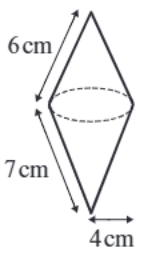
Worked Example: Multiple Cone Objects
For objects made from multiple cones:
- Calculate each cone separately using the appropriate formula
- Add the results together
- Check if any surfaces are hidden where cones connect
Example
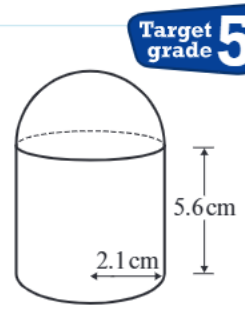
Worked Example: Cylinders with Other Shapes
For cylinders combined with other shapes:
- Remember that cylindrical surface area involves both the curved surface and the circular ends
- Identify which circular ends are visible (not hidden by connections)
- Calculate each component separately before combining
Summary
Key Points to Remember:
- Slant height is different from vertical height - use Pythagoras to find it when needed
- Hemisphere curved surface area is exactly half that of a full sphere
- Compound shapes require you to break them into simpler parts and add surface areas
- Total surface area includes all faces, while curved surface area excludes flat bases
- Always check what type of surface area the question is asking for