Symmetry (AQA GCSE Maths): Revision Notes
📚Revision Notes
Symmetry
Symmetry is a fundamental concept in geometry where shapes have special properties related to reflexion and rotation. Understanding symmetry helps you recognise patterns and solve geometric problems effectively.
Lines of symmetry
Important
Key Definition: A line of symmetry acts as a mirror line that divides a shape into two identical halves. When you imagine folding the shape along this line, both parts would match up perfectly.
The key principle is that one half of the shape forms a mirror image of the other half. This means if you place a mirror along the line of symmetry, the reflexion would recreate the missing half of the shape.
Identifying lines of symmetry
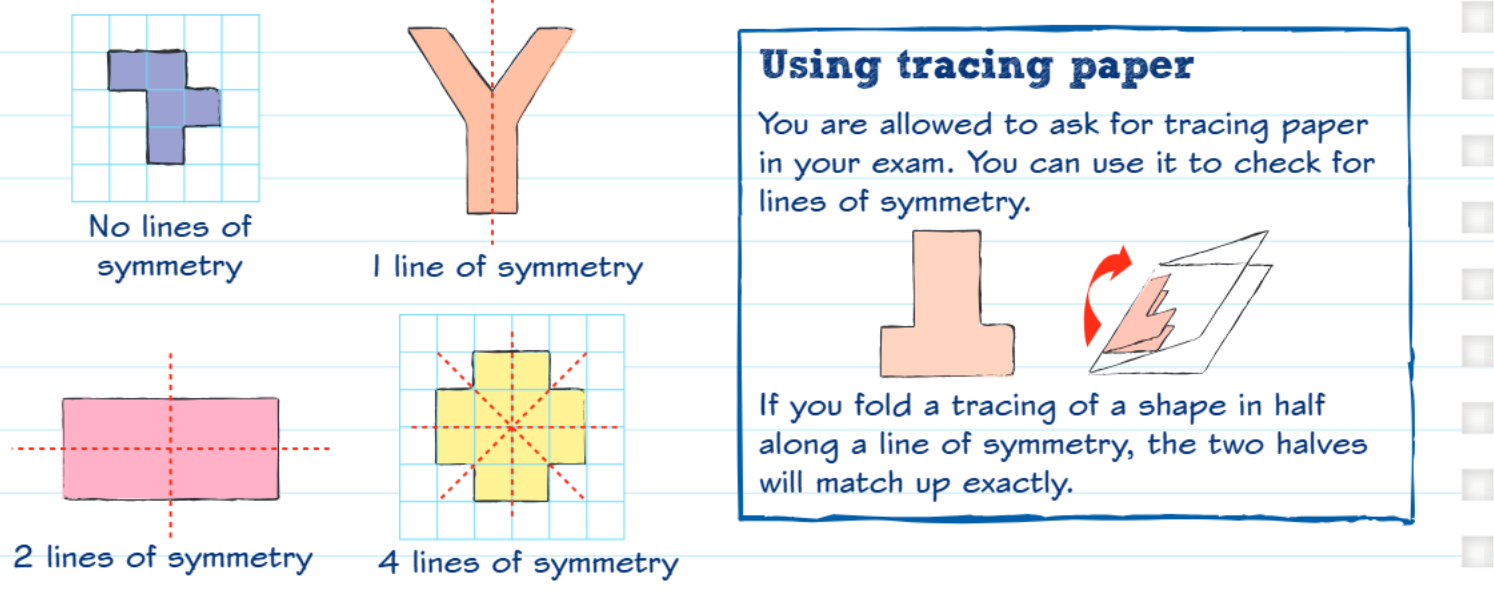
Shapes can have different numbers of lines of symmetry:
- No lines of symmetry: Some shapes cannot be divided into matching halves by any straight line
- One line of symmetry: The shape can be divided into matching halves by exactly one line
- Two lines of symmetry: Two different lines can divide the shape into matching halves
- Four lines of symmetry: Four different lines create matching halves (often seen in regular shapes)
Using tracing paper technique
Note
Tracing Paper Method for Lines of Symmetry: You can use tracing paper in your exam to check for lines of symmetry. This is an allowed technique that helps you verify your answers.
The process works by tracing the shape, then folding the tracing paper along the suspected line of symmetry. If the two halves match up exactly when folded, you have found a genuine line of symmetry.
Rotational symmetry
Important
Key Definition: Rotational symmetry occurs when a shape looks identical after being rotated by a certain angle around a central point. The shape "fits over itself" when turned.
Order of rotational symmetry
The order of rotational symmetry tells you how many times the shape looks identical during one complete 360° turn around its centre.
Example
Worked Example: Understanding Orders of Rotational Symmetry
Order 2: The shape looks the same twice during a full rotation
- At 180° and 360°
Order 3: The shape looks identical three times during a full rotation
- At 120°, 240°, and 360°
Order 4: The shape matches itself four times during a complete turn
- At 90°, 180°, 270°, and 360°
Some shapes have no rotational symmetry, meaning they only look the same in their original position.
Checking rotational symmetry with tracing paper
Note
Tracing Paper Method for Rotational Symmetry: You can trace the shape and then rotate the tracing paper to see how many times it fits perfectly over the original shape during one full turn. This gives you the order of rotational symmetry.

The example shows creating a shape with rotational symmetry of order 2, meaning it looks identical when rotated 180°.
Exam tips
- Ask for tracing paper: You're allowed to request tracing paper in your exam to help check symmetry
- Be systematic: When looking for lines of symmetry, try vertical, horizontal, and diagonal lines
- Check your work: Use the tracing paper method to verify your answers
- Count carefully: For rotational symmetry, make sure you count all positions where the shape matches itself
Summary
Key Points to Remember:
- A line of symmetry creates two identical mirror-image halves
- Rotational symmetry means a shape fits over itself when rotated
- The order of rotational symmetry is the number of identical positions in one full turn
- Tracing paper is your friend - use it to check both types of symmetry in exams
- Practice identifying symmetry in everyday objects to improve your skills