Trigonometry 2 (AQA GCSE Maths): Revision Notes
📚Revision Notes
Trigonometry 2
Finding missing sides in right-angled triangles
You can use trigonometric ratios to find the length of any missing side in a right-angled triangle when you know the length of one other side and one of the acute angles.
Using SOH CAH TOA
When working with trigonometry, you need to identify which sides of the triangle you're working with relative to the given angle:
- Opposite (opp) - the side directly across from the angle
- Adjacent (adj) - the side next to the angle (but not the hypotenuse)
- Hypotenuse (hyp) - the longest side, always opposite the right angle
Note
Remembering SOH CAH TOA
The mnemonic "Some Old Hippie Caught Another Hippie Tripping On Acid" can help you remember the trigonometric ratios! Always label the sides relative to the specific angle you're working with.
The key trigonometric ratios are remembered using SOH CAH TOA:
- Sin = Opposite / Hypotenuse:
- Cos = Adjacent / Hypotenuse:
- Tan = Opposite / Adjacent:
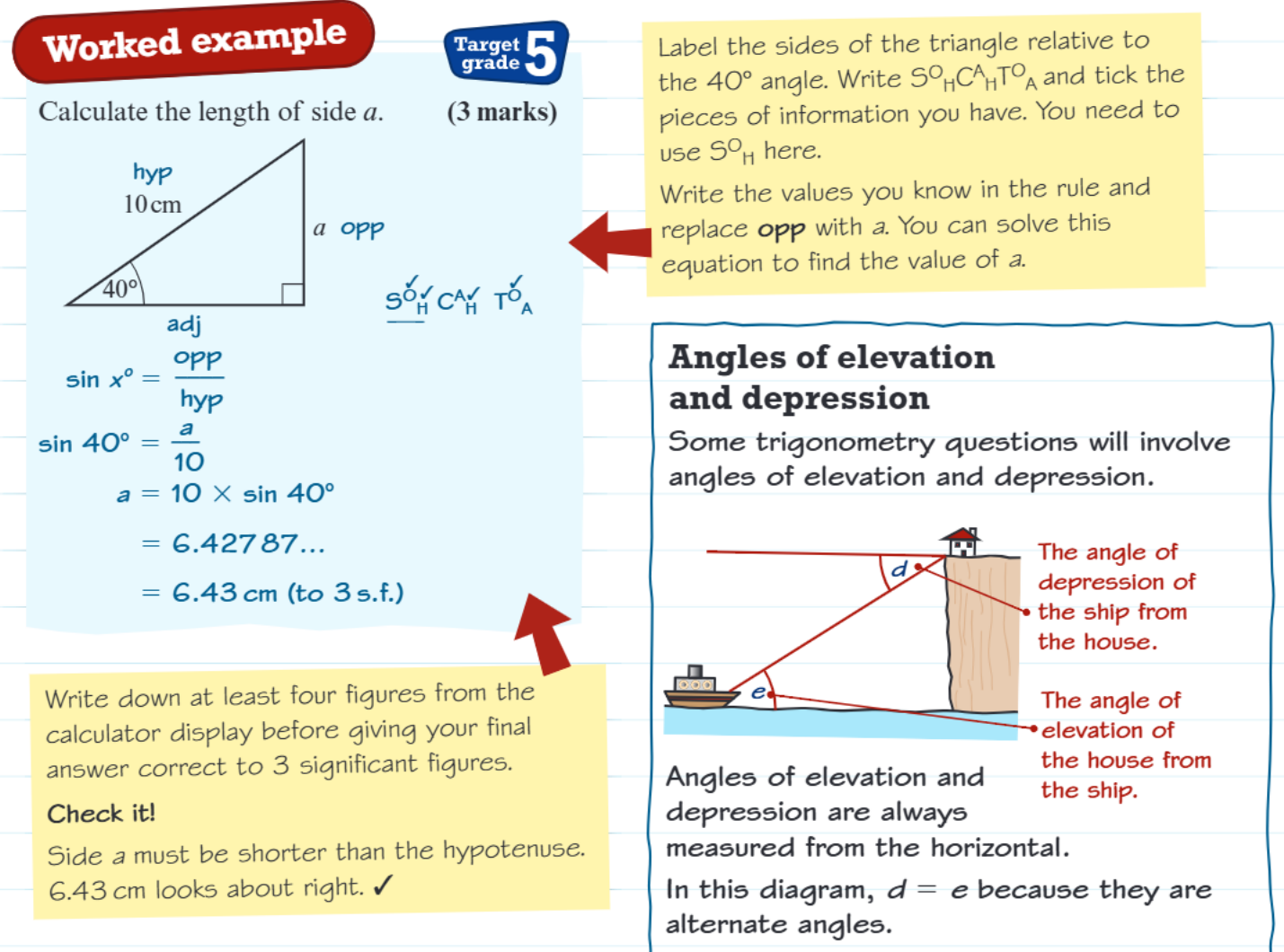
Worked example
Here's how to solve for a missing side using the sine ratio:
Example
Worked Example: Finding the Opposite Side Using Sine
Step-by-step method:
- Label the triangle sides relative to the given angle (40° in this case)
- Identify which trigonometric ratio to use - since we have the hypotenuse (10cm) and need the opposite side, we use sine
- Write the formula:
- Substitute the known values:
- Rearrange to find the unknown:
- Calculate using a calculator:
- Round to 3 significant figures:
Important
Calculator Tips for Accuracy
- Write down at least four figures from your calculator display before rounding
- Always check your answer makes sense - the opposite side must be shorter than the hypotenuse
Angles of elevation and depression
Angles of elevation and angles of depression appear in many trigonometry exam questions, especially those involving real-world scenarios.
Key definitions
- Angle of elevation - the angle measured upwards from the horizontal to an object above eye level
- Angle of depression - the angle measured downwards from the horizontal to an object below eye level
Note
Key Properties of Elevation and Depression Angles
Both angles are always measured from the horizontal line. When dealing with these angles in diagrams, you often find that angles of elevation and depression form alternate angles. This means they are equal when formed by parallel lines (like horizontal lines at different heights).
Practice problems
You'll often encounter triangles in different orientations. Here are three common types you should be able to solve:
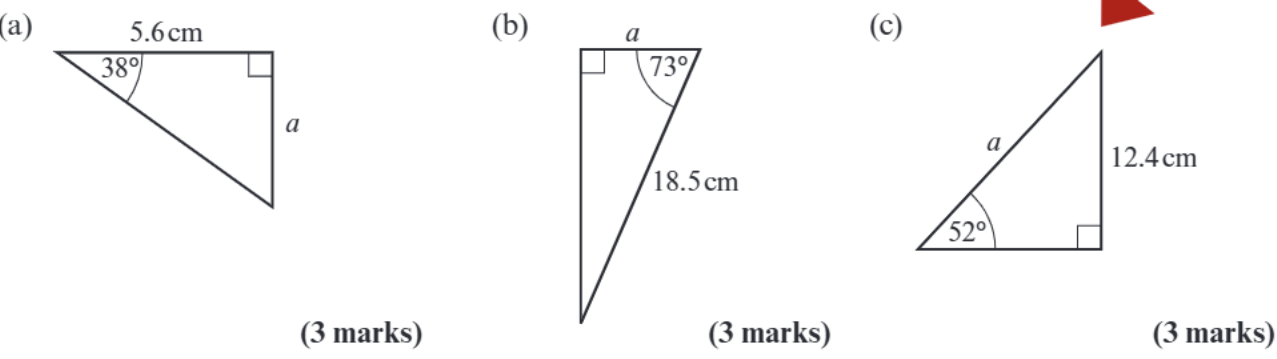
Key points for practice problems:
- Always start by labelling the sides relative to the angle you're working with
- In problem (c), note that 'a' represents the hypotenuse - be careful when setting up your equation
- Remember to substitute carefully and check your final answer is sensible
Important
Common Exam Mistakes to Avoid
- Forgetting to label triangle sides correctly relative to the given angle
- Mixing up which ratio to use - always check whether you need sin, cos, or tan
- Rounding too early in calculations - keep full calculator precision until the final step
Exam tip: Give your answers to 1 decimal place as requested, and always show your working clearly for full marks.
Summary
Key Points to Remember:
- SOH CAH TOA helps you choose the correct trigonometric ratio
- Always label triangle sides relative to the angle you're working with
- Write down several decimal places from your calculator before rounding to the required accuracy
- Check your answer - does it make logical sense given the triangle's dimensions?
- Angles of elevation and depression are always measured from the horizontal line