Vectors (AQA GCSE Maths): Revision Notes
📚Revision Notes
Vectors
What are vectors?
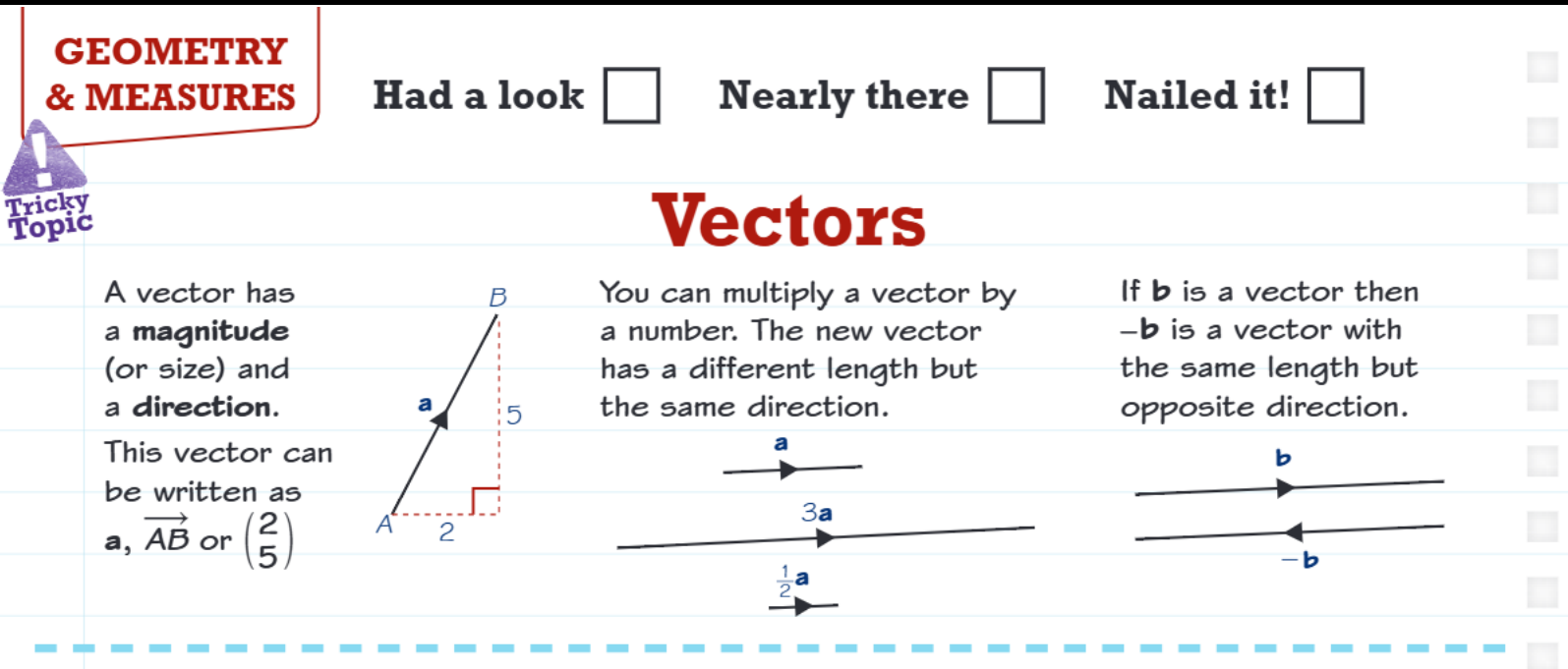
A vector is a mathematical quantity that has both magnitude (size) and direction. Think of it as an arrow pointing from one place to another - the length of the arrow shows the magnitude, and which way it points shows the direction.
Note
Vectors are different from ordinary numbers because they tell us both how much and which way. For example, if you walk 5 metres north, that's different from walking 5 metres south, even though the distance is the same.
Vector notation
Vectors can be written in several different ways:
- Using a single letter: a
- Using two points: AB (from point A to point B)
- As a column vector:
Important
In column vector form, the top number shows horizontal movement and the bottom number shows vertical movement.
Scalar multiplication
When you multiply a vector by a number (called a scalar), you change its length but keep the same direction.
Example
Worked Example: Scalar Multiplication
If vector a has length 4 units pointing east:
- 3a is three times longer (12 units) than a but points the same way (east)
- ½a is half the length (2 units) of a but still points the same way (east)
This is useful when you need to make vectors bigger or smaller whilst maintaining their direction.
Negative vectors
If b is a vector, then -b is a vector with the same magnitude but opposite direction.
Note
Think of it like turning around - you're still the same distance from your starting point, but you're facing the opposite way.
Adding vectors
You can add vectors using the triangle law. This means you trace a path along the vectors to find the new combined vector.
The steps are:
- Draw the first vector
- From the end of the first vector, draw the second vector
- The resultant vector goes from the start of the first vector to the end of the second vector
Example
Worked Example: Adding Column Vectors
For column vectors, you add the top numbers together and the bottom numbers together.
Working with vectors in geometry
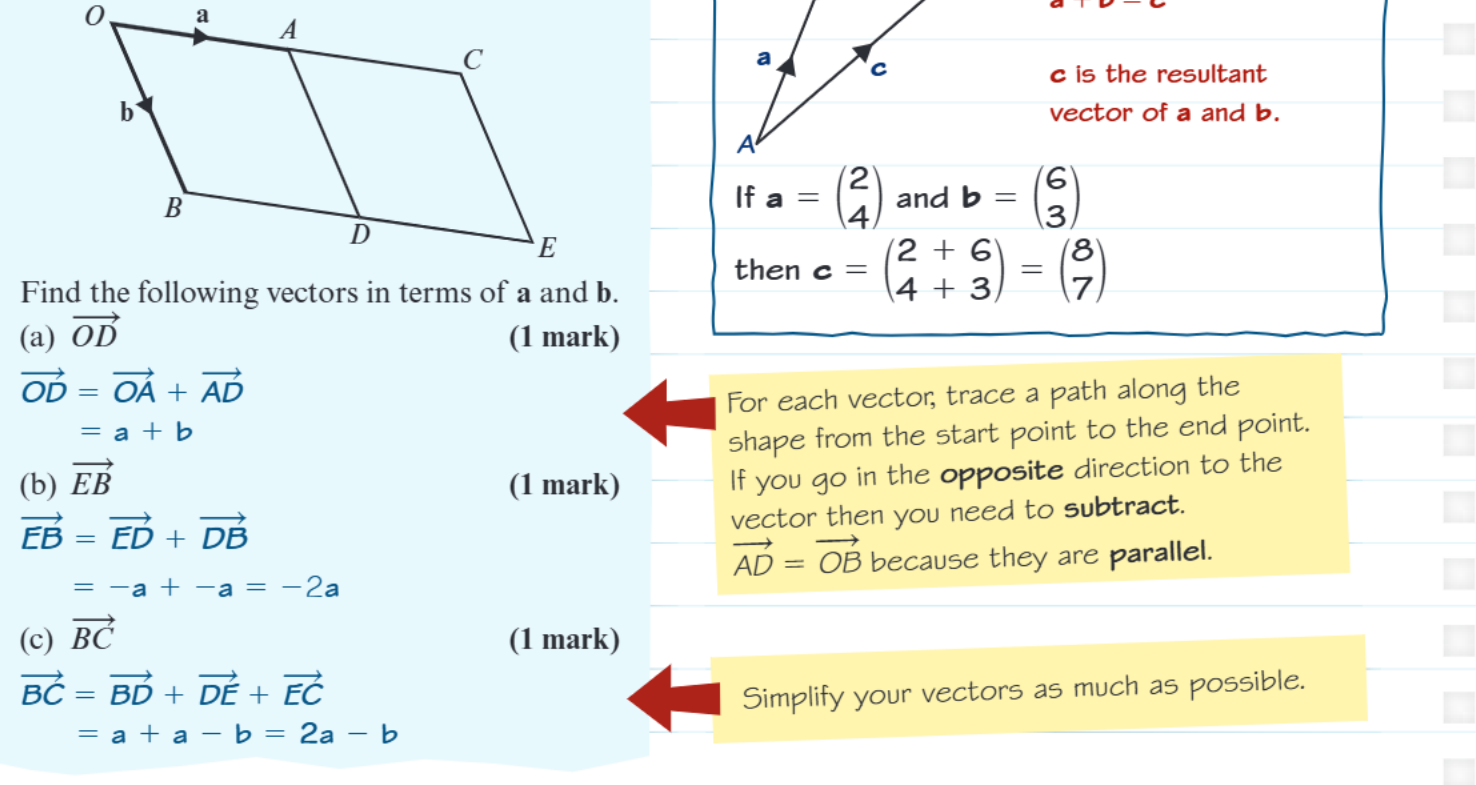
Vectors are particularly useful when working with geometric shapes like parallelograms.
In geometric problems:
- Trace the path from the start point to the end point
- If you go in the opposite direction to a vector, you subtract it
- Parallel vectors are equal (like opposite sides of a parallelogram)
- Always simplify your vector expressions as much as possible
Key techniques for geometric vector problems
Note
Essential Problem-Solving Strategies:
- When finding a vector, trace the route from start to finish
- If you need to go backwards along a vector, use the negative form
- Use the fact that opposite sides of parallelograms are parallel and equal
- Break complex paths into simpler vector additions and subtractions
Column vector operations
When working with column vectors:
Multiplication by a scalar:
Addition:
Important
Remember to multiply or add both parts of the column vector.
Summary
Summary
Key Points to Remember:
- Vectors have both magnitude and direction - they're like arrows showing size and way
- Scalar multiplication changes the length but keeps the same direction
- Negative vectors have the same size but point the opposite way
- Add vectors using the triangle law - trace the path from start to finish
- Column vectors are added by adding the top numbers and bottom numbers separately