Thermoregulation (Edexcel GCSE Biology Combined Science): Revision Notes
📚Revision Notes
Thermoregulation
Note
Thermoregulation is the process by which the body maintains a stable internal temperature, typically around 37°C. This is crucial because many of the body's enzymes work best at this temperature. If the body becomes too hot or too cold, it can negatively impact enzyme activity, and consequently, important bodily functions like respiration. Thermoregulation is controlled by the thermoregulatory centre in the hypothalamus of the brain, which monitors the temperature of the blood and receives signals from temperature receptors in the skin. The hypothalamus sends signals to effectors like muscles or glands to initiate responses that maintain the optimal temperature. These responses include shivering, vasoconstriction, and vasodilation.
Shivering:
What it is: Shivering is the involuntary contraction of skeletal muscles that occurs when the body is cold.
How it works:
- When the body temperature drops below normal, the hypothalamus detects the change and sends signals to muscles to contract rapidly.
- This muscle activity requires energy, and as muscles contract and relax, some of the energy from respiration is released as heat.
- The heat generated from shivering helps raise the body's temperature back to normal. Purpose: Shivering is the body's way of generating extra heat to warm itself up when the external environment is cold. It's particularly important in preventing hypothermia.
Vasoconstriction:
What it is: Vasoconstriction is the narrowing of blood vessels near the surface of the skin, reducing blood flow to the skin.
How it works:
- When the body is exposed to cold temperatures, the hypothalamus signals the blood vessels in the skin to constrict.
- This reduces the amount of warm blood reaching the skin's surface, limiting heat loss through radiation.
- By keeping more warm blood in the core of the body, vital organs are better protected from the cold. Purpose: Vasoconstriction conserves heat by reducing heat loss from the skin when the body is cold.
Vasodilation:
What it is: Vasodilation is the widening of blood vessels near the surface of the skin, increasing blood flow to the skin.
How it works:
-
When the body temperature rises above normal, the hypothalamus triggers vasodilation.
-
This increases blood flow to the skin's surface, allowing more heat to be lost to the environment through radiation.
-
Sweating may also occur, and the heat from the body is used to evaporate the sweat, further cooling the skin. Purpose: Vasodilation helps the body cool down by increasing heat loss when the body is too hot, preventing overheating.
-
Process your body uses to keep its internal temperature steady
-
Maintains your core temperature at 37 degrees
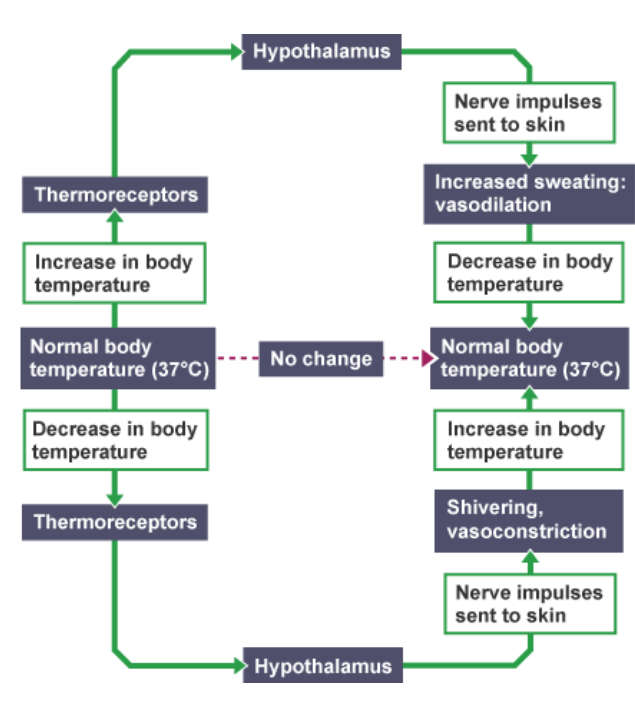
Controlled by the Hypothalamus
Thermoregulatory centre in the hypothalamus Contains receptors that are sensitive to blood temp Receives impulses from receptors in the skin (nerve endings in epidermis & dermis) that provide info about external temperature.
Negative Feedback Mechanism:
Thermoregulation is an example of a negative feedback mechanism. This means that when the body deviates from its normal temperature, mechanisms are activated to bring the temperature back to its optimal range. Once the temperature is restored to normal, the thermoregulatory centre stops sending signals to effectors, preventing excessive correction.
| Under 37C enzymes slow down | Over 37C enzymes denature |
|---|
| When your hot… | When your cold… |
|---|---|
| Pilorelaxation Erector muscles relax so thinner layer of air so heat is lost | Piloerection Erector muscles contract so traps air which acts as an insulator |
| Sweat (water & salts) Produced in the sweat glands in the dermis released through pores in the epidermis, transfers energy from skin so cools you | Shiver Muscles contract automatically which increases respiration so transfers energy to warm the blood |
| Vasodilation Blood vessels in dermis swell or dilate. (INCREASES BLOOD FLOW TO SKIN SURFACE• heat can be lost to the air so keeps you cool) Eg. This is why some people's skin looks redder when they feel too hot. | Vasoconstriction Blood vessels supplying warm blood to the skin constrict. (DECREASES BLOOD FLOW TO SKIN SURFACE• less heat lost so keeps you warmer) Eg. This is why some people's skin looks paler when they feel too cold. |
| Condition | Response | Effect |
|---|---|---|
| Too Cold | Shivering | Muscle contractions generate heat via respiration. |
| Vasoconstriction | Blood vessels narrow, reducing blood flow and heat loss at the skin. | |
| Too Hot | Vasodilation | Blood vessels widen, increasing blood flow and heat loss at the skin. |