Core Practical: Investigating antibiotics & antiseptics (Edexcel GCSE Biology Combined Science): Revision Notes
📚Revision Notes
Core Practical: Investigating antibiotics & antiseptics
Note
Testing the effectiveness of antibiotics, antiseptics, or plant extracts on microbial cultures can be carried out in the laboratory using agar plates and bacteria. This process requires careful aseptic techniques to ensure accurate and uncontaminated results.
Note
Method A: Preparing Agar Plates with a Bacterial Colony
Sterilisation of Equipment:
-
Glass Petri dishes and agar gel must be sterilised in an autoclave, or pre-sterilised plastic Petri dishes can be used.
-
Reason: Sterilisation ensures that no unwanted bacteria are present, which could contaminate the experiment. Pouring the Agar:
-
Pour the sterile agar into Petri dishes and allow it to set.
-
Reason: The agar provides a nutrient-rich environment for the bacteria to grow. Adding Bacteria to the Agar:
-
Use a sterile pipette to add a few drops of the bacterial solution to the agar. Afterward, place the pipette in disinfectant.
-
Reason: This introduces the bacteria that will form a lawn on the agar surface. Spreading the Bacteria:
-
Use a sterile spreader (either pre-sterilised or sterilised in ethanol) to spread the bacterial solution evenly across the agar surface.
-
Reason: Spreading ensures a uniform "lawn" of bacteria across the plate. Sealing and Labelling:
-
Replace the lid quickly and secure with tape, but do not fully seal the plate. Label and store the plates upside down.
-
Reason: Partially sealing prevents contamination but allows oxygen in, preventing the growth of harmful anaerobic bacteria. Storing upside down stops condensation from contaminating the bacterial culture. Incubation:
-
Incubate the plates at a maximum temperature of 25°C in schools.
-
Reason: This prevents the growth of harmful pathogens. In medical settings, plates may be incubated at 37°C (body temperature) for faster bacterial growth.
Note
Method B: Testing Antibiotics, Antiseptics, or Plant Extracts
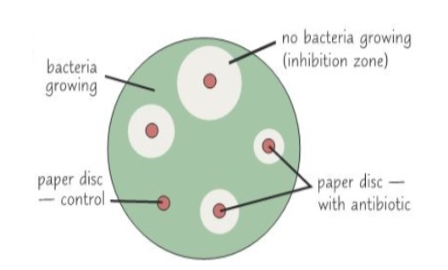
Once the agar plates have been prepared and bacteria spread across the surface, philtre paper discs soaked in different antimicrobial solutions can be used to test their effectiveness:
Soaking Philtre Paper Disks:
- Soak philtre paper discs in a variety of antibiotic, antiseptic, or plant extract solutions. Use different concentrations of the same solution or a variety of different solutions. Reason: This allows you to compare the effectiveness of different solutions or concentrations in killing or inhibiting bacterial growth.
Placing the Discs on the Agar Plate:
-
Carefully place the soaked discs onto the surface of the pre-prepared bacterial agar plate. Measuring the Zone of Inhibition:
-
After incubation, measure the zone of inhibition—the clear area around the disc where bacteria have been killed or prevented from growing.
-
Reason: A larger zone of inhibition indicates a more effective antimicrobial agent. Always include a control disc (soaked in water or another neutral solution) to ensure accurate comparisons.
:::
Aseptic Technique:
- The entire procedure must follow strict aseptic technique to avoid contamination by other microorganisms. This includes sterilising equipment, working quickly to prevent airborne bacteria from contaminating the plates, and handling the bacterial cultures carefully.
Conclusion:
By using this method, you can investigate the effectiveness of antibiotics, antiseptics, or plant extracts in inhibiting bacterial growth. The zone of inhibition around the discs provides a visual indicator of the antimicrobial properties of the tested substances. This is a valuable method in microbiology to study how different substances combat bacteria and can inform medical treatments.