Alleles (Edexcel GCSE Biology): Revision Notes
📚Revision Notes
Alleles
Note
Definition: The genes you inherit control the characteristics you develop, some characteristics are controlled by a single gene but most are controlled by several genes interacting. Alleles are different versions of the same gene. For example, the gene for eye colour has different alleles: one for blue eyes and another for brown eyes. Every individual has two alleles for each gene, one inherited from each parent.
-
All genes exist in versions called alleles (represented by letters in genetic diagrams)
-
There is always 2 versions (alleles) of every gene – one of each chromosome in your body
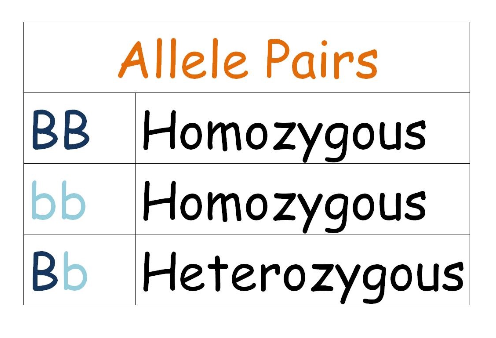
- If both alleles are the same, the individual is homozygous for that gene.
- If the two alleles are different, the individual is heterozygous.
Genotype and Phenotype
-
The genotype is the combination of alleles an individual has for a particular gene. It determines the phenotype, which is the physical expression of the trait (such as eye colour). Examples:
- Individual A: One allele for blue eyes and one allele for brown eyes (heterozygous). Since brown is dominant, this person has brown eyes.
- Individual B: Two brown eye alleles (homozygous dominant). This person has brown eyes.
- Individual C: Two blue eye alleles (homozygous recessive). This person has blue eyes.
Dominant and Recessive Alleles
- A dominant allele is always expressed, even if only one copy is present. Dominant alleles are represented by a capital letter (e.g., A for brown eyes). If a person has one or two dominant alleles, they will show the dominant trait (e.g., brown eyes).
- A recessive allele is only expressed if two copies are present, meaning there is no dominant allele. Recessive alleles are represented by a lowercase letter (e.g., a for blue eyes). For a person to have blue eyes, they must inherit two recessive alleles (aa).
- Your genotype is the combination of alleles
- Your phenotype is determined by what alleles make up for your characteristic
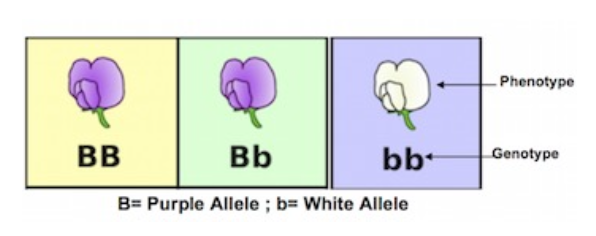
Dominant characteristic (CAPITAL):
2 dominant alleles (CC) Or one recessive and one dominant (Cc)
Recessive characteristic (LOWER CASE):
2 recessive alleles (cc)
Note
Dominant alleles overrule the recessive alleles so if an organism has one dominant and one recessive allele (Cc) then the dominant allele will determine the characteristic
Inheritance of Characteristics
Most traits are not determined by a single gene but by the interaction of multiple genes. These interactions can result in a wide variety of phenotypes beyond simple dominant and recessive patterns.