Inheritance of group bloods (Edexcel GCSE Biology): Revision Notes
📚Revision Notes
Inheritance of group bloods
Understanding codominance
Codominance is a special type of inheritance pattern where both alleles in a heterozygous individual are fully expressed in the phenotype. Unlike typical dominant-recessive relationships, neither allele masks the other. Instead, both contribute equally to the observable characteristics.

A simple example can be seen in chicken feather colours, where some chickens can have speckled feathers showing both white and black colours simultaneously. However, the most important example for humans is our ABO blood group system.
Note
The key difference between codominance and incomplete dominance is that in codominance, both traits are fully expressed simultaneously, rather than blending together to create an intermediate phenotype.
The ABO blood group system
The gene that controls human blood groups demonstrates codominance and involves multiple alleles. This means there are more than two possible versions of the gene that can exist in a population.
The three alleles
The ABO blood group system involves three different alleles:
- IA - codes for A antigens on red blood cells
- IB - codes for B antigens on red blood cells
- IO (sometimes written as i) - codes for no antigens on red blood cells
Dominance relationships
Understanding how these alleles interact is crucial:
Important
Critical Dominance Patterns:
- IA and IB are codominant - when both are present, both A and B antigens appear on the blood cells
- IA is dominant over IO - if someone has IA and IO, only A antigens will be produced
- IB is dominant over IO - if someone has IB and IO, only B antigens will be produced
Genotypes and phenotypes

The relationship between genetic makeup (genotype) and observable blood type (phenotype) follows predictable patterns:
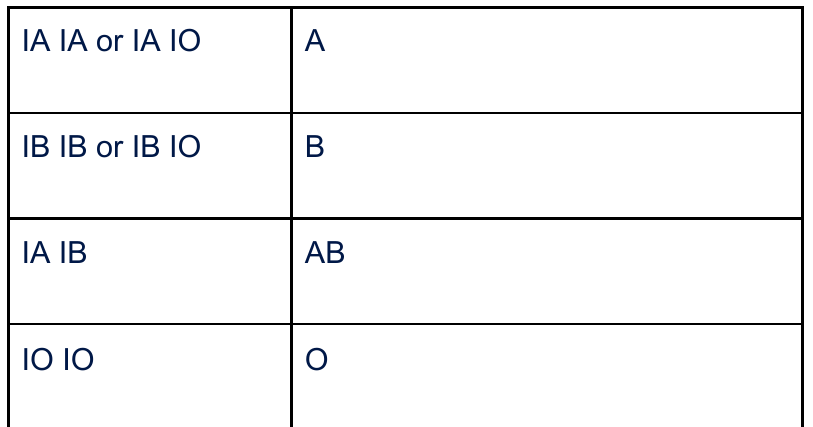
Let's break down each blood group:
Blood Group A: People with this blood type have A antigens on their red blood cells. They can have either:
- IAIA (homozygous) - received IA from both parents
- IAIO (heterozygous) - received IA from one parent and IO from the other
Blood Group B: People with this blood type have B antigens on their red blood cells. They can have either:
- IBIB (homozygous) - received IB from both parents
- IBIO (heterozygous) - received IB from one parent and IO from the other
Blood Group AB: This demonstrates codominance perfectly. People with IAIB genotype express both A and B antigens on their red blood cells because both alleles are codominant.
Blood Group O: People with this blood type have no antigens on their red blood cells. They must have the genotype IOIO because IO is recessive to both IA and IB.
Example
Worked Example: Determining Blood Type
If a person has the genotype IAIB:
Step 1: Identify the alleles present
- Allele 1: IA (codes for A antigens)
- Allele 2: IB (codes for B antigens)
Step 2: Apply dominance rules
- Since IA and IB are codominant, both are expressed
Step 3: Determine phenotype
- Both A and B antigens will be present on red blood cells
- Result: Blood type AB
Blood cell antigens
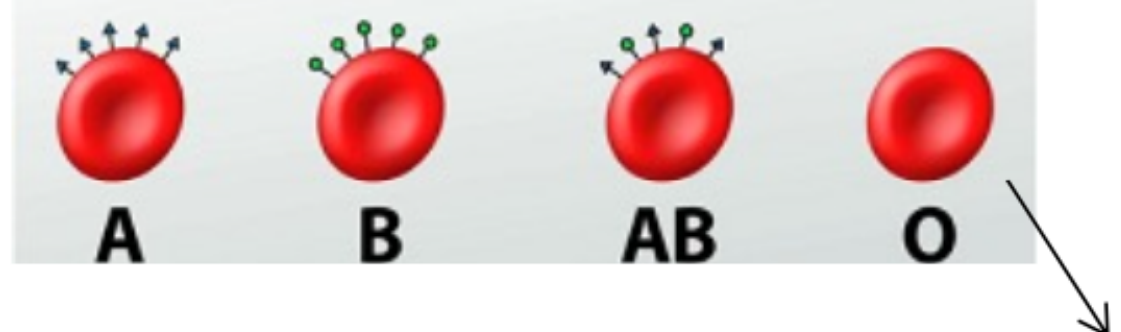
The different blood groups are determined by the presence or absence of specific proteins called antigens on the surface of red blood cells. These antigens act like identification tags that help the immune system recognise the body's own cells.
- Type A blood cells have A antigens
- Type B blood cells have B antigens
- Type AB blood cells have both A and B antigens
- Type O blood cells have no A or B antigens
Note
Think of antigens as molecular "name tags" on blood cells. The immune system learns to recognise these tags as "self" and will attack any blood cells with unfamiliar tags, which is why blood type matching is so critical for transfusions.
Transfusion compatibility
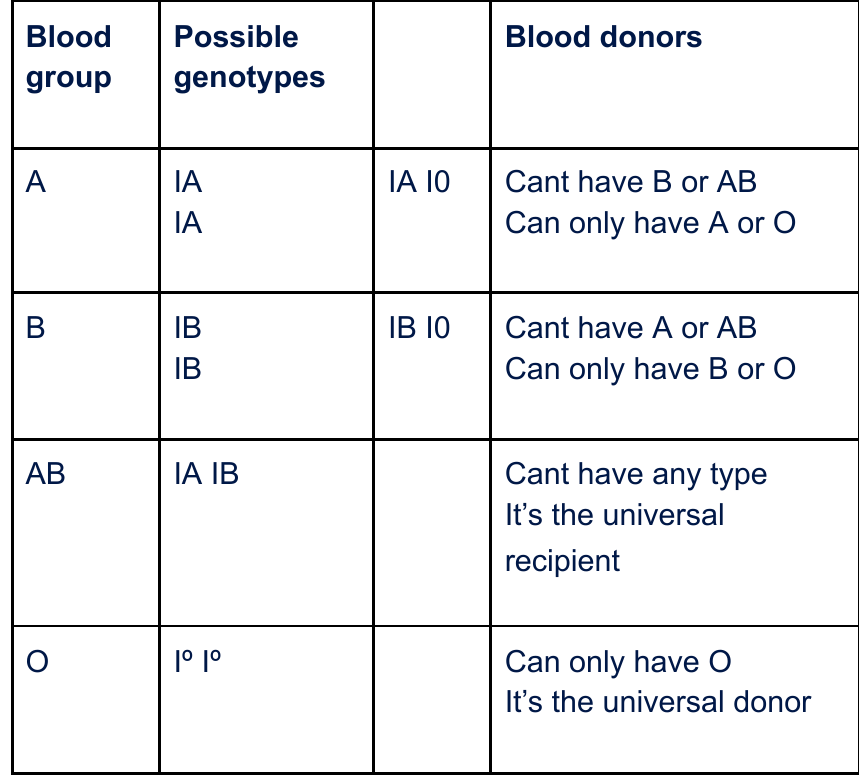
Understanding blood group inheritance is crucial for safe blood transfusions. The immune system will attack blood cells that carry unfamiliar antigens.
Universal donor and recipient
Type O (universal donor): Since type O blood has no antigens on the red blood cells, it can be given to people with any blood type without causing an immune reaction. However, people with type O blood can only receive type O blood.
Type AB (universal recipient): People with type AB blood can receive blood from any type because their immune system is already familiar with both A and B antigens. However, they can only donate to other type AB individuals.
Type A: Can donate to type A and type AB, but can only receive from type A and type O.
Type B: Can donate to type B and type AB, but can only receive from type B and type O.
Important
Transfusion Safety Rule: A person can only receive blood that doesn't contain antigens their immune system hasn't encountered before. This is why careful cross-matching is essential before any blood transfusion.
Inheritance patterns
When predicting inheritance of blood groups, remember that:
Note
Inheritance Key Points:
- Each parent contributes one allele to their offspring
- The combination of these two alleles determines the child's blood group
- Parents with type AB blood (IAIB) will always pass either IA or IB to their children
- Parents with type O blood (IOIO) will always pass IO to their children
- Parents with type A or B blood could pass either their dominant allele or IO, depending on their genotype
Example
Worked Example: Predicting Offspring Blood Types
Cross between Type A parent (IAIO) and Type B parent (IBIO):
Step 1: Identify possible gametes from each parent
- Type A parent can contribute: IA or IO
- Type B parent can contribute: IB or IO
Step 2: Determine all possible combinations
- IA + IB = IAIB (Type AB)
- IA + IO = IAIO (Type A)
- IO + IB = IBIO (Type B)
- IO + IO = IOIO (Type O)
Step 3: Calculate probabilities
- Result: 25% chance each of Type AB, Type A, Type B, and Type O
Summary
Key Points to Remember:
- Codominance means both alleles are expressed equally in the phenotype - this is perfectly demonstrated in type AB blood
- Three alleles exist for the ABO system: IA, IB, and IO, but each person only has two alleles
- IA and IB are codominant with each other but both are dominant over IO
- Type O is the universal donor because it has no antigens that could cause immune reactions
- Type AB is the universal recipient because these individuals can accept A and B antigens without immune problems