Momentum (Edexcel GCSE Physics Combined Science): Revision Notes
📚Revision Notes
Momentum
Note
Momentum: All moving objects have momentum. If an object is not moving, the momentum is zero.
Note
Formula
Where is the momentum in kilogrammes metres per second , is the mass in kilogrammes (kg), and () is the velocity in metres per second .
Conservation of Momentum
- In a closed system, the total momentum before an event is equal to the total momentum after an event.
Example
Example: The backwards momentum of a cannon is equal to the forwards momentum of the cannonball.
- Momentum is always conserved in a collision or explosion (where there are no external forces like friction, air resistance, electrostatic attraction, etc.).
- In collisions:
Example
Example: Two marbles colliding; each will have momentum before and after the collision.
Note
Remember, momentum is a vector.
Changes in Momentum (Physics Only)
Newton's Second Law
Note
Force is equal to the rate of change of momentum.
Where is the force, is the final momentum, is the initial momentum, and is the time.
Conservation of Momentum
Note
In a closed system, the total momentum before an event is equal to the total momentum after the event. This principle is known as the conservation of momentum.
Example
Example:
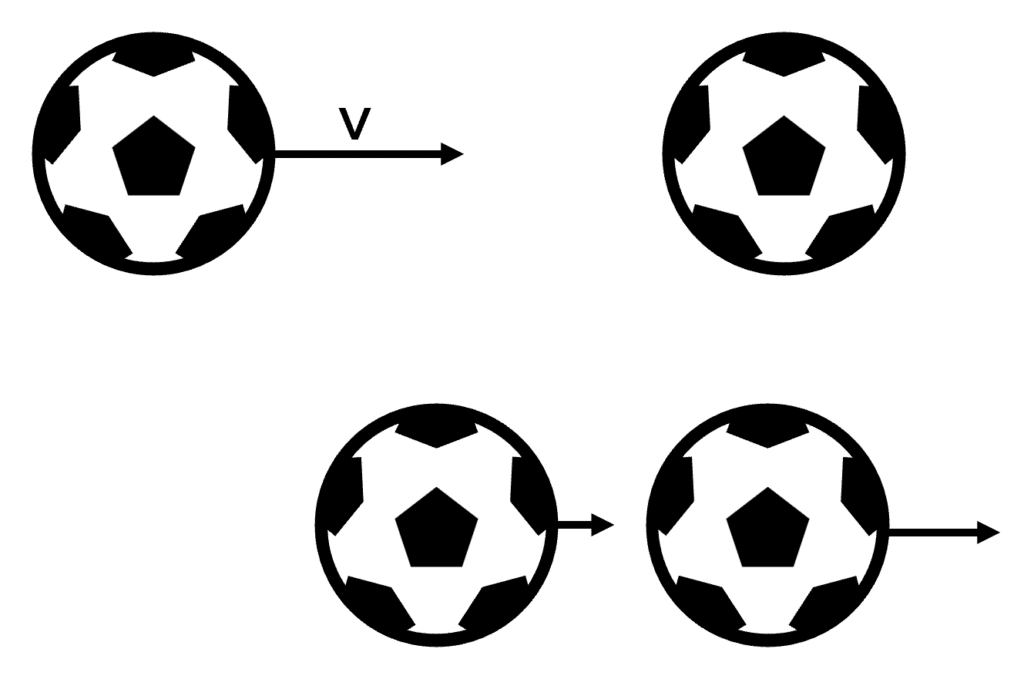
Consider two footballs with the same mass, . One football is stationary, while the other is moving at a velocity of .
The momentum before they collide is just the sum of the momentum of each ball:
total momentum before =
Total momentum before =
So the total momentum before the collision is just the momentum of the moving ball because the other ball is not moving and so has no momentum.
Note
After the collision, the total momentum remains Ball B, which was initially stationary, now has velocity and momentum, while ball A moves with a reduced velocity. The sum of these two momentums after the collision will still equal the total momentum before the collision,