Speed (Edexcel GCSE Physics): Revision Notes
📚Revision Notes
5.6.2 Speed
Note
Like distance, speed is also a scalar quantity. The speed of an object will tell us how fast it is moving, but will not tell us the direction of movement.
Note
Speed is not constant. The speed of an object is not the same at all times (i.e. it is not constant). We can understand this fact because when we run or walk, we hardly ever travel at the exact same speed all the time.
Distance
- Tells us how far an object moves (a scalar quantity).
Example
Example: 500m.
Displacement
- The distance and direction in which an object moves in a straight line from the starting point to the finishing point (vector quantity).
Example
Example: 380m east.
Speed
- Tells us the distance an object travels in a given time (a scalar quantity).
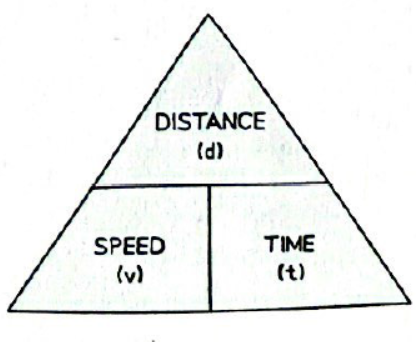
Factors Affecting Speed
- Age – as we get older, our fitness levels will decrease and we find it harder to run at the same speed as we did before.
- Terrain – a rough terrain will have more friction, reducing speed. Similarly, if the incline is higher, it takes more energy to run at the same pace.
- Distance travelled – as distances increase, our muscles get tired and lactic acid builds up due to anaerobic respiration. This leads to muscle cramps, and we find it harder to run as fast.
- Fitness – the more fit you are, the better you are able to cope with intense exercise. This is especially true for running.
Example
Examples of Different Speeds
- Normal walking speed: 1.5 m/s
- Running speed: 3 m/s
- Cycling speed: 6 m/s
- Car on a main road: 13 m/s
- Fast train: 50 m/s
- Cruising aeroplane: 250 m/s
- Speed of sound in air: 330 m/s