Situational Analysis (HSC SSCE Business Studies): Revision Notes
📚Revision Notes
Situational Analysis
Situational analysis is a critical first step in developing an effective marketing plan. It involves gaining a precise understanding of where a business currently stands in the market and determining its future direction. This analysis relies on thorough market research and employs two main analytical tools: SWOT analysis and the product life cycle. Together, these tools help businesses make informed strategic decisions about their marketing approach.
Note
Without a proper situational analysis, businesses risk making decisions that don't align with market realities or their own capabilities. This foundational step ensures that all subsequent marketing strategies are grounded in real data and insights.
What is situational analysis?
A situational analysis examines both the internal capabilities of a business and the external market conditions it faces. This comprehensive review allows management to identify the company's competitive position and make strategic adjustments to their marketing plan. Without this understanding, businesses risk making decisions that don't align with market realities or their own capabilities.
Note
The Power of Combined Insights
The analysis combines quantitative data (such as sales figures and market share) with qualitative insights (such as brand perception and customer loyalty) to create a complete picture of the business environment. This dual approach ensures both the "what" and the "why" behind business performance are understood.
SWOT analysis
SWOT analysis is a strategic planning tool that examines four key areas: strengths, weaknesses, opportunities and threats. This framework helps businesses understand both their internal capabilities and the external market forces affecting them.
Understanding internal and external factors
The SWOT framework divides factors into two categories:
Internal factors are elements within the business's control. These include the company's resources, capabilities, processes and performance. Because these factors are unique to each organisation, they determine the business's strengths and weaknesses. For example, a skilled workforce is an internal strength, while outdated technology represents an internal weakness.
External factors exist in the broader business environment and are largely outside the company's direct control. These include economic conditions, competitor actions, technological changes and regulatory developments. By monitoring these external forces, businesses can identify opportunities to exploit and threats to avoid.
Important
Key Distinction: Control vs. Influence
- Internal factors (strengths and weaknesses) can be directly controlled and changed by management decisions
- External factors (opportunities and threats) must be monitored and responded to, but cannot be directly controlled
Understanding this distinction is essential for developing realistic and effective marketing strategies.
The four components of SWOT
Strengths
Strengths are the positive internal attributes that give a business competitive advantage. When conducting a SWOT analysis, managers should consider questions such as:
- What does the business do particularly well?
- Is the product popular with customers?
- Do customers demonstrate loyalty to the brand?
- Does the business have skilled and motivated employees?
- Is the business operating efficiently?
- Does the company maintain a strong financial position?
- Is equipment modern and up-to-date?
For example, a business might identify strengths such as strong brand recognition, excellent customer service, efficient operations or superior product quality.
Weaknesses
Weaknesses are internal limitations that hinder business performance. Key questions include:
- Does the business have competent managers and employees?
- Are computer systems outdated or obsolete?
- Has the business experienced recent failures?
- Have facilities been upgraded to match competitor standards?
Note
Common weaknesses might include high staff turnover, limited financial resources, outdated technology or poor location. Identifying these honestly is crucial—the goal is not to assign blame but to understand areas for improvement.
Opportunities
Opportunities are favourable external conditions that a business could leverage for growth. Managers should ask:
- What benefits might new technology bring?
- Is the economy performing strongly?
- Are interest rates favourable?
- Are there potential new markets to enter?
- Could the business grow through acquisitions or mergers?
Examples of opportunities include emerging markets, changing consumer preferences that favour the business's products, or new distribution channels becoming available.
Threats
Threats are external challenges that could harm business performance. Important considerations include:
- What market trends have emerged recently?
- Are there new regulations affecting operations?
- Have new competitors entered the market?
- Are existing competitors gaining market share?
Important
Threats might include intense competition, economic downturns, changing regulations or technological disruption making products obsolete. Early identification of threats allows businesses to develop defensive strategies before significant damage occurs.
Applying SWOT analysis
Once completed, a SWOT analysis provides the information needed to assess the business's competitive position. The marketing plan should be adjusted based on these insights—capitalising on strengths, addressing weaknesses, pursuing opportunities and defending against threats.
Case study: Kellogg's SWOT analysis
Example
Worked Example: Kellogg's SWOT Analysis
Kellogg's, the global food manufacturing company, demonstrates how SWOT analysis works in practice:
Key Strengths:
- Wide range of high-quality products
- Market leadership in the cereal industry
- Iconic brands like Corn Flakes and Coco Pops
- Strong global presence across 180 countries
- Significant annual sales of $13.578 billion (2019)
- Substantial investment in marketing (over $1 billion annually)
Notable Weaknesses:
- Questionable marketing practices targeting children with high-sugar products
- High sugar content in many product lines
Opportunities for Growth:
- Expanding into new overseas markets
- Diversifying the product range
- Capitalising on busy modern lifestyles that increase demand for convenience foods
- Partnering with restaurant and hotel chains
Significant Threats:
- Intense competition from substitute products
- Government regulations on high-sugar products and marketing practices
- Changing consumer preferences toward healthier options
- Potential economic downturns affecting consumer spending
This analysis shows how even a market leader like Kellogg's must continuously monitor both internal capabilities and external market forces to maintain competitive advantage.
Product life cycle
The product life cycle describes the stages that products pass through from launch to withdrawal: introduction, growth, maturity and decline. Understanding which stage a product occupies is essential because different marketing strategies are required at each phase.
Important
Why Life Cycle Position Matters
Understanding which stage a product occupies is essential because different marketing strategies are required at each phase. Using the wrong strategy for a product's life cycle stage can waste resources and miss opportunities. For example, aggressive growth strategies won't work on a declining product, and mature products need different approaches than newly introduced ones.
The four stages explained
Introduction stage
The introduction stage begins when a product first enters the market. During this phase, the business focuses on building consumer awareness and establishing market share for the new product. Sales typically start slowly as customers become familiar with the offering.
Product strategy: The business works to establish brand identity and product reliability. Quality and dependability are emphasised to build customer confidence.
Pricing strategy: Prices are often set lower than competitors to gain initial market entry, though some innovative products use premium pricing strategies. Costs are typically high relative to sales during this stage.
Promotion strategy: Marketing communications target early adopters and aim to educate potential customers about the new product's benefits and features.
Distribution strategy: Distribution is usually selective, allowing consumers to gradually develop product acceptance. Products may only be available through limited channels initially.
Growth stage
During the growth stage, the product gains market acceptance and sales increase rapidly. Brand recognition strengthens and market share expands.
Product strategy: Quality is maintained and improved. Support services may be added to enhance customer satisfaction and differentiate from emerging competitors.
Pricing strategy: Prices generally remain stable as the business benefits from increased consumer demand and economies of scale in production. The focus shifts to maintaining market share rather than simply gaining entry.
Promotion strategy: Marketing reaches a broader audience beyond early adopters. The goal is to build widespread brand awareness and preference.
Distribution strategy: Distribution channels expand significantly as the product becomes more popular and retailers seek to stock it.
Note
The growth stage is often the most profitable period in a product's life cycle. Sales are increasing while production costs decrease due to economies of scale and learning curve effects. However, competition also begins to intensify during this stage.
Maturity stage
In the maturity (or saturation) stage, sales growth slows and eventually plateaus as the market becomes saturated. Competition intensifies as multiple businesses compete for market share.
Product strategy: Features and packaging are refined to differentiate from competitors. The business may introduce product variations or improvements to maintain interest.
Pricing strategy: Prices may need to be reduced to defend market share against competitors and maintain sales volume.
Promotion strategy: Marketing emphasises the product's reliability and established reputation, positioning it as a trusted, proven choice.
Distribution strategy: Incentives may be offered to distribution partners to encourage them to prioritise the product over competing offerings.
Important
The Maturity Challenge
The maturity stage presents a critical decision point. Businesses must decide whether to:
- Invest in product improvements to extend the maturity stage
- Accept declining profits and prepare for eventual withdrawal
- Seek new markets or applications for the product
- Use the product's cash flow to fund development of new products
The right choice depends on the competitive landscape and the business's overall strategy.
Decline stage
The decline stage occurs when sales begin to fall consistently. This happens for various reasons including technological obsolescence, changing consumer preferences or superior competitor products.
Product strategy: The business must decide whether to maintain the product with minor improvements, attempt rejuvenation, or discontinue it. Alternatively, the product might be sold to another company.
Pricing strategy: Prices are typically reduced to clear remaining inventory.
Promotion strategy: Promotional activities are usually discontinued or minimised to reduce costs.
Distribution strategy: Distribution channels are reduced, with the product offered only to loyal customer segments.
Why products decline
Products enter the decline stage for several reasons:
- Changing fashions and trends: Consumer preferences shift over time, making once-popular products seem outdated
- Technological advancement: New technologies introduce superior products that replace older ones
- Competition: New products reduce demand for existing offerings
- Economic fluctuations: Changes in economic conditions alter consumer spending patterns
- Sustainability concerns: Growing environmental awareness is making less sustainable products obsolete
Example
Real-World Example: Technology Product Decline
Many technology products have experienced rapid decline as smartphones and tablets absorbed their functions:
- MP3 players - replaced by music streaming on smartphones
- E-readers - tablets now offer reading apps with additional functionality
- Landline phones - mobile phones provide greater convenience and portability
- Personal computers - tablets and smartphones handle many everyday computing tasks
- Digital cameras - smartphone cameras now match or exceed quality for most users
- GPS units - navigation apps on smartphones provide the same functionality
Similarly, car manufacturers face pressure to develop more environmentally sustainable vehicles as consumer awareness of climate change increases. Traditional petrol and diesel vehicles are entering decline as electric and hybrid alternatives gain market share.
Case study: Apple iPad product life cycle
Example
Worked Example: Apple iPad Product Life Cycle (2010-Present)
The Apple iPad demonstrates how products progress through the life cycle stages:
Introduction (2010):
- The iPad launched in April 2010
- Sold 300,000 units on the first day and 3 million units within 80 days
- Apple used premium pricing (price skimming) strategy
- Exclusive distribution through Apple stores
- No direct competitors existed initially, giving Apple a significant advantage
Growth (2011-2012):
- Sales reached 15 million units by year-end 2010
- Prices began decreasing as competitors like Samsung, HP, LG and Cisco entered the market
- Apple released the iPad 2 with enhanced features
- Introduced the more affordable iPad mini to compete with offerings from Google and Amazon
- Distribution expanded to other retailers beyond Apple stores
Maturity (2012-2014):
- iPad sales peaked in 2014
- Multiple screen sizes, colours, price points and accessories became available
- Increased competition forced further price reductions
- Apple released 21 different versions by end of 2019 to maintain interest and avoid decline
Decline (2014-present):
- Sales have fallen dramatically each year since 2014 despite new versions being introduced
- Apple responded by targeting enterprise and education markets
- Developed partnerships (such as with IBM) and created specialised applications for teachers
- Ironically, larger iPhones now compete with iPads for the same functions the iPad was originally designed to perform better than iPhones
Financial Impact:
The graph of iPad revenue as a percentage of Apple's total revenue shows the dramatic rise and fall:
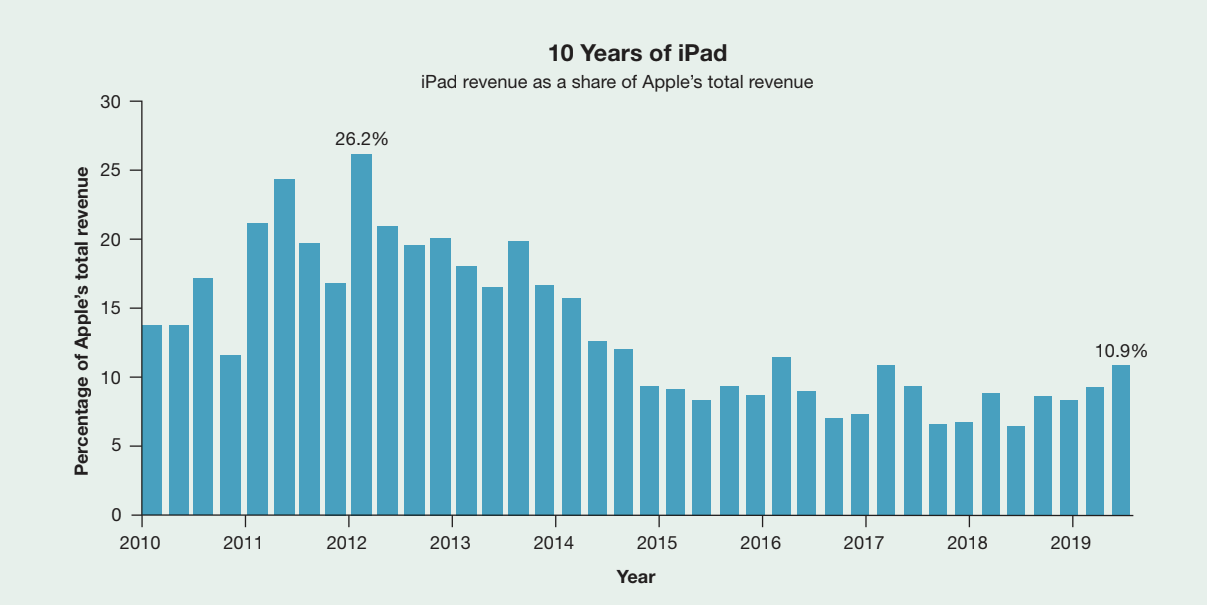
- 2010: 10.9%
- 2012 (peak): 26.2%
- 2019: back to around 10.9%
This case demonstrates that even highly successful products with strong brand support inevitably face the challenges of the product life cycle.
The relationship between SWOT and product life cycle
Both SWOT analysis and product life cycle assessment are essential components of situational analysis. Once a SWOT analysis is completed, businesses should assess where their product sits in the life cycle. This combination provides comprehensive insight:
- The SWOT analysis reveals the business's competitive strengths and weaknesses alongside market opportunities and threats
- The product life cycle position indicates which marketing strategies will be most effective
Together, these tools enable management to develop marketing plans that align with both the business's capabilities and the product's stage of development. The marketing plan should be modified to reflect the insights gained from both analyses.
Summary
Key Takeaways: Integrating SWOT and Product Life Cycle
For a complete situational analysis:
- Conduct a thorough SWOT analysis to understand internal capabilities and external market forces
- Determine the product's life cycle stage to identify appropriate marketing strategies
- Combine insights from both tools to create a comprehensive marketing plan
- Regularly update both analyses as market conditions and product performance change
This integrated approach ensures that marketing strategies are both realistic (based on the business's actual capabilities) and effective (appropriate for the product's current market position).
Remember!
Summary
Key Points to Remember:
-
Situational analysis provides a precise understanding of the business's current market position and future direction through market research and analytical tools
-
SWOT analysis examines internal strengths and weaknesses alongside external opportunities and threats to inform strategic decisions
-
Internal factors (strengths and weaknesses) are within the business's control, while external factors (opportunities and threats) exist in the broader environment
-
The product life cycle consists of four stages: introduction, growth, maturity and decline
-
Different marketing strategies are required at each stage of the product life cycle, covering product, price, promotion and distribution decisions
-
Products decline due to changing trends, technological advancement, competition, economic changes and sustainability concerns
-
Both SWOT analysis and product life cycle assessment should be completed to form a comprehensive situational analysis