Production, Selling, and Marketing Approaches (HSC SSCE Business Studies): Revision Notes
📚Revision Notes
Production, Selling, and Marketing Approaches
Marketing has evolved significantly over the past two centuries. Today's businesses focus on customer satisfaction and building long-term relationships, but this wasn't always the case. Understanding how marketing approaches have changed helps explain why modern businesses operate the way they do.
Note
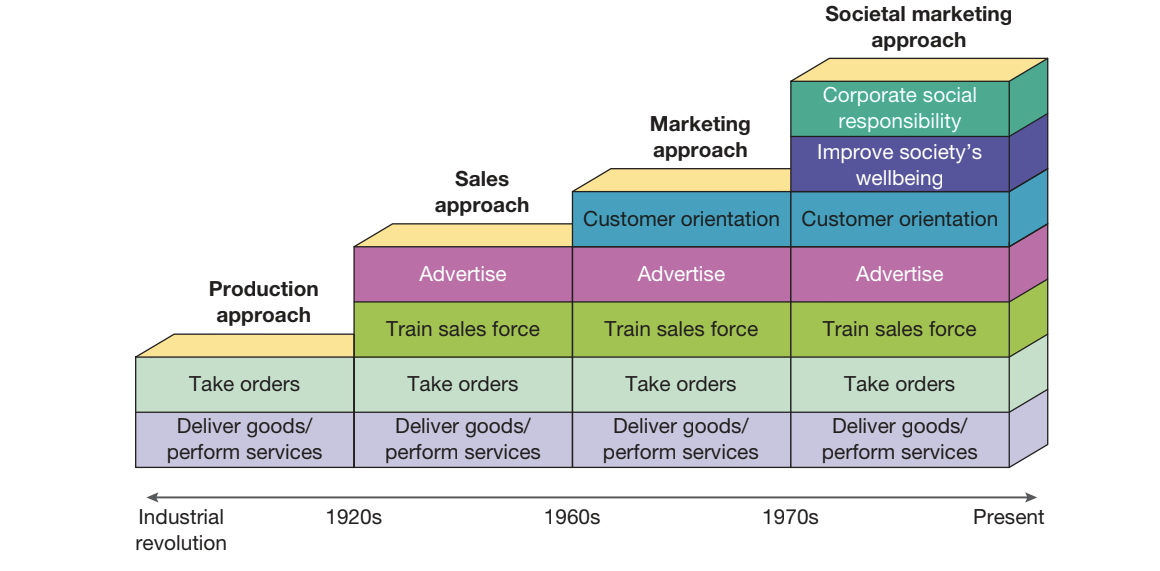
This subtopic examines four distinct marketing approaches that emerged during different historical periods: production (1820s–1920s), selling (1920s–1960s), marketing (1960s–present), and societal marketing (1970s–present). Each approach reflects the business environment and consumer expectations of its time.
Evolution of marketing approaches
The way businesses approach marketing has shifted dramatically from simply making products available to actively researching customer needs and considering social responsibility. This evolution occurred in response to changing market conditions, increased competition, and growing consumer expectations.
During the Industrial Revolution, demand exceeded supply, so businesses focused purely on production. As production capabilities improved and markets became saturated, businesses needed to actively persuade customers to buy their products. Eventually, businesses realised they needed to research and satisfy customer needs before production. Most recently, businesses have recognised their broader responsibilities to society and the environment.
The production approach (1820s–1920s)
Focus and philosophy
The production approach centres on manufacturing goods and services efficiently. Businesses during this era believed that simply producing quality products would guarantee sales. The prevailing attitude was captured in the phrase: "If we make it, they will buy it."
This approach dominated during the Industrial Revolution, when manufacturing capabilities expanded rapidly. Demand for goods and services far exceeded what businesses could produce, creating a seller's market. Businesses could confidently sell their entire output without significant marketing efforts.
Characteristics
Production-oriented businesses prioritised manufacturing efficiency over customer preferences. Product design was based on what could be produced using mass production techniques rather than what customers actually wanted. Marketing activities were minimal, consisting mainly of taking orders and delivering goods.
Example
Historical Example: Henry Ford
Henry Ford exemplified the production approach with his Model T automobile. Ford focused on developing faster, cheaper production methods rather than researching customer preferences. He famously offered the Model T in one colour only (black) because black paint dried fastest, improving production efficiency. Ford was confident customers would buy whatever he produced, provided it was affordable and functional.
Important
Exam Tip: Understanding Historical Context
When answering questions about the production approach, emphasise the historical context: demand exceeded supply, giving businesses no incentive to research customer needs. This contrasts sharply with modern marketing, where competition forces businesses to differentiate their offerings.
The selling approach (1920s–1960s)
Shift in market conditions
After World War I, production efficiency improved dramatically and businesses' output capacity began matching or exceeding demand. For the first time, businesses could no longer rely on simply making products available. High-quality, mass-produced goods flooded markets and competition intensified.
The sales approach emerged in response to these changing conditions. This approach emphasised persuading customers to purchase through aggressive selling and advertising tactics.
Key characteristics
Sales-oriented businesses increased spending on advertising and hired professional sales representatives. They utilised newly developed communication technologies like radio and film to reach broader audiences. Sales teams often employed high-pressure tactics to convince consumers to buy specific brands over competitors' offerings.
However, despite these more sophisticated marketing activities, businesses still neglected to research actual customer needs. They produced what they could manufacture efficiently, then relied on sales teams to create demand. Marketing remained subordinate to other business functions like production and finance.
Important distinction
Important
The Crucial Limitation
The crucial limitation of the sales approach was that businesses still didn't ask customers what they wanted. Instead, they made products based on production capabilities, then pressured sales teams to persuade customers to buy those products. This reactive approach often resulted in customer dissatisfaction and limited repeat purchases.
Example
Real-World Application: Car Dealerships
Modern car dealerships still largely operate using a sales approach. They use aggressive tactics and promotions to persuade customers to purchase their vehicles rather than competitors' models. This explains why many consumers find car buying stressful—the focus remains on closing sales rather than understanding individual customer needs.
Important
Exam Tip: Comparing Production and Sales Approaches
When comparing the sales and production approaches, note that both fail to prioritise customer needs. The key difference is that production-oriented businesses didn't need to actively sell (demand exceeded supply), while sales-oriented businesses had to persuade customers due to increased competition.
The marketing approach (1960s–present)
Fundamental shift
The marketing approach represents a revolutionary change in business philosophy. For the first time, businesses placed customers at the centre of all marketing activities. Instead of making products and then trying to sell them, businesses began researching customer needs first, then developing products to satisfy those needs.
This shift occurred during the post-World War II economic boom. Australian families gained discretionary income—money available after purchasing necessities like food, clothing, and shelter. Consumers could now choose how to spend this extra income on products that satisfied wants as well as needs. They began spending more on travel, recreation, and non-essential goods, forcing businesses to become more customer-focused.
Principles of the marketing concept
The marketing concept is built on four essential principles:
Customer orientation forms the foundation. Businesses must collect information about customer preferences and base all marketing decisions on customer wants and interests. This requires continuous research and feedback gathering.
Customer satisfaction is the primary goal. Businesses aim not just to meet but to exceed customer expectations. Customer satisfaction measures how well a business's goods and services meet or exceed what customers expect.
Integration ensures marketing becomes central to the entire business. All departments and employees, regardless of their specific roles, share responsibility for satisfying customer needs. Financial controllers, operations specialists, and human resource officers all contribute to the marketing effort.
Long-term relationships matter more than one-time transactions. The customer relationship begins with the sale rather than ending there. Businesses continuously strive to maintain high satisfaction levels to encourage repeat purchases and customer loyalty.
Note
Customer Orientation in Practice
A customer-oriented business directs all activities towards putting customers first. Everything from product design to after-sales service focuses on understanding and meeting customer needs. At every organisational level, employees work to build positive customer relationships.
Samsung exemplifies strong customer orientation. The company collects extensive customer information and bases marketing decisions on customer wants and interests. One-third of digital televisions sold globally are made in South Korea, with Samsung producing of them. Samsung's phenomenal success stems from its commitment to not just meeting but exceeding customer expectations through continuous innovation based on customer feedback.
Relationship marketing
Relationship marketing focuses on developing long-term, cost-effective relationships with individual customers. Simply attracting new customers is no longer sufficient; businesses must also retain existing customers through excellent service and ongoing satisfaction.
Customer loyalty generates repeat sales, which are more profitable than constantly acquiring new customers. Businesses achieve loyalty through reward programmes, exceptional customer care, and quality after-sales service.
For example, if you purchase a mobile phone plan and the telecommunications provider delivers excellent pre-purchase assistance, responsive after-sales support, and a valuable reward programme, you'll likely continue using that provider. You might even recommend the service to friends and family, generating new customers at no acquisition cost to the business.
Example
Case Study: Slack's Customer-Centric Success

Slack, the team communication platform launched in , demonstrates extreme customer centricity. The company created its messaging service to address common email complaints: accidental reply-all messages, forgotten attachments, and overwhelming inbox volumes.
Building with Customer Feedback
Slack built its app with obsessive attention to customer feedback from day one. Before releasing the first version, the company tested it for seven months while gathering customer input. They then released it to just ten companies, immediately fixing any issues users identified. As Slack shared the app with progressively larger groups, they continued collecting feedback and making modifications.
Results of Customer-Centric Approach
Today, Slack is worth over $20 billion with more than 8 million daily users. The company uses real-time data and feedback for continuous improvement, putting customers at the heart of their strategy. Many of Slack's greatest features originated from customer suggestions.
Building Long-Term Relationships
Slack aims to build long-term relationships by making customer support teams available for all feedback. These teams are measured by their ability to respond humanly rather than by the number of issues resolved. This ensures customers feel valued rather than like numbers in a queue.
Rather than focusing on financial metrics, Slack analyses customer-facing indicators like daily active users and Net Promoter Score (NPS), which measures customer loyalty. Their goal centres on creating loyal, satisfied customers who recommend the app to others. This focus on long-term customer satisfaction rather than short-term profits has driven Slack's remarkable growth.
Example
Example: Nike's Transformation
Nike initially adopted a production-oriented approach, believing innovation would drive success. In the mid-1980s, intensified competition forced Nike to recognise that consumers should drive innovation. The company shifted to first identifying exactly what customers want, then creating products to meet those needs. This transformation from production to marketing orientation helped Nike become a global leader in athletic footwear and apparel.
Important
Exam Guidance: Analysing the Marketing Approach
When analysing the marketing approach in exam responses:
- Emphasise the fundamental shift from product-centric to customer-centric thinking
- Explain how market research identifies needs before production begins
- Discuss how all business functions contribute to customer satisfaction
- Provide specific examples of customer orientation (like Samsung or Slack)
- Contrast with earlier approaches that ignored customer input
The societal marketing approach (1970s–present)
Emergence and context
During the 1960s and 1970s, public awareness grew regarding unethical business practices, environmental pollution, and resource depletion. Companies faced increasing pressure to consider their broader impact on society. The concept of social marketing emerged in as a more socially responsible and ethical marketing model.
The societal marketing approach extends the marketing concept by incorporating corporate social responsibility and sustainable development. Businesses implementing this approach aim to improve their public image while contributing positively to society.
Core philosophy
Societal marketing emphasises that long-term business success requires maintaining and improving the wellbeing of both customers and society. This approach suggests businesses should make marketing decisions by balancing three considerations:
Consumers' wants: Understanding and satisfying customer needs and preferences remains essential. Businesses cannot survive without meeting customer expectations.
Business profits: Companies must remain financially viable to continue operations. Profitability ensures the business can sustain its activities and grow.
Society's long-term interests: Businesses should consider their environmental and social impact. This includes reducing pollution, conserving resources, supporting communities, and promoting ethical practices.
Note
The societal marketing approach recognises that businesses operate within broader social systems. Actions that damage society or the environment ultimately harm the business itself by reducing consumer trust, depleting resources, or triggering regulatory restrictions.
Example
Case Study: Nestlé's "Good Food, Good Life"
Nestlé exemplifies the societal marketing approach through its mission statement: "Good Food, Good Life". This represents the company's commitment to enhancing lives by providing the best tasting, most nutritious food and beverages.
Nestlé believes long-term success requires creating value for shareholders, communities where they operate, and consumers. They call this philosophy "creating shared value".
Three 2030 Ambitions:
1. Help 50 million children lead healthier lives
Nestlé addresses global public health issues and changing consumer preferences by introducing more nutritious products. They have simplified ingredient lists, removed artificial colours, decreased sugars, sodium and saturated fats, while increasing vegetables and wholegrains in their products. This responds to both social responsibility concerns and consumer demand for healthier options.
2. Improve 30 million livelihoods in communities
The company works with suppliers, partners and farmers globally to support rural development, promote human rights, guarantee decent employment, and encourage diversity. These initiatives build stronger communities while securing reliable supply chains.
3. Strive for zero environmental impact
Nestlé uses responsibly sourced ingredients and renewable resources. They have implemented strategies to operate more efficiently, eliminate waste, manage water responsibly, and reduce greenhouse gas emissions. The company also researches sustainable packaging solutions.
Responsible Marketing Practices:
Nestlé has advocated for responsible marketing to children through their Policy on Marketing Communication to Children. This policy mandates that all communication to children follows responsible marketing principles. The company only promotes products to children that meet specific nutritional profiles, and leverages marketing efforts to promote healthy cooking, eating and lifestyles.
These combined goals improve shareholder value while creating long-term positive impacts on stakeholders throughout the organisation.
Benefits of societal marketing
Businesses adopting the societal marketing approach benefit from:
- Enhanced public image and brand reputation
- Increased customer loyalty from socially conscious consumers
- Reduced regulatory risks
- Improved employee morale and recruitment
- Long-term sustainability and resource security
- Stronger community relationships
Important
Exam Tip: Evaluating Societal Marketing
When evaluating the societal marketing approach, consider both benefits and potential challenges. Benefits include improved reputation and customer loyalty. Challenges might include higher costs, conflicts between profit and social goals, and difficulty measuring social impact. Strong answers demonstrate understanding that businesses must balance multiple stakeholder interests.
Comparing the four approaches
| Approach | Time Period | Focus | Key Characteristics |
|---|---|---|---|
| Production | 1820s–1920s | Manufacturing efficiency | Demand exceeds supply; "If we make it, they will buy it"; minimal marketing effort |
| Selling | 1920s–1960s | Persuading customers | Increased competition; heavy advertising; sales teams; high-pressure tactics |
| Marketing | 1960s–present | Customer satisfaction | Market research; customer needs drive production; long-term relationships |
| Societal Marketing | 1970s–present | Social responsibility | Balancing profit, customer needs, and societal wellbeing; sustainable practices |
Summary
Key Points to Remember:
Key Concepts:
- Production approach: Businesses focused on efficient manufacturing, assuming customers would buy whatever was produced during periods when demand exceeded supply
- Sales approach: As competition increased, businesses emphasised persuading customers through advertising and sales forces, but still didn't research customer needs
- Marketing approach: Businesses shifted to researching customer needs first, then developing products to satisfy those needs, focusing on customer satisfaction and long-term relationships
- Societal marketing approach: Businesses balance customer needs, profitability, and social responsibility, considering environmental and community impact
- Customer orientation means collecting information from customers and basing all marketing decisions on their wants and interests
- Relationship marketing develops long-term, cost-effective relationships with individual customers through loyalty programmes and excellent service
Timeline Progression: Production → Selling → Marketing → Societal (remember: PSMS)
Marketing Concept Principles: Customer-oriented, Integrated, Aimed at satisfaction, Long-term relationships (remember: CIAL)
Evolution Reflects Market Conditions: Each approach emerged in response to changing levels of competition, production capacity, and social awareness. Modern businesses typically combine marketing and societal marketing approaches.