Role of Marketing Overview (HSC SSCE Business Studies): Revision Notes
📚Revision Notes
Role of Marketing Overview
Understanding marketing
Marketing is often misunderstood as simply selling or advertising, but it encompasses much more than these activities. The American Marketing Association defines marketing as the process of planning and executing how products are conceived, priced, promoted and distributed to create exchanges that satisfy both individual and organisational goals.
Note
In simpler terms, marketing is a complete system of interconnected activities designed to plan, price, promote and distribute products to current and potential customers. At its core, marketing focuses on answering one fundamental question: "What do customers want to buy — now and in the future?"
The essence of marketing lies in discovering what customers want and then working to satisfy those needs.
Key features of marketing
Marketing has four main characteristics that distinguish it from other business activities:
- Involves multiple activities — Marketing includes research, planning, pricing, promotion, distribution and customer relationship management
- Applies to diverse offerings — Marketing works for physical goods, services and even ideas (such as charity campaigns or social causes)
- Focuses on satisfying exchanges — Both the buyer and seller must receive something of value from the transaction
- Extends beyond businesses — Not-for-profit organisations, charities and community groups also use marketing to promote causes and ideas
Marketing versus selling and advertising
Many people confuse marketing with selling or advertising, but these are distinct concepts.
Important
Common Misconception: Marketing is NOT the same as selling or advertising. These are components of marketing, not synonyms for it. Understanding this distinction is essential for grasping the full scope of marketing activities.
Marketing versus selling
Selling involves specific activities that salespeople undertake to help customers make buying decisions. Selling is actually just one component of the broader marketing process. Modern marketing takes a wider view and doesn't necessarily require selling a product — for example, charities market ideas and causes without selling tangible goods.
Marketing versus advertising
Advertising is highly visible in our daily lives, making it easy to associate with marketing. However, advertising is only one element of the promotion strategy, which itself is just one part of marketing. Think of marketing as a pie divided into four slices representing the four Ps: Product, Price, Promotion and Place. Advertising is merely one piece within the promotion slice.
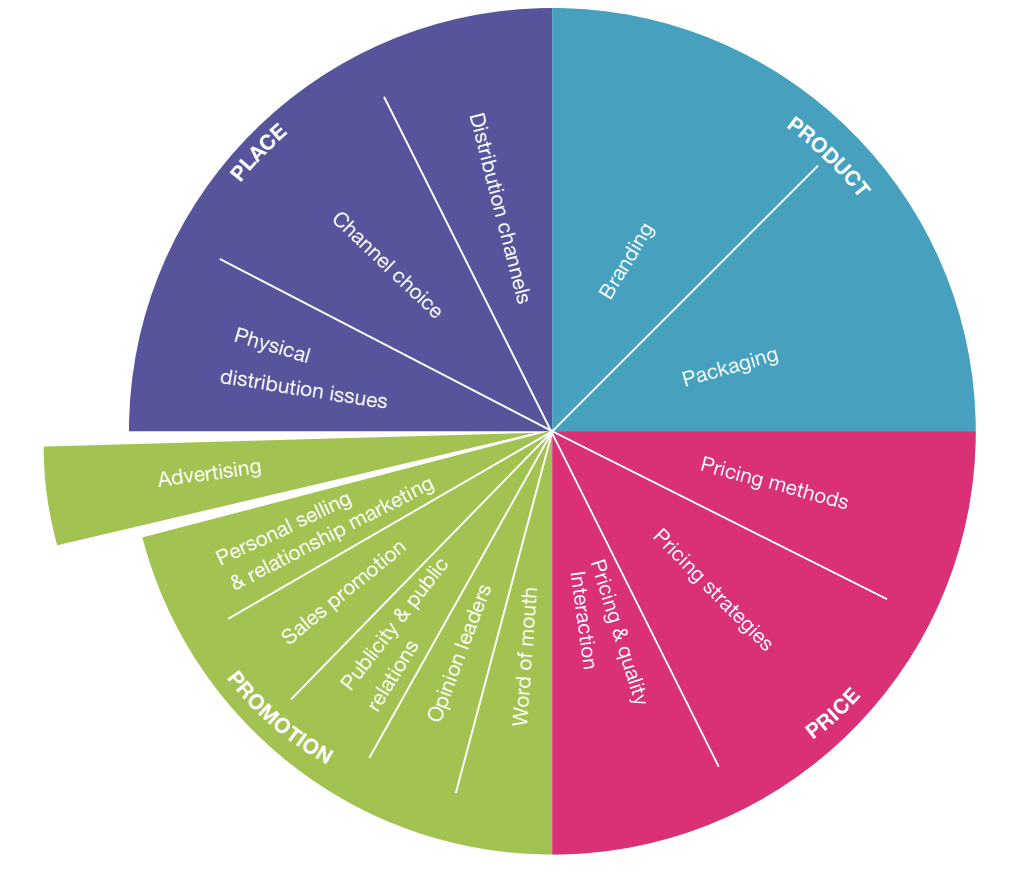
Note
The Marketing Pie Contains:
- Product — Branding and packaging decisions
- Price — Pricing methods, strategies and quality considerations
- Promotion — Advertising, personal selling, sales promotion, publicity and public relations
- Place — Distribution channels, channel choice and physical distribution
All these elements must work together to achieve the business's objectives.
Modern marketing approach
While businesses historically adopted a sales-oriented approach, modern marketing places the customer at the centre of all activities. This contemporary approach prioritises:
- Satisfying customer needs and wants
- Being socially responsible
- Building long-term, cost-effective customer relationships
Strategic role of marketing
Strategic refers to long-term, broad aims affecting all key business areas. The strategic role of each business function involves managers contributing to the strategic direction or overall strategic plan of the business.
The overarching goal of most businesses is profit maximisation — achieving the maximum difference between total revenue and total costs. Therefore, the strategic role of marketing is to develop a combination of strategies that maximise sales, increase brand awareness and improve customer satisfaction, translating the profit maximisation goal into reality.
Marketing's power in achieving business goals
Marketing represents a powerful strategy for achieving business objectives. Consider Coca-Cola's success story as a prime example.
Example
Worked Example: Coca-Cola's Marketing Success
Coca-Cola demonstrates the transformative power of sophisticated marketing built on a highly recognisable brand name.
Initial Performance:
- In its first year: approximately servings of Coke sold daily
Current Performance:
- Sold in over countries
- billion servings consumed every day
This dramatic growth from servings per day to billion servings demonstrates how effective marketing strategies can scale a business from local to global dominance.
Without a marketing strategy, financial disaster becomes inevitable. Many new inventions fail commercially because they haven't been marketed adequately. Developing customer awareness and demand requires an organised marketing campaign, starting with a comprehensive marketing plan — a document listing activities aimed at achieving particular marketing outcomes for goods or services.
Why businesses need marketing plans
When businesses develop new products, they can become too product-focused. To achieve the financial goal of making a profit, products need to generate sales. This requires developing a marketing plan detailing the strategies needed to sell products.
Important
The marketing plan should be the focus of both short-term and long-term planning for three critical reasons:
1. Connects buyers and sellers
The marketing plan outlines strategies to bring buyers and sellers together. Businesses need to identify:
- Where the market is located
- Who will buy the product
- Why they will buy the product
- How often they will purchase
2. Satisfies existing customers
The core of marketing involves satisfying existing customer wants, which should lead to repeat sales and customer loyalty.
3. Generates revenue
Marketing is the revenue-generating activity of any business. Nothing is achieved until a sale is made.
Note
A successful business develops a marketing plan based on careful research and design, with the customer always at the central focus. Any business that fails to develop and maintain a customer base will eventually go out of business.
The marketing plan plays a crucial strategic role in overall business success. If the business plan is the 'road map', then the marketing plan contains the signposts showing which direction to take. The strategic role of marketing is to increase sales and market share, which should hopefully lead to greater profitability.
Interdependence with other key business functions
Interdependence refers to the mutual dependence that key business functions have on one another. Marketing does not occur in isolation but relies on other functions for success.
The marketing concept
During the s, businesses began to slowly accept that they weren't solely producers or sellers, but in the business of satisfying customers' wants. This shift to a customer-oriented approach brought significant changes to marketing, especially the need to undertake market research and develop a marketing concept.
Note
The Marketing Concept Defined:
The marketing concept is a business philosophy stating that all sections of the business are involved in satisfying a customer's needs and wants while achieving the business's goals. The business should direct all its policies, plans and operations towards achieving customer satisfaction.
The marketing plan needs to become integrated into all aspects of the business, with marketing strategies playing a major role in all business activities. At every level of the business, employees should have as their primary focus the satisfaction of the customer. This requires integrating the marketing plan across the four key business functions:
- Operations
- Finance
- Human resources
- Marketing
Important
To be effective, the marketing concept must be embraced by all employees of the business, not only by those directly involved in marketing activities.
Working across business functions
The marketing manager cannot work in isolation and often must work with other managers to ensure marketing plan success:
Operations connection — If the marketing plan requires having a good or service ready by a certain date, the operations plan must be in place to make that happen. For example, if a business makes Christmas puddings, delivering them after December would be useless.
Finance connection — Financial planning must 'connect' with the marketing plan. Marketing costs money, and finances must be available if, for example, the business wishes to embark on an expensive advertising campaign.
Human resources connection — The marketing manager must work with the human resource manager to ensure the right staff are employed to create goods or services that are desirable to customers.
Case study: Apple sets the benchmark in marketing
Apple's success has been a direct result of their marketing, which is why they were voted the overall winner of the CMO Survey Award for Marketing Excellence for eleven consecutive years. Their marketing has become a benchmark for other companies aspiring to reach similar heights of recognition, revenue and market share.
Example
Case Study: Apple's Marketing Excellence
Apple demonstrates how integrated marketing strategies can transform a company from near bankruptcy to industry leadership.
Key Marketing Strategies:
1. Simplicity Apple's marketing strategies are straightforward and kept as simple as possible. Their advertisements don't include feature lists, prices, information on where to buy products, voice-overs or special effects. Instead, they use simple language and graphics to translate their message. Apple doesn't overwhelm customers with jargon, choices and options. Their products are sleek and minimal, and product names are short and easy to remember.
2. Creating mystery and excitement One of Apple's best marketing tactics is their ability to create mystery around new product launches. They withhold information, leak rumours and keep developments under wraps, which generates excitement and mystique until the big unveiling. Their 'fanboys' and 'fangirls' camp out for days to be first in line for latest products.
3. Building brand loyalty Apple has built one of the most hardcore fan bases of any brand. They created a brand personality and culture that inspires devotion among millions of customers worldwide.
4. Emotional connection Apple has created loyal following because they reach customers at an emotional level. Their advertisements show happy people having a great time with products rather than focusing on product details and features. They create advertisements that make customers believe products will make their life better, easier, more fun and cooler.
5. Product placement Since the mid-s, Apple products have been featured in hundreds of movies and TV shows each year. One excellent example was the Modern Family episode 'Connection Lost' where the entire episode is told through Claire Dunphy's MacBook Pro and other Apple apps like FaceTime, Messaging, iTunes, iPhoto and iCloud. The result was an episode that's incredibly funny and effective without seeming like an advertisement.
6. Product synonymy Apple engineers products to be so unique that people view their product name as the product itself. For example, people don't buy a tablet, they buy an iPad. Very few brands have become so ingrained in vocabulary that they're synonymous with the products themselves.
Outcome: These marketing strategies helped turn Apple from near bankruptcy to an industry leader, demonstrating the transformative power of well-executed marketing.
Remember!
Summary
Key Points to Remember:
-
Marketing is comprehensive — It involves planning and executing the conception, pricing, promotion and distribution of ideas, goods and services to satisfy both individual and organisational objectives
-
Marketing differs from selling and advertising — Selling is one part of marketing, and advertising is one element of promotion, which is itself one of the four Ps of marketing
-
The strategic role of marketing — To implement strategies that maximise sales, increase brand awareness and improve customer satisfaction, ultimately achieving profit maximisation
-
Marketing requires interdependence — The marketing plan must be integrated across all business functions (operations, finance, human resources and marketing) with the customer at the centre
-
Customer focus is essential — The marketing concept states that all sections of the business must be involved in satisfying customer needs and wants while achieving business goals