The Polymerase Chain Reaction (VCE SSCE Biology): Revision Notes
📚Revision Notes
The Polymerase Chain Reaction
Purpose of the polymerase chain reaction
The polymerase chain reaction is a powerful laboratory technique that scientists use when they need more DNA than they currently have. Imagine finding a single hair at a crime scene - there's DNA in those cells, but not nearly enough to run the tests needed to identify a suspect. This is where the polymerase chain reaction becomes essential.
Polymerase chain reaction (PCR) is a laboratory technique used to produce many identical copies of DNA from a small initial sample. The term amplify means to increase the quantity of a molecule by making many copies.
PCR works by creating multiple identical copies of a DNA sequence through a process called thermal cycling (cycling through different temperatures). Rather than copying an entire genome, scientists typically focus on specific genes or DNA regions. They can target these specific areas using primers (short, single strands of nucleic acids that act as starting points for polymerase enzymes to attach) or restriction endonucleases (enzymes that act like molecular scissors to cut nucleic acid strands at specific recognition sites, also known as restriction enzymes).
Why DNA amplification is needed
Scientists require DNA amplification whenever the available DNA sample is too small for analysis. After amplification through PCR, researchers can perform various tests and analyses that would otherwise be impossible with the original tiny sample.
Applications of PCR
Once DNA has been amplified through PCR, scientists can conduct several important analyses:
- Paternity testing - determining biological relationships between individuals
- Forensic testing - analysing samples of bodily fluids from crime scenes
- Genetic disease analysis - examining gene fragments to identify genetic disorders
Exponential amplification
One of the most remarkable features of PCR is how quickly it amplifies DNA. After each cycle of the polymerase chain reaction, the amount of DNA present doubles. This means the amplification follows an exponential pattern, which can be calculated using the formula:
Where:
- = number of double-stranded DNA molecules
- = number of cycles
Example
Worked Example: Calculating DNA Amplification
Using the formula , let's calculate how many DNA molecules are produced after 10 cycles:
Starting with just 1 DNA molecule, after 10 cycles you would have 1,024 copies!
For a typical PCR run of 30 cycles:
That's over one billion copies from a single DNA molecule!
The table below demonstrates this exponential growth:
| Number of cycles (n) | Number of double-stranded DNA molecules (x) |
|---|---|
| 0 | 1 |
| 1 | 2 |
| 2 | 4 |
| 3 | 8 |
| 4 | 16 |
| 5 | 32 |
| 6 | 64 |
| 7 | 128 |
| 8 | 256 |
| 9 | 512 |
| 10 | 1024 |
Note
The exponential nature of PCR means that even small numbers of cycles produce dramatic increases in DNA quantity. Just 10 cycles produce over 1,000 copies, and a typical 30-cycle sequence creates over one billion copies of the original DNA molecule!
Important
Exam tip: The VCAA has not specified that PCR is an approved abbreviation. In exam responses, write out 'polymerase chain reaction (PCR)' in full first, then use the abbreviation PCR afterwards.
Process of the polymerase chain reaction
The polymerase chain reaction requires precise control of temperature to work effectively. Scientists use a specialised piece of equipment called a thermal cycler (a laboratory apparatus which alters the temperature in pre-programmed steps for temperature-sensitive reactions like PCR) to automate this process.
Required materials
Before PCR can begin, four essential components must be present:
- DNA sample - the original DNA that will be denatured (separated into single strands) and then amplified
- Taq polymerase - a heat-resistant DNA polymerase enzyme isolated from the bacteria Thermus aquaticus, which amplifies single-stranded DNA molecules by attaching complementary nucleotides
- Nucleotide bases - a constant supply of A, T, G, and C nucleotides that Taq polymerase uses to build new complementary DNA strands
- Sequence-specific DNA primers - these bind to the 3' end of single-stranded DNA through complementary base pairing, forming the first segment of double-stranded DNA where Taq polymerase can attach and begin work
The four-step PCR cycle
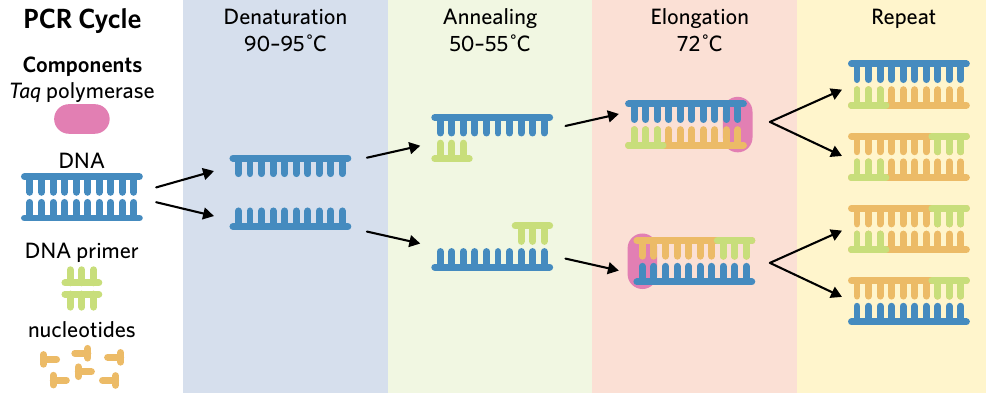
Once all materials are combined in the thermal cycler, the mixture undergoes a repeating cycle of four steps:
Step 1: Denaturation (90-95°C)
The mixture is heated to approximately 90-95°C. This high temperature provides enough energy to break the hydrogen bonds between complementary base pairs. Denature means the disruption of a molecule's structure by an external factor such as heat. When the hydrogen bonds break, the double-stranded DNA separates into two single strands.
Step 2: Annealing (50-55°C)
The temperature is lowered to approximately 50-55°C. At this cooler temperature, the primers can bind to their complementary sequences on the single-stranded DNA. Anneal means the joining of two molecules, for example two complementary DNA strands during the cooling phase of PCR. The primers attach to specific sequences, marking where DNA synthesis will begin.
Step 3: Elongation (72°C)
The temperature is raised again to 72°C, which is the optimal working temperature for Taq polymerase. The enzyme binds to the primer (which acts as a starting point) and begins synthesising a new complementary strand of DNA by adding nucleotides one at a time. Elongate means to synthesise a longer polynucleotide.
Step 4: Repeat
The entire cycle (steps 1-3) is repeated multiple times, typically 25-35 cycles. Each cycle doubles the amount of DNA present, leading to exponential amplification.
Important
Exam tip: When answering exam questions about PCR, you can state temperature ranges or specific temperatures within those ranges. However, you must specifically state that the elongation stage occurs at 72°C, as this is the optimal temperature for Taq polymerase.
Why Taq polymerase is used
You might wonder why scientists use Taq polymerase specifically for PCR, rather than the DNA polymerase found in human cells. The answer lies in heat resistance.
Note
Taq polymerase is an example of a DNA polymerase enzyme, but it has a special property - it remains stable and functional at very high temperatures. This heat resistance is crucial because PCR requires heating DNA to 90-95°C during denaturation. Human DNA polymerase, which functions optimally at body temperature (37°C), would be destroyed at these high temperatures. Taq polymerase comes from the bacterium Thermus aquaticus, which lives in hot springs, so its enzymes have evolved to withstand extreme heat.
Forward and reverse primers
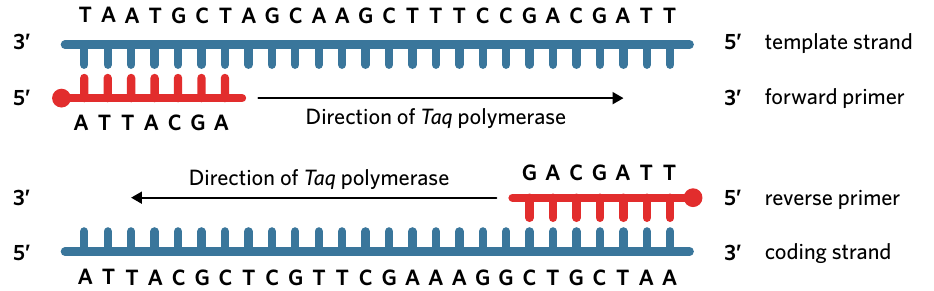
The polymerase chain reaction requires two different types of primers because the two DNA strands run in opposite directions. During denaturation, the double-stranded DNA molecule separates into two single strands:
- The template strand (runs 3' to 5')
- The coding strand (runs 5' to 3')
Since Taq polymerase can only synthesise DNA in the 5' to 3' direction, and it can only extend from an existing 3' end, both strands need their own primer:
Forward primer - a DNA primer that binds to the 3' end of the template strand and reads the DNA in the same direction as RNA polymerase. This primer attaches to the start codon, and Taq polymerase then synthesises a new DNA strand that is complementary to the template strand.
Reverse primer - a DNA primer that binds to the 3' end of the coding strand and reads the DNA in the reverse direction to RNA polymerase. This primer attaches to the stop codon, and Taq polymerase synthesises a new strand complementary to the coding strand.
Note
Having both primers ensures that both separated strands can be copied during each cycle, which is necessary for the exponential amplification that makes PCR so effective. Think of it this way: since the two DNA strands run in opposite directions (antiparallel), and Taq polymerase can only work in one direction (5' to 3'), you need a primer for each strand to ensure both get copied.
Summary
Key Points to Remember:
- The polymerase chain reaction (PCR) is a laboratory technique that amplifies small DNA samples by creating many identical copies
- PCR is essential when there isn't enough DNA for testing, with applications in paternity testing, forensic analysis, and genetic disease screening
- PCR requires four key materials: a DNA sample, Taq polymerase, nucleotide bases, and sequence-specific primers
- The PCR cycle has four steps:
- Denaturation at 90-95°C (separates DNA strands)
- Annealing at 50-55°C (primers bind)
- Elongation at 72°C (Taq polymerase builds new strands)
- Repeat
- DNA amplification is exponential - each cycle doubles the DNA amount, calculated by , where 30 cycles create over one billion copies