Market Mix and Strategy (Edexcel A-Level Business): Revision Notes
📚Revision Notes
Distribution
Introduction to distribution
Distribution is a critical marketing activity that determines where and how consumers can purchase products. It refers to the places, methods and channels through which businesses make their products available to customers.
Getting distribution right is essential for business success. If products are not available in convenient locations at the right time, sales will suffer. Consumers typically lack the time or willingness to search extensively for products.
Note
Consider the impact of location on customer access: motorway service stations located several miles from the motorway would struggle to attract customers, and food producers that fail to secure supermarket shelf space would face severely limited sales opportunities.
Important
The effectiveness of a distribution strategy can make or break a business, as it directly impacts customer access and purchasing behaviour.
Distribution channels
A distribution channel is the pathway a product follows from the manufacturer to the final customer. Businesses can select from various channel options, and many use multiple channels simultaneously to maximise market reach.
The main distribution channels for consumer goods include:
- Direct channel: Manufacturer → Consumers
- One-tier channel: Manufacturer → Retailers → Consumers
- Two-tier channel: Manufacturer → Wholesalers → Retailers → Consumers
- Three-tier channel: Manufacturer → Agents/Brokers → Wholesalers → Retailers → Consumers
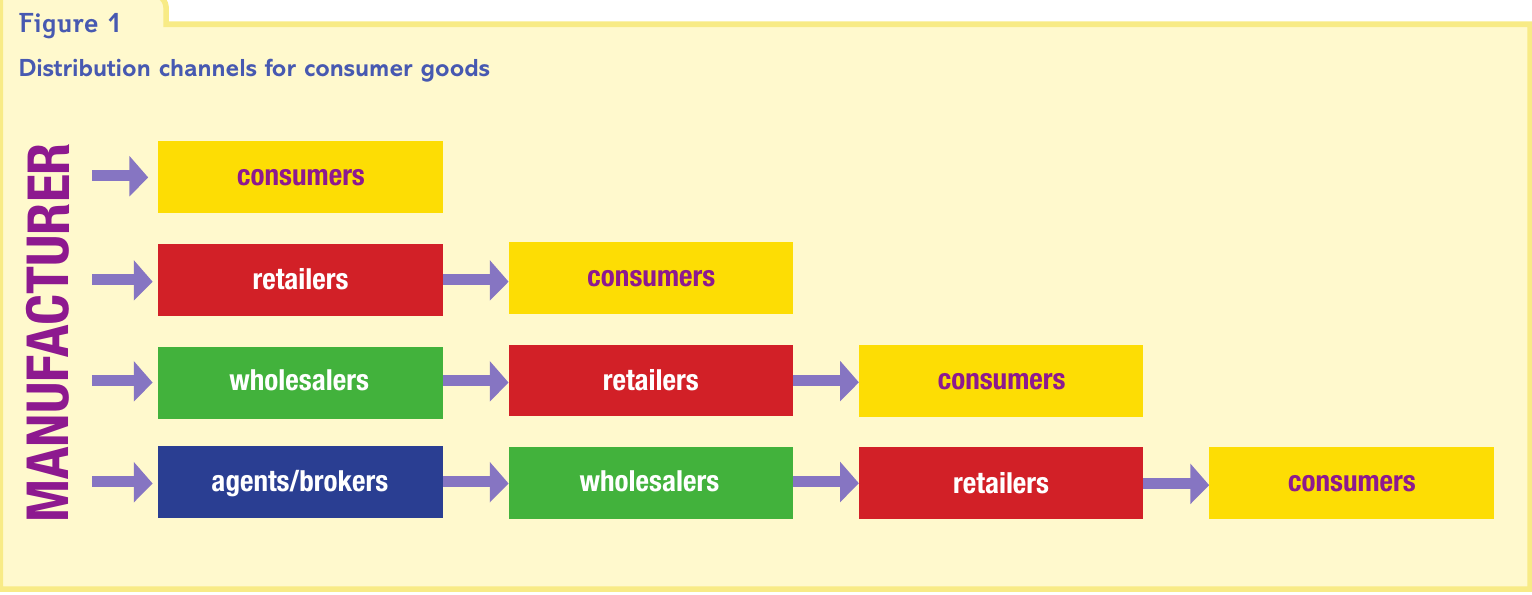
Intermediaries are businesses that create connections between producers and end consumers. Common intermediaries include retailers, wholesalers, and agents. Using intermediaries adds stages to the distribution process but can provide valuable services such as market access, storage, and breaking bulk quantities into consumer-sized portions.
Note
Many businesses adopt a multi-channel distribution strategy, using different routes to reach diverse customer segments and geographical markets. This approach maximises market coverage and allows businesses to serve different customer preferences simultaneously.
Direct selling
Direct selling occurs when producers sell products straight to consumers without using intermediaries. This approach is particularly common for services, as they cannot be stored and typically require direct interaction between provider and customer. Services such as banking, hairdressing, plumbing, and legal advice normally use direct distribution.
Some manufacturers also employ direct selling for physical products. The main methods include:
The internet: A rapidly expanding channel where retailers and manufacturers sell through their own websites. Online distribution has become a dominant force in modern retail and is discussed in detail later in this note.
Direct mail: Businesses send promotional materials through the postal service directly to potential customers' homes, inviting them to purchase products. The utilities and financial services sectors are major users of this method, with financial services companies accounting for approximately 25% of all direct mail sent.
Door-to-door selling: Sales representatives visit households without appointment to promote products or services. Energy providers historically used this method extensively to persuade customers to switch suppliers. However, following complaints about aggressive tactics and the rise of price comparison websites, most energy companies have abandoned this approach. This method is generally in decline across most sectors.
Mail order catalogues: Companies distribute printed catalogues to customers who can browse and order products, traditionally by completing order forms. Major catalogue retailers like Next, Littlewoods and Freemans now complement their print catalogues with online ordering systems, recognising changing consumer preferences.
Direct response advertising: Businesses place advertisements in newspapers, magazines or on television that encourage immediate purchases. Local service providers such as cleaners, gardeners, builders, tutors and childminders commonly advertise their services this way in local publications.
Shopping parties: Representatives organise social events where attendees can view and purchase products in a relaxed, informal setting. Product categories suited to this method include jewellery, cosmetics, Tupperware, fashion accessories and lingerie. The party host typically receives rewards such as discounts or free gifts as an incentive.
Telephone selling (telemarketing): Businesses contact potential customers by phone to promote goods and services. Despite many consumers finding unsolicited calls unwelcome, this method remains widespread. Common users include insurance companies, home improvement firms, legal services, and energy providers. A recent development is 'robocalls' – automated telephone calls using computerised autodialers to deliver pre-recorded messages, usually prompting recipients to press numbers to continue the conversation.
Note
Advantages of Direct Selling
The primary advantage of direct selling is eliminating intermediaries, allowing producers to retain a larger share of profits. Direct methods can also reach customers who prefer not to visit physical shops or who value the convenience of purchasing from home.
Important
Disadvantages to Consider
The main disadvantages include customers' inability to physically examine products before purchase (for some methods), and negative consumer reactions to intrusive techniques like unsolicited phone calls, direct mail, and door-to-door visits. Some direct methods also carry higher risk of fraud or misrepresentation.
Retailing
Retailers are businesses that purchase goods from manufacturers or wholesalers and sell them directly to final consumers. They form a crucial link in most distribution channels and provide several important services:
Breaking-bulk: Retailers buy large quantities from suppliers and divide them into smaller, consumer-friendly quantities. This allows manufacturers to produce efficiently in bulk while consumers can purchase in amounts that suit their needs.
Convenient locations: Retailers establish outlets in places easily accessible to consumers. Supermarkets, for example, typically locate in areas with good transport links and ample car parking facilities.
Value-added services: Retailers enhance the basic product offering by providing additional services such as:
- Assistance with packing and delivery
- Repair and maintenance services
- Product information and expert advice
- Warranties and guarantees
- Gift-wrapping services
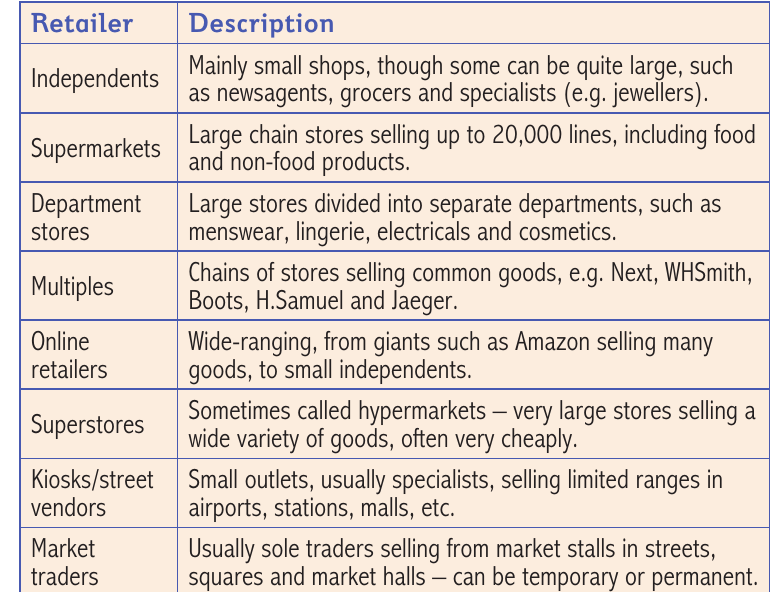
The UK retail sector features diverse outlet types, each serving different market segments:
-
Independents are mainly small shops, though some can be substantial. Examples include newsagents, grocers, and specialist retailers like jewellers. These businesses often serve local communities and may offer personalised service.
-
Supermarkets are large chain stores carrying up to 20,000 product lines, selling both food and non-food items. They dominate the UK grocery sector and typically offer competitive prices through economies of scale.
-
Department stores are large retail establishments divided into distinct departments such as menswear, lingerie, electricals, and cosmetics. Each department functions somewhat independently while sharing common facilities and branding.
-
Multiples are chains of stores selling similar goods across many locations. Examples include Next, WHSmith, Boots, H.Samuel and Jaeger. These chains benefit from consistent branding and centralised purchasing power.
-
Online retailers range from giants like Amazon selling vast product ranges to small independent specialists. This channel has experienced explosive growth and continues to reshape the retail landscape.
-
Superstores/hypermarkets are very large stores offering extensive product ranges, often at discounted prices. These outlets typically locate on out-of-town sites with substantial parking facilities.
-
Kiosks and street vendors are small outlets, usually specialising in limited product ranges. Common locations include airports, railway stations, and shopping centres.
-
Market traders operate from stalls in streets, squares and market halls. These can be permanent fixtures or temporary operations, often run by sole traders.
Note
UK Grocery Market Size
The UK grocery retail market was valued at \£174.5 billion in 2014, with approximately 55p of every £1 of consumer spending going on groceries. Industry forecasts projected growth to \£203 billion by 2019.
The distribution of this market across different channel types in 2014 shows the continuing dominance of large-format stores:
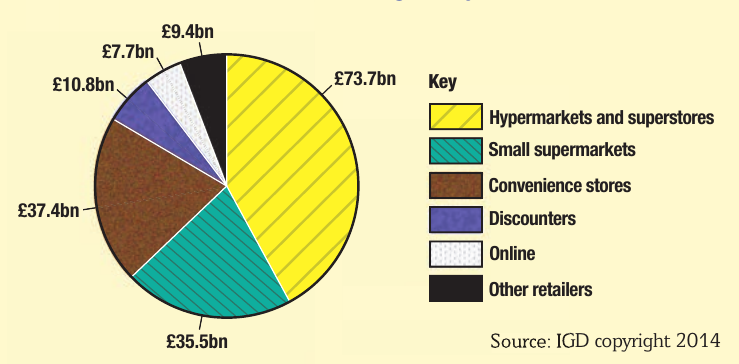
Hypermarkets and superstores captured the largest share at \£73.7 billion, followed by convenience stores (\£37.4 billion) and small supermarkets (\£35.5 billion). Discounters accounted for \£10.8 billion, while online grocery shopping reached \£7.7 billion. Other retail formats made up \£9.4 billion of the total market.
Wholesaling
Wholesalers operate between manufacturers and retailers, purchasing goods in large volumes from producers and selling in smaller quantities to retail businesses. They perform several valuable functions in the distribution chain:
Wholesalers break bulk by dividing large shipments into more manageable quantities suitable for retailers. They may repack goods, redistribute smaller volumes, provide storage facilities, and offer delivery services to retail customers. This reduces the logistical burden on both manufacturers and retailers.
Note
The Value of Product Variety
A key advantage wholesalers offer retailers is product variety. Since wholesalers stock goods from numerous manufacturers, retailers can select from an extensive range of merchandise from a single source, rather than dealing with multiple manufacturers individually. This simplifies procurement and reduces ordering costs for small retailers.
Wholesalers particularly benefit independent retailers who lack the purchasing power to buy directly from manufacturers in economic quantities. By aggregating demand from many small retailers, wholesalers achieve the order volumes manufacturers prefer while meeting retailers' needs for smaller quantities.
Agents and brokers
Agents and brokers act as intermediaries who connect buyers and sellers without taking ownership of goods. They operate across various markets and industries:
-
Travel agents sell holidays, flights and travel packages on behalf of holiday companies, airlines and tour operators. They earn commission on bookings while providing customers with expertise and convenience.
-
Estate agents market properties for vendors (sellers), facilitating property transactions. They handle viewings, negotiations, and paperwork in exchange for a percentage-based fee.
-
Insurance agents sell insurance products, life insurance, and other financial services on behalf of insurance companies and financial institutions.
-
Export agents help manufacturers sell goods in overseas markets. These agents possess valuable knowledge of foreign markets, local regulations, trading practices, and cultural considerations. They can significantly reduce the risks associated with international trade.
For businesses exporting for the first time, agents provide several advantages:
Agents eliminate the costs of recruiting, training and employing specialist international sales staff. They typically work on commission (ranging from 2.5% to 15% of sales value), converting fixed employment costs into variable costs linked to sales performance.
Export agents bring established networks of contacts that can be exploited immediately, whereas businesses entering foreign markets independently would need considerable time to develop such relationships.
Agents allow sellers to maintain greater control over aspects such as pricing, product display, and brand image compared to using independent distributors.
In markets where culture, commercial laws, and trading customs differ significantly from the UK (such as China), agents provide essential expertise and credibility that would be difficult for UK businesses to develop quickly.
Important
Drawbacks of Using Agents
However, using agents has drawbacks. Shipping and related logistical costs may remain the seller's responsibility. Providing after-sales service across international boundaries can prove challenging. Businesses also sacrifice some control over marketing and brand presentation compared to direct operations.
Choosing the appropriate distribution channel
Businesses must carefully select distribution channels based on several key factors. Many successful businesses use multiple channels simultaneously to maximise market coverage and reach different customer segments effectively.
The nature of the product
Different product types suit different distribution approaches:
Services are typically sold directly to consumers because they cannot be stored as inventory. It would be impractical for window cleaners, gardeners, hairdressers, or dentists to use intermediaries, as service delivery requires direct interaction between provider and customer.
Fast-moving consumer goods (FMCG) such as breakfast cereals, confectionery, crisps, and toilet paper cannot realistically be sold directly by manufacturers in single units to individual consumers. These products require wholesalers and retailers to break bulk and make products available in convenient consumer quantities and locations.
High-quality 'exclusive' products such as premium perfumes and designer clothing require carefully selected distribution outlets. Producers of these goods prioritise brand image and product positioning, making them unlikely to distribute through mass-market supermarkets or discount stores. They prefer exclusive boutiques and upmarket department stores that align with their brand values.
Technical or complex products that require explanation, demonstration, or specialist knowledge may need to be sold through expert salespeople or specialist retailers. Complex financial products, for example, often require professional advisors to explain features and risks to customers.
Cost considerations
Businesses typically prefer the most cost-effective distribution channels available. Direct channels are generally cheaper because they eliminate intermediary margins. When intermediaries are used, they take a share of the profit, increasing the final price to consumers.
Note
Large supermarket chains leverage their buying power to purchase directly from manufacturers, negotiating lower prices through bulk purchasing. This allows them to offer competitive retail prices while maintaining healthy margins.
Independent retailers often lack the scale to buy directly from manufacturers and must purchase through wholesalers. This adds an extra margin to their costs, forcing them to charge higher retail prices or accept lower profit margins.
Many producers now sell directly to consumers through their own websites, reducing distribution costs and capturing the full retail margin. This trend has accelerated with improving e-commerce technology and changing consumer shopping habits.
The market
Market characteristics significantly influence channel choice:
Producers targeting mass markets typically require intermediaries to achieve the necessary reach and market penetration. The scale and geographical spread of mass markets make direct distribution impractical for most manufacturers.
Businesses serving smaller, specialised markets can more easily target customers directly. For example, a small-town building contractor can manage direct customer relationships without intermediaries.
Overseas markets often require agents who possess local market knowledge, established customer relationships, and understanding of local regulations and business practices. The risks and complexities of international trade make agents valuable partners.
Business-to-business (B2B) markets tend to use more direct distribution channels. Business buyers often prefer to deal directly with manufacturers, especially for significant purchases or when technical support and customisation are required.
Control requirements
Some producers need to maintain close control over how and where their products are sold:
Manufacturers of exclusive products cannot afford to see their goods sold in inappropriate outlets, as this would damage brand image and perceived value. They carefully select distribution partners who align with their brand positioning.
Products requiring expert installation or compliance with regulations (such as heating systems or electrical equipment) often necessitate direct distribution. Producers can ensure proper installation, safety compliance, and regulatory adherence more effectively when they control the entire distribution process.
Important
Maintaining brand consistency and quality standards across all customer touchpoints is easier with direct or carefully controlled distribution. This is particularly important for service-based businesses and premium brands.
Changes in distribution to reflect social trends
Distribution methods continuously evolve in response to changing consumer behaviour, technological advances, and social trends. Recent decades have witnessed significant transformations:
Major trends include the explosive growth in online shopping, construction of large American-style shopping malls, increased use of call centres for selling products (particularly financial services), supermarket expansion into new product categories and extended opening hours, shopping becoming a leisure activity rather than purely functional, growth of TV shopping channels, and the proliferation of charity shops on high streets.
Online distribution
E-commerce (electronic commerce) represents the most significant distribution trend of recent decades. It involves using electronic systems and the internet to sell goods and services. Two main types exist:
Business-to-Consumer (B2C)
B2C e-commerce involves businesses selling directly to individual consumers online. Most online retail (e-tailing) follows this model, with consumers ordering goods online for home or workplace delivery.
An important development is 'click and collect' services, where customers order online but collect purchases from physical stores or collection hubs. In London, underground stations are being used as collection points. Amazon has established an extensive network of collection locations across the UK, utilising lockers in convenient locations and partnerships with post offices.
Most major traditional retailers now operate significant online operations alongside their physical stores. Examples of B2C e-commerce include:
- Travel tickets for air, rail and coach services
- Tickets for sports events, cinemas, theatres and attractions
- Holidays, weekend breaks and hotel reservations
- Streaming access to audio and video content
- Products sold through eBay and other auction platforms
- General merchandise from online-only retailers
Business-to-Business (B2B)
B2B e-commerce involves businesses selling to other businesses through online platforms. Companies can use specialist procurement software to identify the cheapest suppliers and automate purchasing paperwork. This streamlines procurement processes and reduces administrative costs.
B2B e-commerce platforms often provide features such as bulk pricing, account management, credit terms, and integration with business accounting systems.
Benefits to consumers of online distribution
Online shopping offers several advantages to consumers:
Online retailers frequently offer lower prices than physical stores because they incur reduced operating costs. Savings on shop premises, utilities, and staff can be passed to customers through competitive pricing.
Consumers can shop 24 hours a day, 7 days a week (24/7), unrestricted by traditional store opening hours. This convenience particularly benefits people with irregular working hours or busy schedules.
The internet provides extensive choice, with consumers able to compare products from numerous retailers quickly. Price comparison websites and review platforms help consumers make informed decisions.
Online shopping enables purchases from any location with internet access, whether at home, work, or while travelling. Mobile devices have further enhanced this convenience.
Benefits to businesses of online distribution
Online distribution provides significant advantages for businesses:
-
Reduced property costs: E-tailers may avoid the substantial costs of operating physical retail stores, including rent, rates, utilities, and maintenance.
-
Lower start-up costs: Both fixed and variable costs are typically lower for online businesses compared to traditional retail operations. This lowers barriers to entry for new businesses.
-
Automated transaction processing: Many online systems automatically handle order processing, payment collection, and inventory updates, reducing labour costs and improving efficiency.
-
Reduced paper usage: Digital documents such as invoices and receipts replace paper equivalents, cutting costs and supporting environmental objectives.
-
Digital payment systems: Online payment processing through credit cards, debit cards, and services like PayPal is faster and more secure than traditional methods.
-
Global market access: B2C online businesses can potentially reach customers worldwide, not just local or national markets. This dramatically expands the potential customer base.
-
24/7 operation: Businesses can serve customers around the clock without staffing stores continuously. Automated systems handle orders while staff work normal hours.
-
Location flexibility: Online businesses can locate operations anywhere with good internet connectivity and logistics access, not necessarily in expensive high street locations.
Note
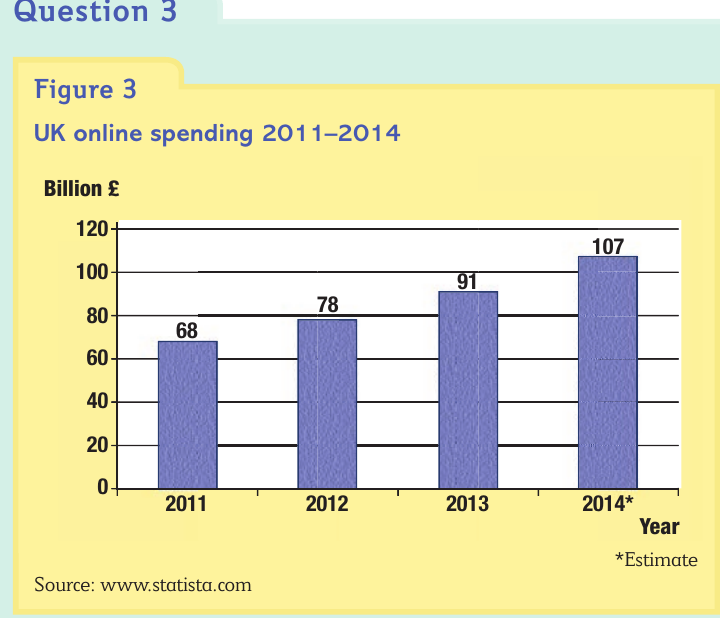
UK Online Retail Growth
UK online retail spending demonstrated remarkable growth between 2011 and 2014. Spending increased from \£68 billion in 2011 to \£78 billion in 2012, then \£91 billion in 2013, reaching an estimated \£107 billion in 2014. This represents a 57% increase over the four-year period, highlighting the rapid consumer adoption of online shopping.
Drawbacks of online distribution
Despite its advantages, online distribution presents challenges for businesses:
-
Increased competition: Online selling's relatively low barriers to entry mean businesses face more competitors, including international rivals who can sell to UK customers from anywhere in the world at any time.
-
Lack of personal contact: Some customers value face-to-face interaction with sales staff. The absence of human contact online may deter certain customer segments, particularly for complex purchases requiring advice.
-
Dependence on delivery services: E-tailers rely heavily on third-party courier and postal services over which they have limited control. Poor delivery experiences (late deliveries, damaged goods, failed delivery attempts) can damage the retailer's reputation despite being beyond their direct control.
-
Technical problems: Websites can crash, suffer virus attacks, or experience slow loading times. Internet connections may be unreliable in some areas. These technical issues can frustrate customers and result in lost sales.
-
Security risks: Computer hackers may attempt to access sensitive customer information, including payment card details and personal data. Security breaches can severely damage business reputation and result in regulatory penalties.
Important
Consumer Drawbacks of Online Shopping
Consumers also face drawbacks with online shopping:
- Inability to physically inspect, touch, or try products before purchase
- Risk of poor or unavailable after-sales service
- Exclusion of people without internet access or credit/debit cards
- Greater difficulty identifying fraudulent or unreliable traders
- Delivery timing challenges for people who work during standard delivery hours
- Increased risk of impulse purchases and overspending

Changing from product to service
Western economies have experienced significant structural changes, with the tertiary (service) sector expanding while the primary (agriculture and mining) and secondary (manufacturing and construction) sectors have declined relatively. This shift requires businesses to focus more carefully on distributing services rather than physical products.
Since most services are sold directly to consumers, businesses must consider the full range of direct distribution channels available. Unlike goods, services cannot be held in inventory, transported, or resold, making distribution strategies fundamentally different.
Some businesses that traditionally sold physical products (goods) now primarily offer services, requiring complete rethinking of distribution strategies. Technology and changing consumer preferences have driven this transformation.
Example
Examples of Product-to-Service Transformations
Music distribution: Consumers previously purchased music on CDs sold through retail stores or wholesalers. Today, most people access music by streaming or downloading via the internet directly to computers, tablets, and smartphones. Services like Spotify, Apple Music, and YouTube provide access to vast music databases from any location. Physical music sales have collapsed while streaming services dominate.
Film and video: Rather than buying DVDs from retail outlets, consumers now access film content through streaming services and digital rental platforms. Films can be viewed on computers, mobile devices, or televisions via internet connections. Services like Netflix, Amazon Prime Video, and Disney+ provide large content libraries for subscription fees.
News and information: Instead of purchasing newspapers from shops, many consumers access news through online subscription services or free websites. Traditional newspaper publishers have had to adapt by developing digital distribution strategies, often using paywalled content, advertising-supported free access, or hybrid models.
These shifts from products to services have fundamentally changed distribution strategies, with businesses moving from physical supply chains involving wholesalers and retailers to direct digital delivery platforms. This transformation continues to accelerate as technology improves and consumer preferences evolve.
Remember!
Summary
Key Points to Remember:
-
Distribution determines where and how consumers can access products – getting this right is critical for business success
-
Distribution channels are the pathways products follow from manufacturers to final customers, ranging from direct sales to complex multi-tier systems using intermediaries
-
Direct selling eliminates intermediaries and includes methods such as online sales, direct mail, telephone selling, and shopping parties – it maximises producer profits but may limit market reach
-
Retailers, wholesalers, and agents each play distinct roles as intermediaries, providing services like breaking-bulk, convenient access, and market knowledge
-
Businesses choose distribution channels based on product nature, cost, market characteristics, and control requirements
-
Online distribution (e-commerce) has transformed retail, offering benefits like 24/7 availability, lower costs, and global reach, but also presenting challenges such as delivery dependence and increased competition
-
The shift from products to services (music streaming vs CDs, film streaming vs DVDs) has fundamentally changed distribution strategies toward direct digital delivery
Key Terms: Distribution, distribution channel, intermediaries, breaking-bulk, retailers, wholesalers, agents/brokers, direct selling, e-commerce, B2C (Business-to-Consumer), B2B (Business-to-Business), FMCG (Fast-Moving Consumer Goods)
Critical Frameworks:
- Four main distribution channel models: direct, one-tier (via retailers), two-tier (via wholesalers and retailers), three-tier (via agents, wholesalers, and retailers)
- Four factors in choosing distribution channels: product nature, cost, market, control