Product Life Cycle (Edexcel A-Level Business): Revision Notes
📚Revision Notes
Product Life Cycle
What is the product life cycle?
The product life cycle is a model that illustrates how a product's sales performance changes over time. Understanding this concept helps businesses plan marketing strategies and forecast future performance.
Every product moves through distinct phases from initial development through to eventual decline. Some products, like Bisto gravy powder (launched in 1908), have exceptionally long life cycles spanning over a century. Others, such as the Sony Walkman, enjoyed approximately 30 years on the market before withdrawal in 2009. Some products are fads with very brief lifespans, often seen with children's toys.
By recognising which stage a product has reached, businesses can make informed decisions about pricing, promotion, and whether to invest in keeping the product viable or withdraw it from the market.
Note
Real-World Examples: Different products have vastly different life cycles. While Bisto gravy powder has remained successful for over a century, the Sony Walkman lasted about 30 years before market withdrawal. Understanding these variations helps businesses set realistic expectations for their products.
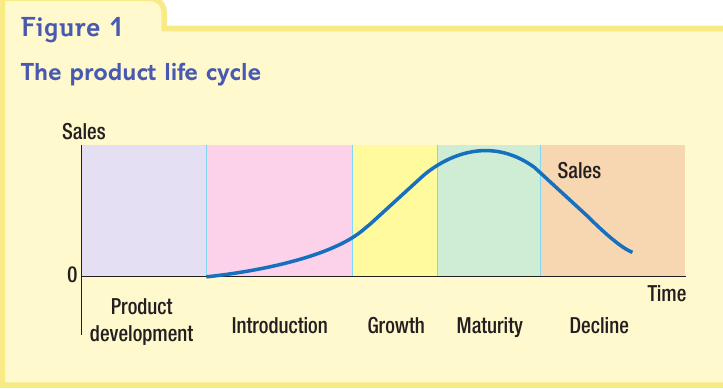
Stages of the product life cycle
Development
This initial phase involves researching, designing and testing the product concept. Key activities include:
- Investigating suitable ideas
- Creating and testing prototypes or models
- Deciding whether to proceed with a full launch
Important
Financial Characteristics of Development:
- High costs for research and development
- Zero revenue as no sales occur
- Many products fail at this stage due to business risk aversion
Businesses invest heavily during development without generating any income, making this a financially challenging period.
Introduction
The product enters the market at this stage. Launch characteristics include:
- Slow initial sales as consumers become aware of the product
- High costs from building production facilities, promotion and distribution
- Typically not yet profitable
- Limited retail distribution as few outlets stock new products
Note
Pricing Strategies at Introduction:
Businesses have two main pricing approaches during introduction:
- High pricing may be used to recover promotional costs quickly
- Low pricing might help penetrate the market and gain market share rapidly
The choice depends on the product type, competition, and business objectives.
The introduction period's length depends on product type. Technical innovations often have longer introduction phases as consumers need time to gain confidence in the product's reliability. Initially, these products may carry premium prices. Conversely, fashion items and fast-moving consumer goods can achieve rapid sales growth, becoming instant hits.
Growth
Once established and recognised by consumers, the product enters a rapid expansion phase:
- Rapid sales increase from new customers and repeat purchases
- Falling unit costs as production scales up
- Product becomes profitable for the first time
- Competitors enter the market if sales growth is strong, potentially slowing growth momentum
Note
Marketing Considerations During Growth:
As the product gains traction, businesses face new challenges:
- May need to reduce initially high prices to remain competitive
- Increased promotion may be necessary to build brand loyalty and defend against new competitors entering the market
The growth stage is crucial for establishing long-term market position.
Maturity and saturation
Eventually, sales growth slows and stabilises:
- Sales reach their peak and level off
- Product achieves a stable market share
- Market becomes saturated with competitors all seeking profit opportunities
- Some businesses exit as too many firms compete for the same customers
Important
Critical Decision Point:
This stage is critical for extension strategies (discussed below), which businesses use to prolong the product's commercial viability and delay decline. Implementing these strategies at the right time can significantly extend a product's profitable life.
Decline
For most products, sales eventually fall due to:
- Changing consumer preferences and tastes
- New technology making the product obsolete
- Introduction of superior replacement products
The product loses customer appeal and will eventually be withdrawn from the market or sold to another company. Profitability may still be possible if:
- Premium prices can be maintained
- Minimal investment is made in promotion or other costs
Note
Even during decline, some products can remain profitable if businesses carefully manage costs and maintain pricing power with remaining loyal customers.
Extension strategies
Extension strategies are techniques businesses use to prolong a product's life and delay the decline phase. These are valuable because product development costs are substantial, and extending maturity allows the product to generate more revenue.
Two main approaches exist: making product adjustments or investing in promotional activities.
Product adjustments
Businesses "freshen up" their products through various modifications:
Updating
Common for technical products and consumer durables. Car manufacturers regularly release updated versions of successful models with improved features, styling, or performance.
Example
Worked Example: Car Industry Updates
Major car manufacturers like Volkswagen, Toyota, and BMW release updated models every few years. The VW Golf, for instance, has been continuously updated since 1974, with each generation featuring:
- Improved fuel efficiency
- Enhanced safety features
- Updated styling and interior design
- Advanced technology integration
This approach has kept the Golf relevant for nearly 50 years, making it one of the world's best-selling cars.
Making improvements
Adding value by enhancing product functionality. Computer manufacturers exemplify this by releasing machines with faster processors, increased memory, improved aesthetics, and additional features. Service businesses like banks offer enhanced accounts with added benefits such as travel insurance, breakdown cover, and mobile phone protection.
Extending the product range
Introducing variations to appeal to different consumer preferences. Crisp manufacturers frequently launch new flavours—in 2014, Walkers introduced "pulled pork in a sticky BBQ sauce" after a public voting campaign on proposed new flavours.
Example
Worked Example: Product Range Extension
Walkers Crisps demonstrates effective range extension:
- Original range: Ready Salted, Cheese & Onion, Salt & Vinegar
- Extended flavours: Prawn Cocktail, Roast Chicken, Smoky Bacon
- Limited editions: Seasonal and campaign-driven flavours
- Sub-brands: Sensations, Max, Oven Baked variants
Each extension appeals to different taste preferences while maintaining the core brand identity, helping Walkers dominate the UK crisp market.
Repackaging
Creating the impression of modification by changing product packaging. Soft drinks manufacturers sell identical products in different formats (cans, glass bottles, various-sized plastic bottles). Music companies release compilation albums featuring previously released hits with new cover artwork.
Promotion strategies
Some businesses maintain the product unchanged but revitalise sales through promotional investment:
Finding new uses
Expanding the product's application range. WD-40, originally developed in 1953 to repel water and prevent corrosion, is now promoted for multiple purposes including removing dirt, loosening screws, and displacing moisture in car engines.
Example
Worked Example: WD-40's Multiple Uses
WD-40 exemplifies successful new use promotion:
- Original purpose: Water displacement and corrosion prevention (1953)
- Expanded uses promoted: Cleaning tools, loosening rusty parts, removing adhesive residue, silencing squeaky hinges, protecting metal surfaces
- Result: The company now promotes over 2,000 different uses for the product
This strategy transformed WD-40 from a specialist industrial product into a household essential, significantly extending its product life cycle.
Finding new markets
Geographical expansion from local to regional, regional to national, or national to international markets. UK retailers like Tesco and Marks & Spencer have attempted this approach with varying degrees of success.
Investing in advertising campaigns
Substantial advertising expenditure, particularly television campaigns, can reignite consumer interest and boost sales.
Encouraging more frequent use
Persuading consumers to use products in new contexts or more regularly. Cereal manufacturers have promoted eating cereals as supper options rather than exclusively for breakfast.
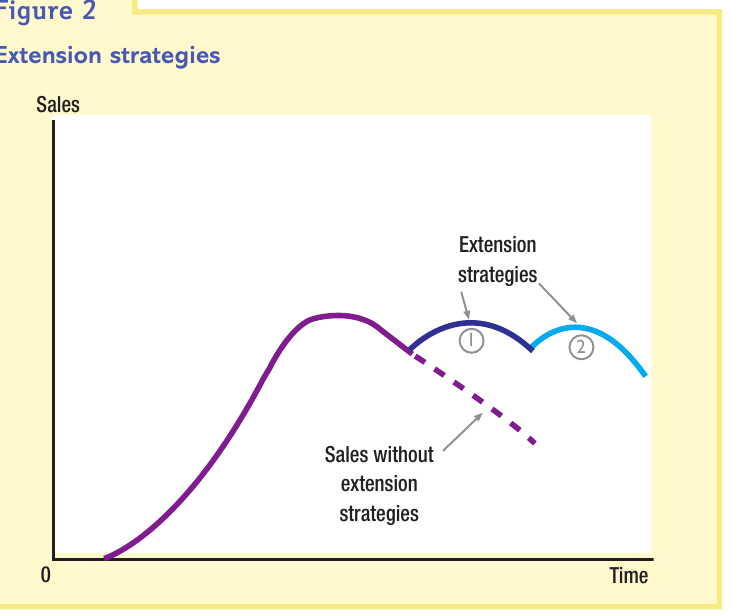
Important
Timing is Critical:
The diagram above illustrates how extension strategies delay the decline phase. As the market saturates and sales begin falling, implementing extension strategies postpones this decline.
Ideally, businesses should deploy these strategies during the maturity stage—before decline begins. Companies that accurately forecast falling sales can proactively implement extension strategies rather than waiting for decline to commence.
Summary
Key Points to Remember:
- The product life cycle model shows how sales change across six stages: development, introduction, growth, maturity, saturation, and decline
- Development and introduction stages typically involve high costs and low or zero profitability
- The growth stage brings rapid sales increases, falling unit costs, and profitability, but also attracts competitors
- Maturity and saturation occur when sales peak and level off as markets become crowded
- Extension strategies help prolong product life through either product adjustments (updating, improving, extending range, repackaging) or promotion (new uses, new markets, advertising, encouraging frequent use)
- Businesses should implement extension strategies during maturity, before decline begins, to maximise their effectiveness
Key terms: Product life cycle, development stage, introduction stage, growth stage, maturity stage, decline stage, extension strategies, product adjustments, promotion, unit costs, market saturation, fast-moving consumer goods, fads