Market Mapping (Edexcel A-Level Business): Revision Notes
📚Revision Notes
Market Mapping
Understanding market positioning
Before exploring market mapping, it's important to understand the concept of market positioning. This refers to how consumers perceive and categorize products in the marketplace. Rather than viewing every product individually, consumers simplify their choices by grouping products according to factors such as quality, status, and value for money.
Note
Consumers typically position products relative to competitors. They might create a mental "pecking order" or product ladder. Businesses use marketing activities strategically to shape these consumer perceptions and achieve their desired market position.
What is market mapping?
Market mapping (also called perceptual mapping or positioning mapping) is a visual tool that shows where brands are positioned in a market according to customer perceptions. These maps display the results of market research in an easy-to-interpret format.
Important
The critical point to understand is that brand positioning depends on customer perceptions, not what the business believes about its own products. For instance, a business might consider its brand to be high-quality and up-market, but if customers perceive it as low-quality and down-market, it is the customer view that matters and will ultimately influence sales performance.
Purpose and uses of market mapping
Market mapping serves several important strategic purposes for businesses:
Finding current brand position
When a business wants to understand where its brand sits in the market, it can conduct market research to gather customer perceptions. This research reveals how customers view the brand compared to competitors. The findings help businesses understand whether their intended positioning matches customer reality.
Note
Understanding Position vs. Perception
Market research bridges the gap between what businesses think about their brand and what customers actually believe. This alignment is crucial for effective marketing strategy.
Launching new brands
Before launching a new product, businesses need to identify their target market and understand what characteristics the brand must possess to succeed. Market research can reveal:
- The price range customers are prepared to pay
- Product features that matter most to the target audience
- The type of promotional support needed (e.g. national TV advertising versus retailer-focused promotion)
- Gaps in the market where competition is weak
This information guides product development and marketing strategy decisions.
Creating and interpreting perceptual maps
A perceptual map is constructed using two axes, each representing a different product attribute. Common attributes used include:
- Price (high to low)
- Quality (low to high)
- Traditional to modern styling
- Basic to luxury features
Brands are then plotted on the map according to how customers perceive them across these two dimensions.
Example: supermarket positioning
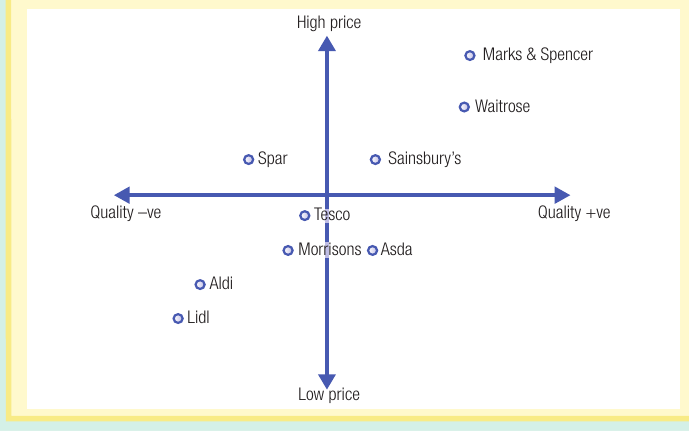
This perceptual map shows how consumers perceive different UK supermarket chains. The vertical axis represents price (high to low), while the horizontal axis represents quality perception (negative to positive).
Example
Worked Example: Analyzing Supermarket Positioning
Key insights from this map:
- Marks & Spencer and Waitrose occupy the high-price, high-quality quadrant
- Aldi and Lidl are positioned in the low-price, lower-quality-perception area
- Tesco sits near the center, suggesting it lacks a clearly defined position
- This positioning information helps businesses understand their competitive position and identify potential opportunities
Example: car market positioning
Looking at the car market, manufacturers position their brands across dimensions such as price and styling (traditional versus sporty). Luxury brands like Bentley and Rolls Royce occupy the high-price, traditional segment, while brands like Ferrari appeal to the high-price, sporty segment. Budget brands occupy the lower-price segments.

Note
These two vehicles represent different market positions. The white Volkswagen Golf GTI targets customers seeking sporty performance in a practical package, while the yellow Renault Clio with its distinctive styling appeals to those wanting a more budget-friendly sporty appearance. This demonstrates how manufacturers differentiate their products to target specific market segments.
Types of market maps
Research-based maps
These maps are created using primary market research data collected from customers. This involves surveying or interviewing consumers to understand their genuine perceptions of brands. While this approach provides accurate, evidence-based insights, it requires significant investment in market research activities.
Intuitive maps
Also called judgemental maps or consensus maps, these are created by marketers based on their professional understanding and experience of the industry. Management uses its best judgement rather than formal research data.
Important
The Risk of Intuitive Mapping
The value of intuitive maps is questionable, as these maps may simply reflect management's existing assumptions rather than actual customer views. Without real customer data, businesses risk making strategic decisions based on incorrect perceptions.
Limitations of market mapping
While market maps are useful strategic tools, they have several important limitations that businesses must consider:
Two-dimensional constraint
Important
Perceptual maps can only analyze two product attributes simultaneously. In reality, customers consider multiple factors when evaluating brands. To get a complete picture, businesses would need to create several different maps using different attribute combinations, which becomes complex and time-consuming.
Cost of research
Obtaining reliable data for perceptual maps requires primary market research, which can be expensive. Small businesses or those with limited budgets may struggle to justify this investment, potentially making decisions based on incomplete information.
Perception versus reality gap
There may be a significant difference between consumers' perception of a brand's benefits and the actual benefits it delivers. The map shows perception only, not objective product qualities.
Note
This means a high-quality product might be positioned poorly if customers don't perceive its quality correctly. Marketing communications play a crucial role in bridging this perception gap.
Brand level issues
Market maps work better for individual product brands than for corporate brands. A company with multiple product lines may find that different products are perceived differently, making corporate-level positioning difficult to map accurately.
Limited value of intuitive maps
Maps created without proper research data often simply validate what management already believes. They may give a false sense of credibility to preconceived ideas rather than revealing genuine market insights.
Exam application
When answering exam questions on market mapping:
-
Explain questions: Define what market mapping is and describe how it helps businesses understand customer perceptions. Use specific examples from the map provided.
-
Assess/Evaluate questions: Discuss both benefits (visual clarity, identifies gaps, informs strategy) and limitations (two-dimensional, cost, perception vs reality). Make a judgement about whether market mapping would be valuable in the given context.
Important
Always relate perceptual maps to customer perception rather than product features. The map shows what customers think, not what products actually are.
Remember!
Summary
Key Points to Remember:
- Market positioning is based on customer perceptions, not business opinions
- Market maps (perceptual maps) are visual tools showing brand positioning across two dimensions
- They help businesses understand their current position and identify opportunities for new products
- Market research is needed to create accurate maps based on real customer views
- Maps are limited by being two-dimensional and showing perception rather than reality
- Intuitive maps created without research may simply reflect management assumptions
Key Terms:
- Market positioning: How consumers perceive and categorize products
- Perceptual map: Visual representation of brand positions based on customer perceptions
- Market research: Gathering data about customer views to inform positioning decisions
Critical Concept:
Always remember that perceptual maps show customer perception, not objective reality. A product can be genuinely high quality but positioned as low quality if customers perceive it that way.