Product and Market Orientation (Edexcel A-Level Business): Revision Notes
📚Revision Notes
Product and Market Orientation
Understanding how businesses position themselves relative to their products and customers is fundamental to appreciating different strategic approaches in business. Companies can be positioned along a spectrum, ranging from being highly focused on technical production to being driven entirely by customer demands.
What is product orientation?
Product orientation describes businesses that prioritise the manufacturing process and technical excellence of what they produce. These organisations concentrate their resources on developing and creating products they believe will perform well in the market, with customer interaction occurring primarily at the point of sale.
Historical context
Note
In earlier periods of industrialisation, many companies adopted this approach successfully. Businesses manufacturing radios and televisions, for example, could rely on product orientation because the market conditions were fundamentally different from today.
The historical success of product orientation was built on several factors:
- Limited competition existed in the marketplace
- Growing domestic demand created ready buyers
- International competitors were minimal
- The novelty and technical sophistication of products generated consumer interest without extensive marketing
The products essentially marketed themselves through their innovative features and technological advancement.
Modern product-oriented industries
Some sectors continue to operate with a product-oriented approach today:
Machine-tool manufacturing provides a clear example. These businesses produce equipment used in manufacturing other goods and must meet precise technical specifications. However, even traditionally product-oriented sectors face pressure to consider consumer requirements more carefully due to intensifying competition. Customer input now increasingly influences the technical specifications that manufacturers work toward.
Note
Pharmaceuticals and research-intensive industries often engage in pure research—investigation conducted without a specific end product in mind or direct consideration of immediate consumer needs. This research-driven approach remains valuable and necessary for innovation in certain fields.
Key characteristics
Product-oriented businesses typically:
- Emphasise technical development and production quality
- Focus on creating products first, then finding customers
- Engage with consumers mainly at the sales stage
- Prioritise research and development over market feedback
- Operate more successfully in less competitive environments
What is market orientation?
Market orientation describes a fundamentally different approach where businesses continuously investigate, evaluate and respond to customer requirements. These organisations are led by market demands rather than production capabilities.
The pioneering approach: Henry Ford
Example
Pioneering Market Orientation: The Model T
Henry Ford exemplified early market orientation when developing the Model T automobile. Rather than simply designing a vehicle, manufacturing it economically and attempting to sell the result, Ford started from a different position:
Step 1: He first identified the price point at which large numbers of consumers would purchase a car
Step 2: He then worked backwards to design and produce a vehicle that could profitably meet that target
This customer-focused starting point made the Model T one of the first true mass-market products.
Contemporary examples
Modern businesses frequently adopt market-oriented strategies. Sony has built its reputation on understanding and responding to consumer preferences. Apple's development of products like the iPhone 6 demonstrates how successful companies create innovations directly addressing customer desires rather than simply showcasing technical capabilities.
Advantages of market orientation
Businesses that prioritise market understanding gain several competitive benefits:
- Faster response capability: Access to market information enables quicker reactions to changing conditions and trends
- Competitive resilience: Better positioned to counter new entrants and competitive threats
- Anticipatory capacity: More able to predict and prepare for market shifts before they occur
- Launch confidence: Greater certainty that new products will achieve commercial success
Requirements for market orientation
Adopting a market-oriented approach demands specific business practices:
- Continuous consumer consultation: Regular market research to maintain current understanding of customer preferences
- Customer-led design: Developing products according to consumer specifications and desires
- Demand-appropriate production: Manufacturing quantities aligned with actual market demand
- Customer-focused distribution: Delivering products through channels matching consumer purchasing habits and delivery expectations
- Consumer-acceptable pricing: Setting prices at levels customers are willing and able to pay
Important
These elements combine to form the marketing mix—delivering the right product at the right price in the right place, whilst ensuring consumers know about its availability. This concept is fundamental to successful market orientation.
Limitations of market orientation
Despite its advantages, market orientation cannot guarantee success. Well-researched products still fail commercially.
Important
Learning from Failure: The Coloroll Example
Coloroll, a wallpaper manufacturer that successfully expanded into home textiles and furnishings, experienced failure when attempting to enter the DIY burglar alarm market. The company's design reputation and expertise held little value in a sector where consumers prioritised security technology and electronics credentials.
This demonstrates that market research and customer focus, whilst valuable, cannot eliminate business risk.
Factors determining business orientation
Whether a business emphasises product or market orientation depends on multiple influences:
Nature of the product
Companies operating at the frontier of innovation—in biotechnology, pharmaceuticals or electronics, for instance—must prioritise research and development to remain viable. Although these businesses may attempt to anticipate consumer demand, their research is often "pure" in nature, meaning researchers explore possibilities without predetermined product outcomes in mind.
Policy decisions
Note
Organisational objectives shape orientation. When leadership sets goals around technical quality or safety standards, the business naturally emphasises production aspects. Conversely, objectives focusing on market share or revenue growth push the organisation toward marketing and customer engagement.
Management perspectives
The professional background and priorities of decision-makers influence strategic direction:
- Accountants and financial directors typically emphasise cash flow projections and profit forecasting
- Production engineers prioritise technical quality control and research investment
- Marketing professionals concentrate on consumer research and relationship management
The balance of power among these stakeholders affects overall business orientation.
Market nature and size
When production costs are substantial, businesses typically adopt market orientation to ensure they meet customer needs and avoid expensive unsold inventory. High production costs create strong incentives to understand demand accurately before committing resources.
Competitive intensity
Note
Limited competition may allow businesses to invest in research without immediate concern about market share erosion. In contrast, companies facing intense rivalry typically increase marketing expenditure, fearing that insufficient customer focus will result in lost market position.
The orientation spectrum
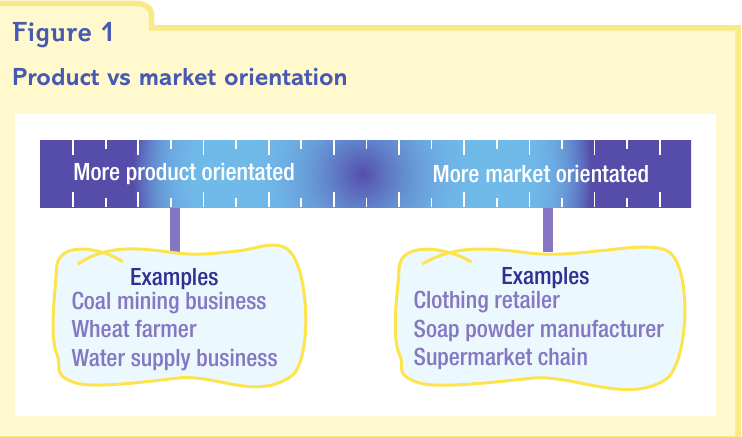
Rather than representing absolute categories, product and market orientation form two ends of a spectrum. Most businesses position themselves somewhere between these extremes, with their exact position reflecting their industry, strategy and circumstances.
More product-oriented examples include:
- Coal mining operations
- Wheat farming
- Water supply companies
More market-oriented examples include:
- Clothing retailers
- Soap powder manufacturers
- Supermarket chains
A copper mining company would typically operate toward the product-oriented end, whilst a supermarket chain would position itself toward the market-oriented end. This spectrum recognises that pure examples of either extreme are rare, and most businesses balance both orientations to varying degrees.
Real-world application: AstraZeneca
Example
Case Study: AstraZeneca's Product Orientation
AstraZeneca, a British-Swedish pharmaceutical corporation, illustrates product orientation in a modern context. Serving global healthcare markets with focus areas including cancer and cardiac treatments, the company employs approximately 57,500 people worldwide with manufacturing facilities across 16 countries.
The UK hosts AstraZeneca's major research and development operations, with centres like Alderley Park leading cancer research initiatives. The site contains advanced facilities for drug discovery, including sophisticated compound management and screening capabilities. AstraZeneca ranks among the world's largest R&D investors.
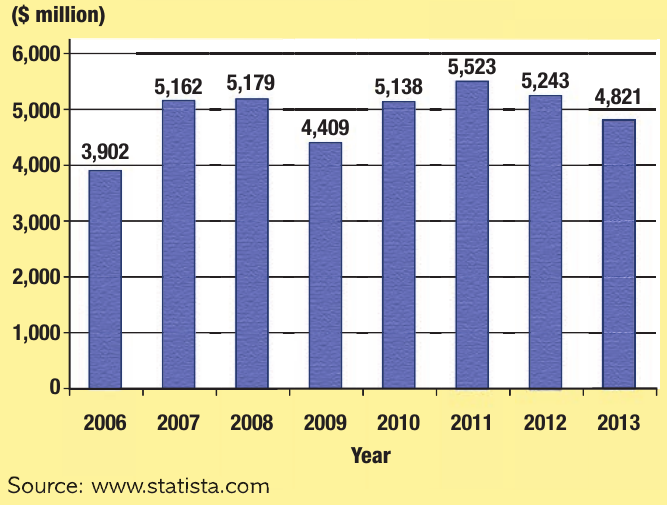
Between 2006 and 2013, the company's R&D expenditure fluctuated significantly, starting at $3,902 million in 2006, peaking at $5,523 million in 2011, before declining to $4,821 million by 2013. This substantial, sustained investment in research exemplifies product orientation, where technical development and innovation receive priority over immediate market demands.
Note
However, even in pharmaceuticals, complete product orientation has limitations. Drug companies must still understand patient needs, physician preferences and healthcare system requirements. The most successful pharmaceutical businesses balance research excellence with market awareness, demonstrating that even heavily product-oriented industries benefit from customer understanding.
Remember!
Summary
Key Points to Remember:
- Product orientation focuses on technical excellence and production capabilities, with customer engagement occurring primarily at the sales stage
- Market orientation prioritises continuous customer research and bases all business decisions on meeting consumer needs
- Market-oriented businesses gain advantages in responsiveness, competitive resilience and anticipatory capability, though this approach doesn't guarantee success
- The marketing mix ensures businesses deliver the right product at the right price in the right place with appropriate promotion
- Most businesses position themselves along a spectrum between these extremes, influenced by factors including product nature, policy decisions, management views, market characteristics and competitive intensity
- Industries requiring substantial research investment (pharmaceuticals, biotechnology) tend toward product orientation, whilst consumer-facing retail businesses typically adopt market orientation