Organisational Structures (Edexcel A-Level Business): Revision Notes
📚Revision Notes
Organisational Structures
What is an organisational structure?
An organisational structure (also called business structure, internal structure, or formal organisation) refers to how positions and roles are arranged within a business. It defines the framework that shapes how a business operates on a day-to-day basis.
Note
The organisational structure is like the skeleton of a business—it provides the fundamental framework that determines how everything functions and connects together.
The organisational structure determines several critical elements:
- Employee roles and job titles – what each person's position is called and what they do
- Decision-making pathways – how and where decisions are made in the business
- Lines of accountability – who answers to whom and for what activities
- Working relationships – how different positions relate to and interact with each other
- Communication channels – how employees share information and stay connected
Different businesses require different structures based on their objectives, size, and operational needs. Small businesses typically have simpler structures with fewer layers, while larger businesses often divide into multiple departments with dedicated managers. Structure becomes increasingly important as a business grows—a two-person plumbing firm faces fewer organisational challenges than a multinational corporation.
Businesses can develop their structure in different ways. Some build their structure organically around the skills and abilities of existing employees. Others design the complete structure first, defining all necessary roles, then recruit people to fill those positions.
Example
Real-World Example: Virgin Atlantic's Structure
Entrepreneur Richard Branson reportedly planned the entire organisational structure for Virgin Atlantic before launching the airline. He defined all necessary roles and positions in advance, then recruited 102 people to fill those predetermined positions. This approach ensured the airline had the right structure from day one.
Hierarchy
Many businesses create organisational charts to visualise their structure. These diagrams illustrate how the business is organised and show:
- Division into departments or divisions
- Employee roles and their official job titles
- Lines of responsibility throughout the business
- Accountability relationships (who reports to whom)
- Communication pathways between positions
- Working relationships between different roles
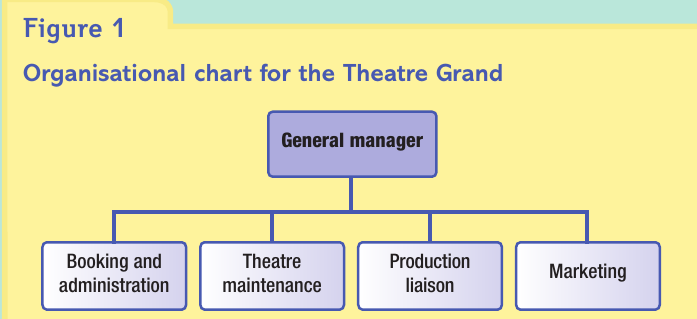
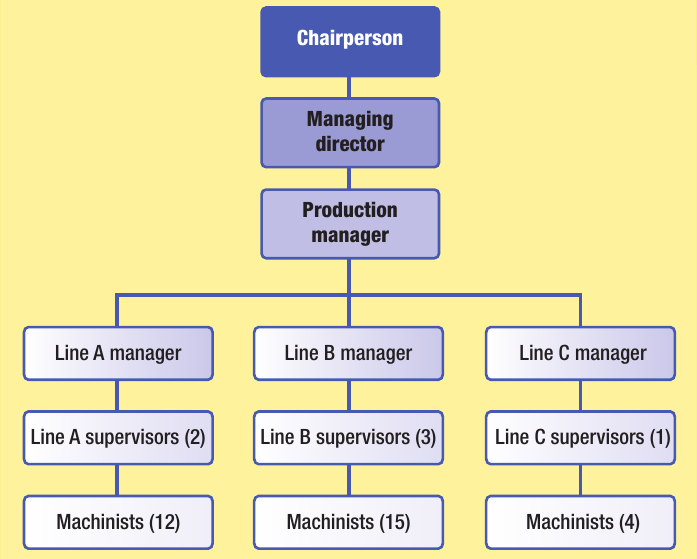
The hierarchy represents the levels of management within a business, from the lowest rank to the highest. A hierarchical structure shows that employees hold different levels of authority and responsibility. Those at the top of the hierarchy (such as directors or chairpersons) have the most authority and responsibility, while those at the bottom (such as general staff or apprentices) have the least.
Employee roles in the organisational hierarchy
Understanding the different roles within the hierarchy helps clarify how authority and responsibility flow through a business. Here are the main categories of positions:
Directors
Directors are appointed to run the business on behalf of its owners. In small businesses, the owners and directors may be the same people. In larger businesses (particularly those owned by shareholders), directors are separate from the owners.
Directors hold ultimate responsibility for major organisational decisions. They meet as the board of directors to make strategic decisions affecting the business's future. Two types of directors exist:
- Executive directors actively participate in running the business
- Non-executive directors provide oversight and guidance but don't manage day-to-day operations
Note
The managing director (MD) has overall responsibility for the entire organisation and holds authority over other directors, such as the finance director or marketing director. This is the highest executive position in many businesses.
Managers
Managers are responsible for controlling and organising specific areas within the business. They typically make day-to-day operational decisions. For example, a sales manager oversees all sales activities and reports to the marketing director.
Different types of managers include:
- Departmental managers – oversee specific functions like marketing, human resources, finance, or production
- Regional managers – organise business operations across geographical areas
- Branch managers – run individual branches or stores
Team leaders
Team leaders coordinate and facilitate team effectiveness. Their primary role involves resolving conflicts between team members and ensuring the team works cohesively toward its goals.
Team leaders may lead permanent teams (such as cell production teams) or temporary project teams (such as a staff morale investigation group). They often represent their team's views to higher management levels, such as presenting market research findings to department managers.
Supervisors
Supervisors monitor and regulate work within their assigned area, such as stock supervision or payroll supervision. They operate at a level below managers but may be delegated some managerial responsibilities, including:
- Hiring decisions
- Disciplinary actions
- Performance management (promoting, rewarding, or addressing poor performance)
Supervisors ensure that work in their area meets required standards and targets.
Professionals
Professionals are highly qualified and experienced staff who make important decisions and ensure high-quality task completion. These positions require significant expertise and carry responsibility for delivering excellent results.
Examples include doctors, architects, stockbrokers, product designers, chefs, and accountants. These roles typically require formal qualifications and extensive training.
Operatives
Operatives are skilled workers directly involved in production or service delivery. They follow instructions from managers or supervisors while ensuring their specific tasks meet quality and efficiency targets.

Examples of operatives include:
- Production operatives – assembling cars, manufacturing furniture
- Warehouse operatives – checking invoices, managing deliveries
- IT operatives – providing technical support for equipment and systems
General staff
General staff perform essential routine tasks that keep the business functioning. These positions don't require specialised skills but are vital to operations.
Note
While general staff positions may not require specialized skills, they form the foundation of daily business operations. Without these essential workers, many businesses simply could not function.
Examples include checkout staff, shelf stackers, cleaners, receptionists, and general labourers on farms or building sites.
Chain of command
The chain of command shows how authority is organised within the hierarchy. It represents the path through which:
- Orders and instructions flow downward (from senior to junior levels)
- Information and feedback flow upward (from junior to senior levels)
Important
The Communication Challenge
Research by R. Townsend suggests that each additional management level reduces communication effectiveness by approximately 25%. This means that a message passing through four management levels could lose up to 75% of its effectiveness!
Therefore, businesses generally aim to keep their chains of command as short as possible to maintain clear, efficient communication.
Span of control
The span of control refers to the number of subordinates (people) that one person directly manages or controls. For example, if a production manager oversees ten subordinates, their span of control is ten.
- Wide span of control = many subordinates reporting to one manager
- Narrow span of control = few subordinates reporting to one manager
Note
Fayol's Recommendation
Henri Fayol, a pioneer in management theory, recommended keeping the span of control between three and six subordinates. His reasoning was:
- Managers need to maintain tight control from senior levels
- Physical and mental limitations restrict how many people and activities a single manager can effectively control
When the span of control exceeds six people, management effectiveness may decline.
The implications of different spans of control are explored in more detail when examining different organisational structure types.
Authority and responsibility
While these terms are related, they have distinct meanings:
Important
Understanding the Difference
Responsibility means being accountable and required to justify actions or outcomes. For example, a department manager is responsible for their team's performance and must explain poor results to the board of directors. If the human resources department recruits someone who proves unsuitable for a role, they must explain why.
Authority means having the power and permission to carry out specific tasks. For example, an office worker cannot pay company debts unless they have authority to sign cheques.
Employees at lower hierarchy levels have less responsibility and authority than those higher up. However, managers can delegate (pass down) authority to subordinates while retaining ultimate responsibility.
Example
Worked Example: Delegation in Practice
A manager might delegate cheque-signing authority to an office worker to speed up payment processing. This gives the office worker the authority to sign cheques on the company's behalf.
However, if something goes wrong—such as an incorrect payment or fraud—the manager remains responsible for the outcome, even though they didn't personally sign the cheque.
This demonstrates how authority can be delegated, but ultimate responsibility remains with the manager.
Modern businesses increasingly recognise the benefits of delegating both authority and responsibility to empower employees and improve decision-making speed.
Important
Exam Tip
Don't confuse authority with responsibility—they're not the same:
- Someone with responsibility is accountable for others' work
- Someone with authority has the right to carry out particular tasks or duties
Remember: A manager can delegate authority but still retains responsibility.
Summary
Key Points to Remember:
- Organisational structure defines how positions are arranged, including roles, decision-making routes, accountability, relationships, and communication channels
- Organisational charts visually represent the business structure, showing divisions, roles, responsibilities, and reporting relationships
- Hierarchy shows management levels from bottom to top, with authority and responsibility increasing at higher levels
- Key roles include directors, managers, team leaders, supervisors, professionals, operatives, and general staff—each with distinct responsibilities
- Chain of command shows how authority flows through the organisation; shorter chains improve communication effectiveness (each level can reduce effectiveness by 25%)
- Span of control indicates how many subordinates report to one manager; Fayol recommended 3-6 for effective management
- Authority (ability to act) differs from responsibility (accountability for outcomes)—managers can delegate authority while retaining responsibility