Price Elasticity of Demand (Edexcel A-Level Business): Revision Notes
📚Revision Notes
Price elasticity of demand
Price elasticity of demand (PED) measures how responsive the quantity demanded of a product is to changes in its price. Understanding PED is crucial for businesses when making pricing decisions, as it helps predict the impact of price changes on sales and total revenue.
What is price elasticity of demand?
When businesses change prices, the quantity demanded usually changes too. However, the extent of this change varies between products. Some products experience large changes in demand when prices change (elastic), while others see relatively small changes (inelastic).
Price elasticity of demand measures the responsiveness of demand to a change in price. It quantifies the relationship between percentage changes in price and the resulting percentage changes in quantity demanded.

Note
The PED formula is fundamental for understanding how price changes affect demand. It provides a numerical value that helps businesses make informed pricing decisions.
The formula for calculating price elasticity of demand is:
To calculate percentage changes, use:
Price inelastic demand
Price inelastic demand occurs when a change in price results in a proportionately smaller change in demand. This means the percentage change in quantity demanded is less than the percentage change in price.
When demand is price inelastic:
- PED value is less than 1 (e.g. 0.5, 0.3, 0.8)
- Price changes have relatively little impact on demand
- Consumers continue buying similar quantities despite price changes
Example
Worked Example: Calculating Inelastic Demand
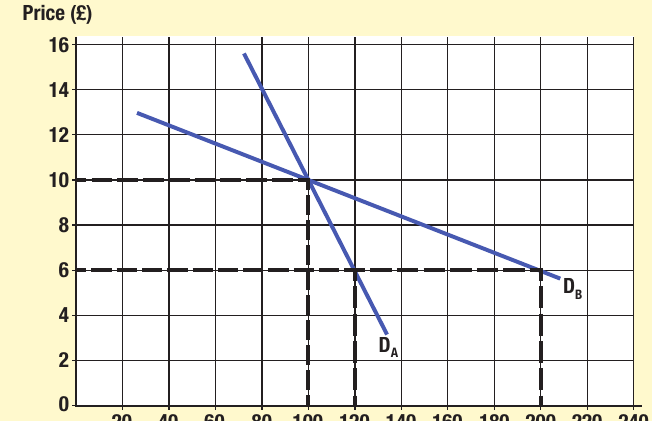
Product A demonstrates inelastic demand. When price falls from £10 to £6 (a 40% decrease), demand only increases from 100 to 120 units (a 20% increase).
Step 1: Calculate percentage change in quantity demanded
Step 2: Calculate percentage change in price
Step 3: Apply the PED formula
Since 0.5 < 1, demand is price inelastic. The steep demand curve (DA) reflects this lower responsiveness.
Examples of price inelastic products:
- Petrol (in the short term)
- Necessities like bread and milk
- Products with few substitutes
- Addictive products like cigarettes
A minority of goods have price inelastic demand. These tend to be essential items or products where consumers have limited alternatives.
Price elastic demand
Price elastic demand occurs when a change in price results in a greater proportionate change in demand. The percentage change in quantity demanded exceeds the percentage change in price.
When demand is price elastic:
- PED value is greater than 1 (e.g. 1.5, 2.0, 3.5)
- Demand responds strongly to price changes
- Consumers significantly adjust their purchasing based on price
Example
Worked Example: Calculating Elastic Demand
Product B demonstrates elastic demand. The same price fall from £10 to £6 (40% decrease) causes demand to increase from 100 to 200 units (a 100% increase).
Calculation:
Since 2.5 > 1, demand is price elastic. The flatter demand curve (DB) shows this higher responsiveness.
Examples of price elastic products:
- Luxury goods
- Products with many substitutes
- Non-essential items
- Branded products facing competition
Most goods have price elastic demand, particularly in competitive markets where consumers can easily switch between alternatives.
Calculating price elasticity of demand
Let's work through the calculation process step by step.
Example
Worked Example: Complete PED Calculation
Step 1: Calculate the percentage change in quantity demanded
If quantity demanded increases from 100 to 120 units:
Step 2: Calculate the percentage change in price
If price falls from £10 to £6:
Note: The negative sign indicates a price decrease.
Step 3: Apply the PED formula
Interpretation: Since 0.5 < 1, demand is price inelastic.
Important
Important note about negative signs: PED values are technically negative because price and demand move in opposite directions (when price rises, demand falls, and vice versa). However, when interpreting PED values, we focus on the numerical size, ignoring the negative sign.
Interpreting numerical values of PED
The numerical value of PED tells us whether demand is elastic or inelastic:
PED less than 1 (e.g. 0.5, 0.3, 0.7):
- Demand is price inelastic
- Quantity demanded changes by a smaller percentage than price
- Example: If PED = 0.5, a 10% price rise causes only a 5% fall in demand
PED greater than 1 (e.g. 1.5, 2.0, 3.0):
- Demand is price elastic
- Quantity demanded changes by a larger percentage than price
- Example: If PED = 2.5, a 10% price rise causes a 25% fall in demand
PED equal to 1 (rare):
- Demand is unit elastic
- Percentage changes in price and quantity are exactly equal
Note
The negative sign in PED calculations is not used to determine elasticity. We compare the absolute value (ignoring the minus) to 1 to classify demand as elastic or inelastic.
Factors influencing price elasticity of demand
Several factors determine whether a product has elastic or inelastic demand. Understanding these helps businesses predict consumer responses to price changes.
Time period
Price elasticity tends to increase over longer time periods. In the short term, consumers may have limited options to change their behavior, making demand more inelastic. However, over time, they can find alternatives or adjust their habits.
Example
Worked Example: Petrol Demand Over Time
When petrol prices rise by 20% in a week, demand might only fall slightly (perhaps 5%) because car owners still need to drive to work or shops. This makes short-term demand highly inelastic.
Short-term PED calculation: (highly inelastic)
However, over ten years, consumers can respond by:
- Buying more fuel-efficient cars
- Using public transport
- Moving closer to work
This makes long-term demand more elastic, potentially with PED > 1.
Competition and substitutes
The availability of substitute products significantly affects elasticity. When many alternatives exist, consumers can easily switch if prices rise, making demand more elastic.
Perfect substitutes: In highly competitive markets where products are identical (like wheat or potatoes sold by farmers), demand becomes extremely price elastic. If one seller raises prices above the market rate, they lose all customers to competitors selling at the lower price.
Differentiated products: When products differ from competitors, demand becomes more inelastic. Consumers may accept higher prices for their preferred brand or product features.
Branding
Strong branding reduces price elasticity by creating customer loyalty and perceived differences from substitutes. Successful brands convince consumers that alternative products are not adequate replacements.
Note
Example: Kellogg's Corn Flakes
Many Kellogg's Corn Flakes buyers do not consider supermarket own-brand cornflakes as acceptable substitutes, even when they cost 50% more. They remain loyal to Kellogg's despite the price premium. This brand loyalty makes demand for Kellogg's more inelastic than demand for generic cornflakes.
Effective branding reduces the number of products consumers see as substitutes, thereby reducing price elasticity.
Proportion of income spent
The share of consumer income spent on a product affects how sensitive demand is to price changes.
Inexpensive products: When the amount spent is trivial compared to income, demand tends to be inelastic. A 20% price increase on a 10p box of matches (rising to 12p) involves such small amounts that consumers barely notice. Demand falls by much less than 20%.
Expensive products: When purchases represent a significant portion of income, demand becomes more elastic. A 20% increase in car prices from £20,000 to £24,000 involves an extra £4,000 - a substantial amount for most consumers. This large absolute increase deters many buyers, causing demand to fall by more than 20%.
Product category versus individual brand
General product categories typically have lower price elasticity than specific brands within that category.
Product category (more inelastic): Demand for petrol as a whole is relatively inelastic because it has few substitutes for car owners who need to drive. Even if all petrol prices rise, people still need to fill their tanks.
Individual brand (more elastic): Demand for Shell petrol specifically is much more elastic because Shell petrol competes directly with Esso, BP, and other brands. If Shell raises its prices above competitors, customers easily switch to alternatives.
Important
This distinction is important for businesses. Even companies with strong brands usually operate where demand is price elastic because consumers can choose rival brands.
Price elasticity of demand and pricing decisions
Understanding PED helps businesses develop effective pricing strategies. The appropriate strategy depends on whether demand is elastic or inelastic.
Pricing with inelastic demand
When a product has inelastic demand, businesses can increase prices without losing many customers. The percentage fall in quantity demanded is smaller than the percentage price increase, potentially increasing total revenue.
Benefits of raising prices with inelastic demand:
- Revenue increases (explained in next section)
- Costs may fall due to lower production volumes
- Profits typically increase
Note
Real-world Example: UK Energy Companies
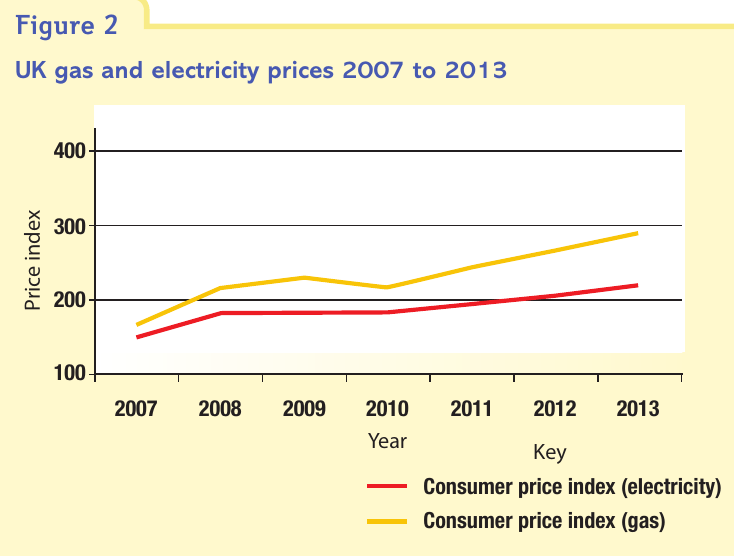
UK energy companies selling gas and electricity have substantially increased prices since 2007. The diagram shows gas prices nearly doubled between 2007 and 2013, with electricity prices also rising significantly.
Despite these large price increases, demand has not fallen noticeably, confirming that energy demand is highly price inelastic. Energy companies successfully raised prices without suffering significant demand reductions because consumers have limited alternatives for heating and powering their homes.
Pricing with elastic demand
When demand is price elastic, increasing prices causes a more than proportionate fall in demand, typically reducing total revenue. Instead, businesses should consider price reductions.
Benefits of lowering prices with elastic demand:
- Demand increases by a larger percentage than the price cut
- Revenue increases (explained in next section)
- Market share may grow
Note
Real-world Example: Aldi and Lidl
Low-cost supermarkets like Aldi and Lidl have experienced significant sales growth by charging lower prices in the highly competitive grocery market. In this market, demand is elastic because consumers can easily switch between supermarkets.
By reducing prices, these retailers attract customers away from competitors, increasing their sales by more than the percentage price reduction.
Important consideration for all businesses
Even businesses with strong brands and limited competition typically operate where demand is price elastic at their current prices. Here's why:
Important
Why Demand Must Be Elastic at Current Prices
If demand were inelastic, raising prices would:
- Increase revenue (due to inelastic demand)
- Reduce costs (selling fewer units means lower production costs)
- Increase profits
A profit-maximizing business would therefore continue raising prices until demand becomes elastic. This means even luxury brands like Chanel or Gucci, despite their prestige and loyal customers, likely face elastic demand at their current selling prices.
Price elasticity of demand and total revenue
Total revenue (TR) equals price multiplied by quantity sold. Understanding how PED affects total revenue is crucial for pricing decisions.
Inelastic demand and total revenue
When demand is price inelastic (PED < 1):
- Price increase → Total revenue rises
- Price decrease → Total revenue falls
Example
Worked Example: Inelastic Demand and Total Revenue (Product A)
At P = \10: $$\text{TR} = 10 \times 100 = \1{,}000$$
At P = \6: $$\text{TR} = 6 \times 120 = \720$$
Result: When price fell from £10 to £6, total revenue decreased by £280. Even though more units were sold (120 instead of 100), the lower price per unit caused overall revenue to fall.
Why this happens: With inelastic demand, the percentage gain in quantity is smaller than the percentage loss from the lower price. The extra units sold don't compensate for the reduced revenue per unit.
Elastic demand and total revenue
When demand is price elastic (PED > 1):
- Price increase → Total revenue falls
- Price decrease → Total revenue rises
Example
Worked Example: Elastic Demand and Total Revenue (Product B)
At P = \10: $$\text{TR} = 10 \times 100 = \1{,}000$$
At P = \6: $$\text{TR} = 6 \times 200 = \1{,}200$$
Result: When price fell from £10 to £6, total revenue increased by £200. The large increase in quantity sold (from 100 to 200) more than compensated for the lower price per unit.
Why this happens: With elastic demand, the percentage gain in quantity exceeds the percentage loss from the lower price. The extra units sold generate enough additional revenue to offset the lower price per unit.
Summary of PED and total revenue relationships
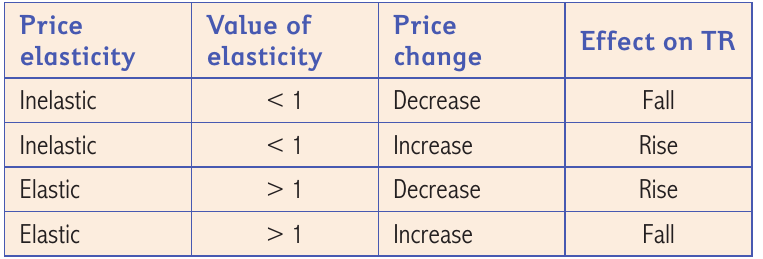
| Price elasticity | Value | Price change | Effect on total revenue |
|---|---|---|---|
| Inelastic | < 1 | Decrease | Falls |
| Inelastic | < 1 | Increase | Rises |
| Elastic | > 1 | Decrease | Rises |
| Elastic | > 1 | Increase | Falls |
Business applications
Note
Rail Companies and Off-Peak Pricing
Many rail companies charge lower prices for off-peak travel. By reducing prices during quieter periods, they attract more travelers. If revenue increases from these lower prices, this confirms that demand during off-peak periods is price elastic - the percentage increase in passengers exceeds the percentage price reduction.
Note
Energy Companies
The ability of UK energy companies to raise prices substantially without significant demand falls demonstrates inelastic demand. They correctly identified that increasing prices would increase total revenue.
Limitations of using PED for pricing decisions
While PED is a valuable tool, businesses should be aware of several limitations when using it to make pricing decisions.
Historic data problems
Businesses often calculate PED by examining how sales responded to past price changes. However, this historic data may not accurately predict future consumer behavior.
Important
Example Problem with Historic Data
A business might calculate that when it reduced prices by 12% four years ago, demand rose by 18%, giving a PED of 1.5. However, market conditions may have changed significantly since then:
- New competitors might have entered
- Consumer preferences might have shifted
- The economic situation might be different
Using this outdated PED value could lead to incorrect pricing decisions.
Market research accuracy
An alternative approach involves conducting market research to estimate how consumers will react to future price changes. This provides more current data but faces different challenges.
Potential issues with market research:
- Sample may not be representative of the entire customer base
- Consumers often say one thing in surveys but behave differently in reality
- People may not accurately predict their own future behavior
- External factors (like competitor actions) aren't captured in research
Practical implications
Businesses using PED for pricing decisions should:
- Recognize that elasticity values are estimates, not precise measurements
- Use multiple data sources when possible
- Monitor actual results after price changes and adjust strategies accordingly
- Consider that PED values can change over time as market conditions evolve
Exam guidance
Important
Common Mistake to Avoid
Some students incorrectly state that "demand for product x is inelastic, meaning a business can raise the price with no change in demand." This is wrong.
Even with inelastic demand, price changes still cause demand changes - they're just smaller proportionate changes. Inelastic demand means a price increase causes a less than proportionate fall in demand, not that demand stays constant.
Remember!
Summary
Key Concepts:
- PED measures responsiveness - it quantifies how much demand changes when prices change
- PED < 1 = inelastic - demand changes by a smaller percentage than price (e.g. necessities, products with few substitutes)
- PED > 1 = elastic - demand changes by a larger percentage than price (e.g. luxuries, products with many substitutes)
- Formula:
- Ignore the negative sign when determining whether demand is elastic or inelastic
Factors Affecting PED:
- Time - demand becomes more elastic over longer periods
- Competition - more substitutes make demand more elastic
- Branding - stronger brands face more inelastic demand
- Income proportion - expensive items have more elastic demand
- Category vs brand - individual brands face more elastic demand than product categories
Total Revenue Relationships:
- Inelastic demand: price up → revenue up; price down → revenue down
- Elastic demand: price up → revenue down; price down → revenue up
- Businesses should raise prices when demand is inelastic and lower prices when demand is elastic to maximize revenue
Key Terms:
- Price elasticity of demand - the responsiveness of demand to a change in price
- Price elastic demand - when a price change causes a greater proportionate change in demand (PED > 1)
- Price inelastic demand - when a price change causes a smaller proportionate change in demand (PED < 1)
- Total revenue - price multiplied by quantity sold ()