Recruitment and Selection Process (Edexcel A-Level Business): Revision Notes
📚Revision Notes
Recruitment and Selection Process
What is recruitment?
Recruitment is the process businesses use to attract and hire the most suitable employees for vacant positions. It involves identifying candidates who possess the right skills, qualifications and experience needed for specific roles. Selection refers to choosing the best candidate from those who apply.
Note
In small businesses, recruitment might be informal—perhaps a simple conversation between the owner and a potential employee. However, larger organisations typically follow a structured, formal recruitment process managed by the human resources (HR) department. This systematic approach helps ensure the business employs people who will contribute effectively to organisational goals.
Why businesses recruit new employees
Organisations need to recruit new staff for several key reasons:
- Business expansion: When a company grows, it requires additional workers to handle increased workload and operations
- Staff turnover: Employees leave for various reasons (retirement, resignation, relocation), creating vacancies that must be filled
- Internal promotion: When existing staff are promoted to higher positions, their previous roles become available
- Temporary cover: Businesses need workers to cover absences such as maternity leave, paternity leave, or long-term sickness
Understanding why recruitment is needed helps businesses plan the type of employee required—whether full-time, part-time, permanent or temporary.
The seven-stage recruitment and selection process
Effective recruitment follows a systematic procedure to ensure the right person is appointed. This process can be broken down into seven distinct stages:
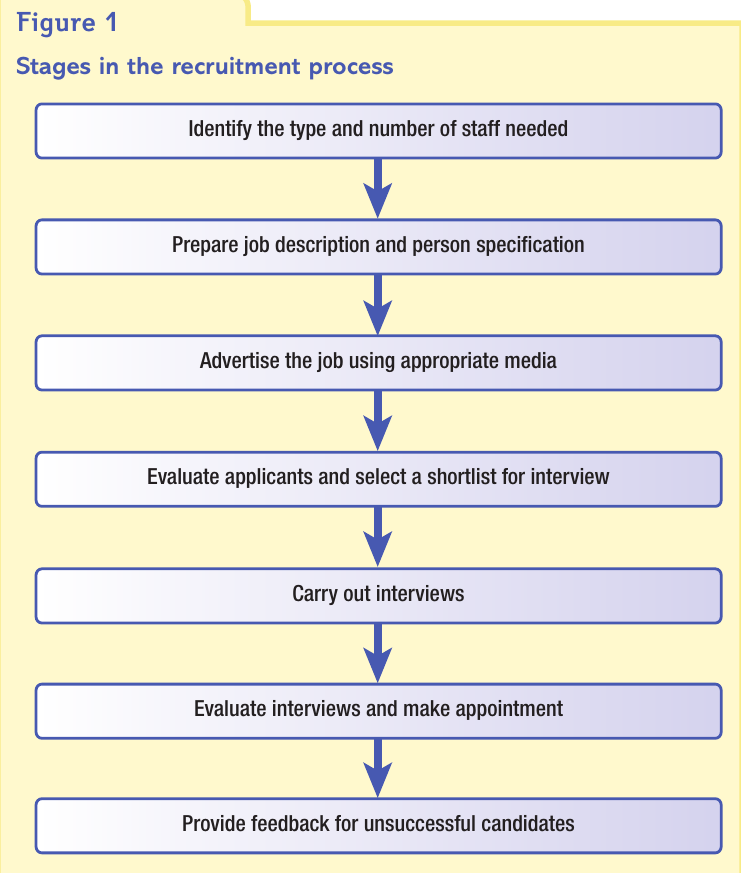
Stage 1: Identify staffing needs
The first step involves determining exactly what the business requires. Managers must decide:
- How many employees are needed
- What type of workers are required (full-time, part-time, permanent, temporary)
- What skills and experience are necessary
The overall business plan provides guidance here. For example, if expansion is planned, the business will need to attract larger numbers of applicants to fill multiple positions.
Stage 2: Prepare job description and person specification
Once staffing needs are identified, the business creates two crucial documents:
A job description outlines the title of the position and details the tasks, duties and responsibilities the role involves. This document serves multiple purposes:
- Clarifies what is expected from the employee
- Provides content for job advertisements
- Acts as a reference point during performance appraisals
Note
Job descriptions typically include:
- Job title and department
- Main duties and responsibilities
- Reporting relationships
- Salary and benefits
- Working hours and conditions
A person specification describes the ideal candidate for the role. It lists the qualifications, experience, skills, personal qualities and characteristics required. Person specifications help HR departments screen applications efficiently by identifying which candidates meet the essential criteria.
Important
Requirements are usually classified as either:
- Essential: Must be possessed by the candidate (e.g., specific qualifications, minimum experience)
- Desirable: Preferred but not mandatory (e.g., additional skills, relevant interests)
Stage 3: Advertise the vacancy
The business must communicate the vacancy to potential candidates using appropriate media. The choice of advertising method depends on:
- The type and seniority of the role
- The budget available
- The geographic area from which candidates should be drawn
Example
Worked Example: Matching Advertising to Position
A hospital seeking porters would use local newspapers or jobcentres rather than expensive national advertising. This is because:
- The role requires local candidates
- The position doesn't require extensive qualifications
- Cost-effectiveness is important for lower-paid roles
Conversely, a senior management position requires wider publicity to attract high-calibre candidates, making national newspapers or specialist publications more suitable.
Stage 4: Evaluate applications and create a shortlist
When applications arrive (either as completed application forms, letters with CVs, or online submissions), HR staff must review them against the person specification. This screening process involves:
- Creating a longlist of potentially suitable candidates
- Eliminating applicants who don't meet essential criteria
- Producing a shortlist of the best candidates to invite for interview
A curriculum vitae (CV) is a personal document candidates submit containing:
- Personal details and contact information
- Educational qualifications
- Work experience and employment history
- Skills and competencies
- Names of referees
- Interests and hobbies
- Reasons for applying
Note
It is impossible and impractical to interview every applicant, so shortlisting ensures only the most promising candidates proceed to the next stage.
Stage 5: Conduct interviews
Shortlisted candidates are invited to attend interviews. This face-to-face meeting allows:
- Interviewers to gather more information about candidates through questioning
- Candidates to provide detailed information about their suitability
- Both parties to ask questions and clarify expectations
Effective interviewing requires skill and experience. Many businesses:
- Train staff in interviewing techniques
- Use panel interviews (multiple interviewers) to gain different perspectives
- Allow time for discussion about each candidate's performance
Stage 6: Evaluate interviews and make appointment
After all interviews are completed, interviewers must decide which candidate to appoint. This stage involves:
- Reviewing each candidate's interview performance
- Comparing candidates against the person specification
- Checking references from previous employers or academic institutions
- Making a final hiring decision
Many businesses notify candidates by post or email after taking time to thoroughly evaluate all applicants. This approach allows for careful consideration rather than rushed decisions.
Stage 7: Provide feedback
The recruitment process concludes when:
- A job offer is made and accepted by the successful candidate
- Unsuccessful candidates receive feedback
Note
Providing feedback is courteous and professional. It helps unsuccessful applicants understand how they might improve for future applications.
Internal versus external recruitment
Businesses can fill vacancies by recruiting from within the organisation or by seeking candidates from outside. Each approach has distinct advantages.
Internal recruitment
Internal recruitment means appointing an existing employee to the vacant position. The vacancy might be advertised through:
- Company email circulars
- Noticeboards
- Staff newsletters
- Company magazine
- Internal website pages
Advantages of internal recruitment:
- Lower costs: No need to pay for external advertising at commercial rates, significantly reducing recruitment expenses
- Faster adaptation: Internal recruits already understand the organisation's procedures, culture and working environment, requiring less induction training and becoming productive more quickly
- Better assessment: Managers already know the qualities, abilities and potential of internal candidates, reducing the risk of appointing someone unsuitable
- Improved motivation: Regular internal recruitment demonstrates career progression opportunities, motivating all staff and showing the employer values existing employees
External recruitment
External recruitment involves appointing someone from outside the business. This requires advertising the vacancy to attract external candidates.
Advantages of external recruitment:
- Fresh perspectives: External recruits bring new ideas and different approaches, preventing stagnation and keeping the business competitive
- Wider choice: Attracting applications from the external labour market provides access to a larger pool of candidates, increasing the chances of finding the perfect match
Methods of external recruitment
Businesses use various channels to reach potential external candidates:
Word of mouth: Many people hear about job opportunities through informal networks—friends, family or acquaintances who work for the organisation. This method costs nothing but may limit the diversity of applicants.
Direct application: Some jobseekers speculatively send their details to organisations they wish to work for, hoping a suitable vacancy exists or will arise. Businesses may retain these applications for future use.
Advertising: Placing advertisements in various media reaches large numbers of potential applicants:
- Local newspapers (for local positions)
- National newspapers (for senior or specialist roles)
- Specialist magazines and journals (for technical or professional positions)
- Internet job boards and company websites (increasingly popular and cost-effective)
- Physical notices on company premises
Note
While advertising can be expensive, it effectively reaches jobseekers actively looking for new opportunities.
Private employment agencies: Specialist recruitment agencies find candidates on behalf of businesses. They:
- Advertise vacancies
- Screen applicants
- Provide shortlists of suitable candidates
- Specialise in particular sectors or levels (e.g., temporary workers, executive positions)
Agencies reduce the workload for employers but charge substantial fees for their services.
Headhunting: For senior positions like chief executives, businesses may use headhunting. This involves:
- Creating a list of suitable candidates who currently work elsewhere
- Approaching these individuals directly to gauge their interest
- Offering the position to the most interested and suitable candidate
Note
Headhunting works best when there are few qualified candidates for highly specialised roles. Nobody formally applies or attends traditional interviews.
Jobcentres: Government-run jobcentres allow businesses to advertise vacancies at relatively low cost. These are particularly useful for:
- Lower-paid positions
- Roles requiring fewer qualifications
- Reaching unemployed jobseekers
However, jobcentres are unsuitable for senior or specialist positions.
Government training schemes: Some businesses recruit trainees through government-funded programmes, such as apprenticeship schemes. These initiatives may provide financial incentives to employers who take on young workers (typically aged 16-24) and provide training.
Online recruitment
Digital recruitment methods have become increasingly popular because they:
- Allow candidates to apply 24/7 from anywhere globally
- Enable businesses to store application data electronically
- Provide tools for automated screening and testing
- Cost up to 90% less than traditional methods
- Reduce administrative burden on HR staff
- Reach wider audiences, including passive candidates not actively job-hunting
Many businesses use integrated recruitment software that combines job boards, applicant tracking systems, CV databases, and online assessment tools.
Costs of recruitment and selection
Recruitment involves significant financial investment at every stage. According to research by Oxford Economics, replacing a single employee can cost as much as £30,614. This total comprises:
- Lost output costs: Reduced productivity while the position remains vacant and during the new employee's induction period
- Process costs: Direct expenses incurred during recruitment and selection
Generally, recruitment costs increase with the seniority of the position being filled.
Specific recruitment costs
Recruitment and selection expenses:
- HR department time spent identifying staffing needs
- Preparing job descriptions and person specifications
- Designing and placing advertisements (can be very expensive for national media)
- Using recruitment agencies (significant fees)
- Processing and reviewing applications
- Conducting interviews (including interviewer time and facilities)
- Checking references
- Administration and correspondence
Note
For a single vacancy, these costs might be modest. However, when opening a new branch or recruiting multiple positions simultaneously, expenses escalate rapidly.
Important
The substantial cost of recruitment emphasises why businesses must implement effective recruitment processes that attract high-quality candidates who will remain with the organisation long-term. Poor recruitment decisions lead to repeated costs if employees leave shortly after appointment.
Summary
Key Points to Remember:
- Recruitment involves attracting suitable candidates, while selection means choosing the best person from applicants
- The recruitment process follows seven stages: identify needs, prepare documents, advertise, shortlist, interview, appoint, and provide feedback
- Job descriptions outline duties and responsibilities; person specifications describe the ideal candidate's qualities
- Internal recruitment (from within) is cheaper and motivates staff, while external recruitment (from outside) brings fresh ideas and wider choice
- External recruitment methods include advertising, agencies, jobcentres, headhunting, and increasingly, online platforms
- Recruitment is expensive—potentially over £30,000 per employee—making effective processes essential for business success