Design Mix (Edexcel A-Level Business): Revision Notes
📚Revision Notes
Design Mix
What is product design?
Product design is the process businesses use to create new products and services. It involves generating and developing ideas that lead to products or services ready for the market. New product development helps businesses increase revenue and stay competitive.
Before designers begin work, businesses typically create a design brief - a document outlining the key features and requirements of the intended product. For example, a brief for a travel iron might state: "a compact travel iron with all the features of a full-sized model". Designers use this brief to guide decisions about shape, materials, dimensions, production methods, and brand image.
Note
A well-crafted design brief serves as the foundation for successful product development. It ensures all stakeholders share a common understanding of the product's purpose, target market, and key requirements before significant resources are committed to development.
Understanding the design mix
When creating any product or service, designers must balance three essential elements known as the design mix. These three elements work together to create a successful product that meets customer needs whilst remaining profitable.
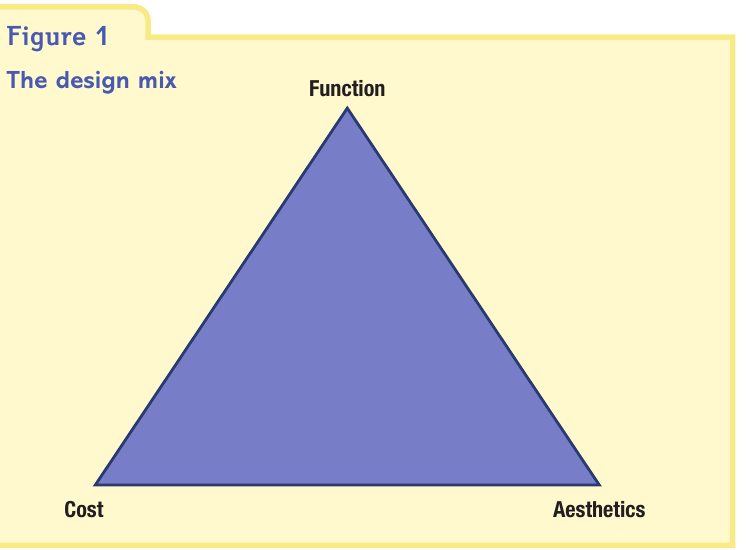
The three elements of the design mix are:
- Function - How well the product does its job
- Aesthetics - How appealing the product is to the senses
- Cost - Whether the product can be made and sold profitably
Important
Different products place different emphasis on each element. A luxury sports car might prioritize aesthetics and function over cost, whilst budget furniture might emphasize cost whilst maintaining acceptable function and aesthetics.
The key to successful design is finding the right balance for your specific product, target market, and business strategy.
Function: making products that work
Function means a product must be fit for purpose - capable of performing the job it's designed to do. A waterproof jacket that lets in rain has failed its primary function. Similarly, an internet service provider must deliver a reliable, safe connection every time customers use it.
Key aspects of function
Reliability and durability are crucial to functional design. Products must work correctly every time customers use them. Many manufacturers of consumer durables (long-lasting products like washing machines or televisions) offer extended warranties to demonstrate confidence in their products' reliability. Products that fail to perform as expected generate returns, adding unnecessary costs for the business.
Convenience and ease of use significantly impact customer satisfaction. Consumers become frustrated when they cannot quickly download an app or struggle to understand flat-pack furniture instructions. Technical products requiring regular maintenance should be designed so this maintenance can be performed easily. However, in competitive markets, dissatisfied customers can simply switch to alternative suppliers offering better convenience.
Note
Ergonomic Design in Practice
Ergonomic design ensures people can interact with products safely and comfortably, without unnecessary effort. Ergonomically designed products consider how humans naturally move and work.
For example, an office chair might feature adjustable height, proper back support, and armrests positioned to prevent strain. Computer workstations designed ergonomically help prevent repetitive strain injuries and improve productivity.
Safety is particularly important when designing products for vulnerable groups such as children, elderly people, or pregnant women. Designers must ensure products don't contain toxic materials like dangerous paints or chemicals. When potentially hazardous features are necessary (such as sharp blades on power tools), adequate protection must be built into the design.
Using function as a competitive advantage
Businesses can use superior functionality as a unique selling point (USP) - a distinctive feature that sets their product apart from competitors.
Example
Worked Example: Function as a USP
Volvo has successfully positioned safety as their USP, with most consumers recognizing their vehicles as particularly safe. This functional emphasis has become central to their brand identity.
By consistently prioritizing and marketing safety features across all their models, Volvo has created a strong association between their brand and vehicle safety in consumers' minds. This USP differentiates them from competitors and attracts safety-conscious customers.
Aesthetics: appealing to the senses
Aesthetic appeal refers to how products stimulate our senses beyond simply performing their function. This includes visual appearance, size, shape, smell, taste, and even the presentation of services. Aesthetics significantly influence consumer purchasing decisions.
Why aesthetics matter
Designers must carefully consider aesthetic elements because they directly impact what consumers choose to buy. Sometimes, aesthetic features become the primary reason for purchase. A customer might select a luxury car because they love the smell of leather seats and the look of wooden dashboard panels, rather than for fuel efficiency or performance specifications.
Companies often invest in more expensive materials and manufacturing processes to enhance aesthetic appeal, recognizing that visually or sensory appealing products typically sell better. Fashion items, luxury goods, home furnishings, and personal accessories particularly depend on strong aesthetic design.
Changing aesthetic preferences
As manufacturing costs decrease and technology advances, aesthetics has become increasingly important in the design mix. Product design has evolved dramatically in recent years. Computers, vehicles, mobile phones, and music players have become more compact, powerful, and user-friendly.
Note
Modern consumers generally prefer smaller, more portable products with intuitive interfaces, driving designers to prioritize sleek, minimalist aesthetics. This shift reflects broader cultural trends toward simplicity, efficiency, and seamless integration of technology into daily life.
Cost: ensuring economic viability
Economic viability means businesses must be able to produce and sell products or services at a profit. Even the most functional and beautiful product fails if it cannot be manufactured cost-effectively.
Balancing cost and design
Designers must select materials and manufacturing processes that minimize production costs whilst maintaining acceptable function and aesthetics. This often requires compromises.
Example
Worked Example: Cost-Driven Design Decisions
Apple reportedly wanted to use curved glass for early iPhone models, but prototypes proved too expensive to manufacture, forcing them to shelve the idea.
In this case, the desired aesthetic enhancement would have made the product unprofitable at the target price point. Apple prioritized economic viability, choosing flat glass instead whilst still maintaining strong aesthetic appeal through other design elements.
In the service sector, airlines only introduce new routes if they can operate them cost-effectively, balancing customer demand against operational expenses.
When cost compromises become too great
Important
Sometimes, high costs force businesses to abandon product ideas entirely. If the materials or processes required to achieve the desired function and aesthetics make the product unprofitable, it won't reach the market.
Designers continuously balance the three elements of the design mix, seeking the optimal combination for their target market and business objectives. Understanding when to compromise and when to abandon a project is a critical skill in product design.
Social trends influencing the design mix
Modern product design must respond to changing social attitudes and concerns. Contemporary consumers increasingly expect businesses to demonstrate environmental and ethical responsibility, forcing designers to adapt the design mix accordingly.
Resource depletion concerns
Growing awareness of limited natural resources has prompted designers to consider sustainability throughout the product lifecycle. Businesses now select materials more carefully, considering:
- Whether resources are renewable or finite
- The environmental impact of extraction and processing
- How much material is genuinely necessary
- Whether alternative materials could serve the same function
Designing for waste minimization, re-use and recycling
Environmental consciousness has shifted design priorities toward:
- Waste minimization - reducing material use and packaging during production
- Re-use - creating products that can serve multiple purposes or have longer lifespans
- Recyclability - selecting materials that can be easily recovered and processed after the product's useful life ends
Note
Lifecycle Thinking in Design
Designers increasingly plan for the entire product lifecycle, considering what happens when consumers finish using the product. This might involve designing products that can be easily disassembled for recycling, or choosing materials already widely recycled in existing systems.
This holistic approach represents a significant shift from traditional design practices that focused primarily on production and initial use.
Ethical sourcing
Ethical sourcing means ensuring materials and components come from suppliers who treat workers fairly and operate responsibly. Consumers increasingly want assurance that products weren't made using child labor, unsafe working conditions, or exploitation. Businesses must verify their supply chains meet ethical standards, potentially affecting which materials and suppliers designers can use.
Important
These social trends don't replace the traditional design mix elements but add additional layers of consideration. Modern designers must balance function, aesthetics, and cost whilst also addressing environmental sustainability and ethical concerns.
This expanded design mix reflects evolving consumer values and increasing awareness of business impacts on society and the environment.
Applying the design mix in practice
Different products require different emphasis within the design mix. Understanding where to place emphasis helps businesses create products that resonate with their target market.
Example
Worked Example: Design Mix Emphasis Across Product Categories
Function-focused products include hiking boots, power tools, central heating systems, and exercise equipment. Customers prioritize reliable performance over appearance. For these products, the design mix might allocate 60% emphasis to function, 20% to aesthetics, and 20% to cost.
Aesthetics-focused products include fashion accessories, jewelry, luxury goods, interior furnishings, and sunglasses. Visual appeal and sensory experience drive purchasing decisions. These products might emphasize aesthetics at 60%, function at 20%, and cost at 20%.
Cost-focused products include budget consumer goods, public transport services, and insurance policies. Customers prioritize affordability whilst accepting acceptable function and aesthetics. The emphasis here might be 60% cost, 25% function, and 15% aesthetics.
Most products balance all three elements, with emphasis shifting based on target market, brand positioning, and competitive strategy. Understanding this balance helps businesses design products that meet customer needs whilst remaining commercially viable.
Summary
Key Points to Remember:
-
The design mix consists of three key elements: function (how well it works), aesthetics (how appealing it is), and cost (whether it's profitable to produce)
-
Function means fit for purpose: products must reliably perform their intended job, be convenient to use, and be safe for consumers
-
Aesthetics matter: sensory appeal influences consumer choices, sometimes even more than functionality
-
Cost determines viability: even excellent products fail if they cannot be manufactured and sold profitably
-
Social trends are reshaping design: modern consumers expect businesses to address resource depletion, design for recycling and re-use, and ensure ethical sourcing throughout supply chains
-
Different products emphasize different elements: luxury goods prioritize aesthetics, tools prioritize function, whilst budget products prioritize cost - but all must balance the three elements for success