Motivation Theories (Edexcel A-Level Business): Revision Notes
📚Revision Notes
Motivation theories
Understanding what drives employees to perform well is essential for business success. Motivation refers to the willingness of workers to put effort into their jobs and work towards achieving business objectives. This topic explores four key theories that help explain what motivates employees and how businesses can apply these ideas in practice.
Note
Understanding employee motivation is not just an academic exercise - it has direct implications for business performance, productivity, and profitability. The theories explored in this topic provide practical frameworks that managers can use to improve workplace motivation.
Why motivation matters to business
Businesses need motivated employees to achieve high productivity and maintain competitive advantage. When workers are motivated, they work harder, produce better quality output, and remain committed to the organisation.
Short-term effects of poor motivation:
- Reduced effort and commitment from employees
- Lower quality work and output
- Increased need for supervision and monitoring
- Negative motivation - employees only work because they fear wage cuts or redundancy
Long-term effects of poor motivation:
- High levels of absenteeism (workers taking time off)
- Increased staff turnover (employees leaving the business)
- Industrial disputes and conflicts with management
- Falling productivity and profitability
- Damage to business reputation
Important
Well-motivated employees are more productive, innovative, and loyal. This leads to improved efficiency, higher quality products or services, better customer satisfaction, and ultimately greater profits. Conversely, poor motivation creates a cycle of decline that can seriously damage business performance.
Taylor's theory of scientific management
Frederick W. Taylor published The Principles of Scientific Management in 1911, establishing what became known as the scientific management school. Taylor observed that work practices in early 20th century American factories were inefficient and unorganised.
Taylor's observations
At the time, workers had considerable control over how they performed tasks:
- Workers brought their own tools and equipment
- Decisions about machine speeds were left to operators
- Training was informal - workers learned by watching others
- Foremen made decisions about rest periods and staffing
Taylor argued this approach was wasteful. Management did not understand production processes properly, while workers engaged in 'soldiering' - deliberately working slowly together to hide their true productive capacity.
Key principles of scientific management
Taylor believed efficiency could be improved through objective, scientific analysis of work. His method aimed to discover the single best way to perform each task, which would benefit both management and workers by increasing output and pay.
Note
Taylor's method for finding the 'best way':
- Select skilled workers performing the task
- Observe and record how they work
- Time each element of the task with a stopwatch
- Eliminate any wasteful movements or actions
- Select the quickest sequence of movements
- Train all workers to follow this exact method
- Allow no variation from the set procedure
- Include appropriate rest periods
- Supervise workers to ensure compliance
This systematic approach represented a radical departure from traditional work practices and formed the foundation of modern industrial engineering.
Taylor's view of motivation
Taylor held a simple view of what motivated workers: money. He believed employees should receive "a fair day's pay for a fair day's work". His approach linked pay directly to output through piece rates - workers were paid based on the number of units they produced.
Under this system:
- Workers who failed to meet targets would earn less
- Workers who exceeded targets would receive bonus payments
- This created a financial incentive to work efficiently
Example
Worked Example: Taylor's Scientific Management in Practice
At Bethlehem Steel Works (1899), Taylor applied his scientific management principles to pig iron production. Through careful analysis of work methods and implementation of financial incentives:
Results achieved:
- Production increased by almost 400% per worker per day
- Workers followed precisely defined methods for lifting and carrying
- Rest periods were scientifically calculated
- Pay was directly linked to output achieved
This dramatic improvement demonstrated the potential power of Taylor's approach, though it also highlighted some of the human costs that would later become apparent.
Limitations of Taylor's approach
Despite some successes, Taylor's theory has significant weaknesses:
Important
Ignores individual differences: The idea of one 'best way' for all workers fails to recognise that people have different abilities, preferences, and working styles. What works best for one person may not suit another. This rigid approach can demotivate workers who feel their individuality is not valued.
Treats workers as machines: Taylor viewed employees as primarily motivated by money, ignoring their social and psychological needs. People work for many reasons beyond financial reward, including personal satisfaction, social connections, and sense of purpose.
Note
Overlooks non-financial motivators: Research has shown that factors like achievement, recognition, and positive working relationships are often more important motivators than money alone.
A 2004 American survey by Robb and Myatt found the top three motivating factors were:
- Sense of achievement
- Recognition of achievement
- Positive working relationships
Notably, money did not appear in the top three, challenging Taylor's fundamental assumption about what drives workers.
Creates conflict: Workers often resisted scientific management when businesses tried to implement it in the 1920s and 1930s, leading to industrial unrest. The perception that management was exploiting workers and treating them as mere cogs in a machine generated significant resentment.
Mayo's theory of human relations
Elton Mayo's work in the 1930s established the human relations school of management thinking. His research suggested that social and psychological factors were more important than physical conditions or pay in motivating workers.
The Hawthorne studies
Between 1927 and 1932, researchers conducted experiments at Western Electric's Hawthorne Plant in Chicago. Initially, these studies followed scientific management principles, investigating how working conditions affected productivity.
Example
The Relay Assembly Test Room Experiment:
Setup:
- Six women assembled telephone relays
- Researchers systematically varied conditions: incentive schemes, rest periods, hours, lighting, heating
Surprising findings:
- Output increased regardless of which changes were made
- Productivity rose with both positive and negative changes
- Even when conditions returned to the original state, productivity remained high
Conclusion: This unexpected result became known as the Hawthorne effect - productivity improved because workers felt valued and responded positively to the attention shown by researchers, not because of the physical changes themselves.
Example
The Bank Wiring Observation Room:
Setup:
- 14 men with different tasks were studied
- Researchers observed group dynamics and social interactions
Findings:
- Results confirmed earlier findings about the importance of attention
- Group dynamics and social relationships proved more important than physical conditions
- Workers formed their own informal social structures and norms
Key findings from Mayo's research
Mayo's conclusions challenged scientific management thinking:
Social needs matter: Workers are motivated by feeling part of a group and having positive relationships with colleagues. Group cohesion and communication are powerful motivators that Taylor's theory completely overlooked.
Attention and recognition: Employees respond positively when management shows interest in their work and values their contribution. Simply being noticed and acknowledged can significantly impact motivation.
Informal groups are important: Workers form social groups with their own norms and behaviours. Management should work with these groups rather than against them, recognising their influence on workplace culture.
Consultation increases commitment: Involving workers in decision-making makes them more committed to outcomes and more motivated to achieve goals. People support what they help create.
Business applications
Many companies have applied human relations principles in practice:
Example
Volvo (Uddevalla plant, 1989):
- Teams of 8-10 workers built complete cars together
- Teams made production decisions collectively
- Absenteeism averaged 8% compared to 25% at Volvo's traditional assembly line plant in Gothenburg
This dramatic improvement demonstrated the power of team-based work organisation and worker autonomy.
Example
Honda (Swindon):
- Emphasised teamwork across the entire organisation
- No distinction between 'workers' and 'directors' - everyone called 'associates'
- Created a sense of equality and shared purpose that enhanced motivation
Example
McDonald's and Mary Kay:
- Used company social events to build team spirit
- Made employees feel part of the organisation
- Recognised and celebrated employee contributions publicly
- Created strong social bonds that increased commitment
Limitations of human relations theory
Despite its insights, Mayo's theory also has significant weaknesses:
Important
Assumes shared goals: The theory suggests workers and management have common interests. In reality, conflict often exists over issues like pay, working conditions, and redundancies. The interests of employers and employees may genuinely diverge, and no amount of social cohesion can completely eliminate this fundamental tension.
Example
Rover's 'Working with Pride' programme (1980s):
Rover attempted to improve quality through better communication and team building. However:
- Enthusiasm varied significantly by hierarchy level
- Supervisors often dismissed it as "just a gimmick"
- Their interests differed from senior management
- The programme struggled to achieve its objectives
This demonstrated that human relations approaches cannot overcome genuine conflicts of interest.
May increase conflict: Greater communication can sometimes highlight differences rather than resolve them. Learning about directors' high salaries or planned redundancies may create resentment rather than build harmony.
Manipulation concerns: Critics argue human relations techniques manipulate workers into being productive while appearing to empower them. This may weaken trade union influence and mask underlying power imbalances in the employment relationship.
Maslow's hierarchy of needs
Abraham Maslow published his hierarchy of needs theory in Motivation and Personality (1954). His model classifies human needs into five categories arranged in a hierarchical structure.
The five levels of needs
Maslow arranged needs in a pyramid structure, with basic survival needs at the bottom and higher psychological needs at the top. According to the theory, lower-level needs must be satisfied before higher-level needs become motivating.
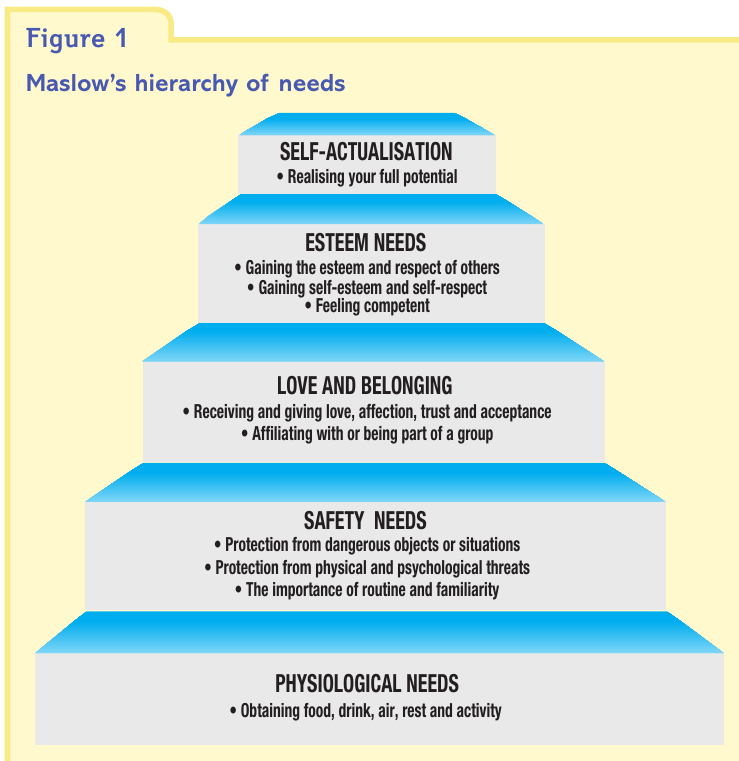
1. Physiological needs (bottom level):
- Basic survival requirements: food, water, air, rest, shelter
- In the workplace: Adequate wages to afford essentials, reasonable working hours, breaks, comfortable temperature
2. Safety needs:
- Protection from danger, security, stability
- In the workplace: Job security, safe working conditions, protection from hazards, predictable routine, fair treatment
3. Love and belonging:
- Social relationships, acceptance, affiliation
- In the workplace: Friendly colleagues, supportive team environment, good communication, feeling part of the organisation
4. Esteem needs:
- Recognition, respect from others, self-respect, feeling competent
- In the workplace: Recognition for achievements, praise from managers, status, responsibility, opportunities to demonstrate competence
5. Self-actualisation (top level):
- Fulfilling your full potential, personal growth, creativity
- In the workplace: Challenging work, opportunities to develop new skills, promotion, autonomy, scope to innovate
How the hierarchy works
Note
Prepotency: Lower needs are more powerful than higher needs. A person concerned about having enough food will not be motivated by social acceptance or recognition until their hunger is satisfied. This explains why threats to basic needs can completely overwhelm other motivational factors.
Progression: Once a need level is satisfied, it becomes less important as a motivator. The person then focuses on the next level up. For example, once someone has job security (safety needs), they start seeking recognition and achievement (esteem needs).
Important
Regression: If a lower-level need becomes threatened, the person moves back down the hierarchy. For example, an employee motivated by challenging work (self-actualisation) may suddenly focus only on job security if redundancies are announced. This means that motivation is not a one-way journey up the hierarchy.
Self-actualisation is different: Unlike other levels, self-actualisation never becomes fully satisfied. People continue seeking growth and development. However, Maslow noted that few people actually reach this level in practice.
Applying Maslow's theory to business
The theory offers clear guidance for managers: identify which level each employee has reached, then provide appropriate rewards and opportunities to motivate them.
Example
Examples of business applications:
Physiological level:
- Competitive wages that allow employees to afford necessities
- Good working conditions (temperature, lighting, ventilation)
- Reasonable working hours with adequate breaks
Safety level:
- Employment contracts providing job security
- Comprehensive health and safety measures
- Fair and consistent policies that protect workers
Belonging level:
- Team-building activities and social events
- Collaborative projects that foster cooperation
- Open communication channels
Esteem level:
- Employee of the month schemes
- Public recognition of achievements
- Increased responsibility and status
Self-actualisation level:
- Promotion opportunities for career advancement
- Challenging projects that stretch capabilities
- Scope to be creative and innovative in work
Limitations of Maslow's theory
Despite its intuitive appeal, Maslow's hierarchy faces several criticisms:
Important
Not universal: Some people do not seem to follow the hierarchy. For example, a dedicated artist may neglect food and sleep (physiological needs) to complete creative work (self-actualisation). Similarly, activists may risk their safety for a cause they believe in, skipping multiple levels of the hierarchy.
Overlapping needs: Many rewards satisfy multiple levels simultaneously. Money addresses physiological needs (buying food) but also serves as recognition (esteem) and status symbol (belonging/esteem). This makes it difficult to apply the theory neatly in practice.
Difficult to measure: It is hard to determine when a need level has been "satisfied". How much security is enough? When has someone achieved sufficient recognition? The lack of clear measurement criteria makes the theory challenging to test scientifically.
Individual differences: The importance of different needs varies between people and cultures. Some individuals value social acceptance more than others, while some seek achievement and status more than security. The hierarchy may not accurately reflect everyone's priorities.
Cultural variations: The hierarchy may reflect Western individualistic values, where self-actualisation and personal achievement are highly prized. Collectivist cultures might prioritise group harmony and belonging over individual achievement, suggesting the hierarchy is not culturally universal.
Herzberg's two-factor theory
Frederick Herzberg developed his two-factor theory in 1966 after researching what created job satisfaction and dissatisfaction. He asked professional engineers and accountants to describe workplace incidents that made them feel particularly satisfied or dissatisfied, then analysed the causes.
The two categories of factors
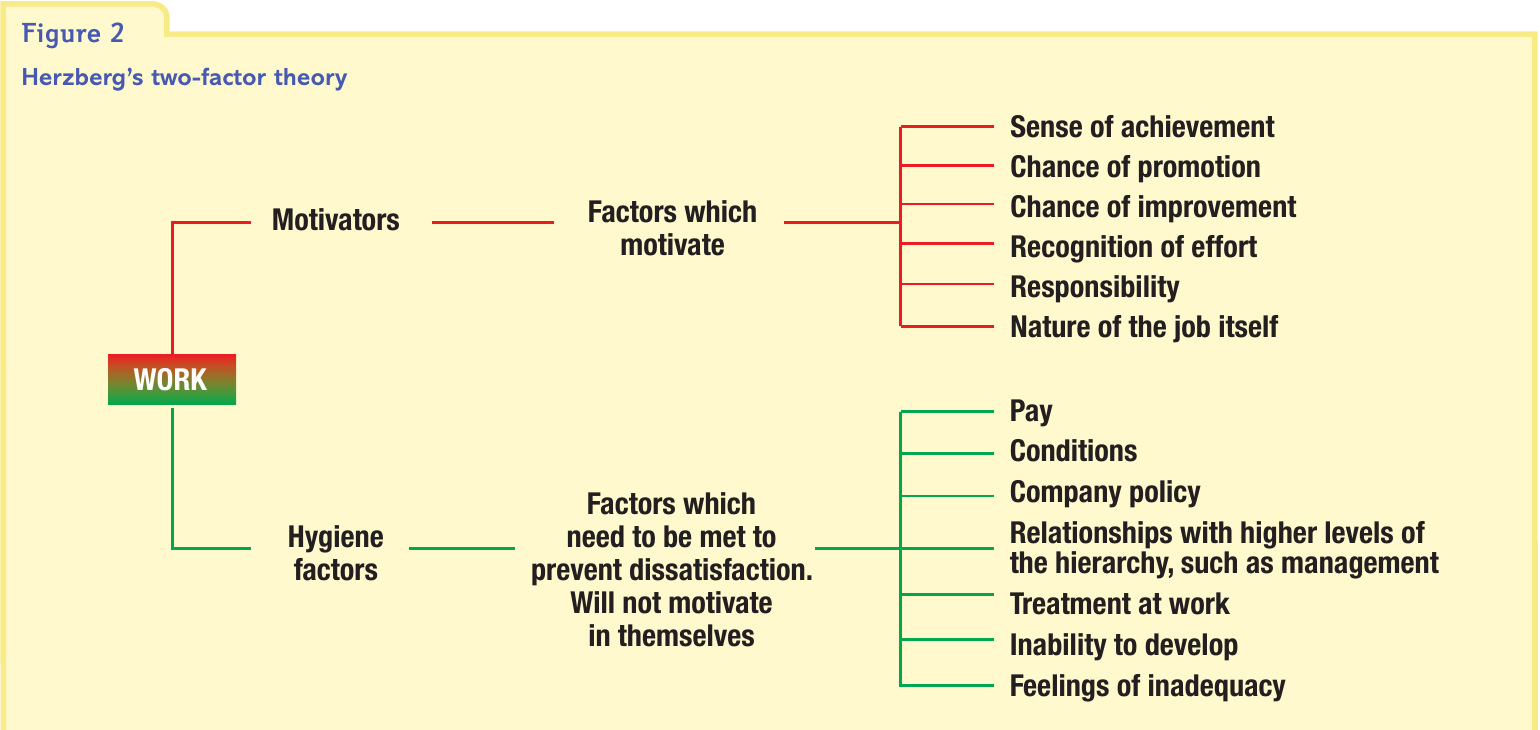
Herzberg discovered that satisfaction and dissatisfaction are influenced by two distinct sets of factors, not simply opposite ends of the same scale.
Motivators (satisfiers)
Motivators are factors that actively increase job satisfaction and motivate employees to work harder. These relate to the actual job content and the intrinsic rewards of work itself.
Key motivators include:
- Achievement: Successfully completing tasks and meeting goals
- Recognition: Praise and acknowledgment for good work
- Responsibility: Being trusted with important tasks and decisions
- Advancement: Opportunities for promotion and career progression
- The work itself: Interesting, challenging, and meaningful tasks
- Growth: Opportunities to learn, develop, and improve
Note
Increasing motivators leads to greater job satisfaction and potentially higher productivity. However, improvements in these areas do not guarantee increased productivity, as other factors also influence performance. Motivators create positive motivation rather than simply removing dissatisfaction.
Hygiene factors (dissatisfiers)
Hygiene factors (also called maintenance factors) do not motivate employees by themselves. However, if these factors are inadequate, they cause dissatisfaction which can reduce productivity.
Key hygiene factors include:
- Pay: Wages and salary levels
- Working conditions: Physical environment, facilities, equipment
- Company policies: Rules, procedures, administration
- Relationships: Interactions with supervisors and managers
- Job security: Stability of employment
- Status: Position within organisational hierarchy
- Treatment: Fairness and respect at work
Important
Improving hygiene factors removes dissatisfaction but does not motivate employees to perform better. For example, better canteen facilities may make workers less unhappy about their environment, but this alone will not drive them to work harder. This is a crucial distinction that managers must understand.
Relationship to Maslow's theory
Herzberg's theory relates to Maslow's hierarchy:
- Hygiene factors correspond roughly to Maslow's lower needs (physiological, safety, some social needs)
- Motivators correspond to Maslow's higher needs (esteem and self-actualisation)
Herzberg argued that only the higher-level needs truly motivate workers. Meeting lower-level needs simply prevents dissatisfaction.
Job enrichment
Herzberg's research led to the concept of job enrichment - redesigning jobs to increase motivators by giving workers:
- More responsibility and control over their work
- Opportunities to use a wider range of skills
- Greater involvement in decision-making
- More challenging and varied tasks
- Better feedback on performance
Example
Worked Example: Job Enrichment in Practice
Herzberg applied his ideas to clerical workers in a large corporation who had low performance and poor attitudes:
Initial situation:
- Workers performed repetitive, monotonous tasks
- No responsibility or decision-making authority
- Poor morale and low productivity
Job enrichment changes:
- Increased individual responsibility for tasks
- Provided regular recognition for good work
- Gave workers more control over how they completed tasks
- Offered opportunities for skill development
Results:
- Both performance and attitudes improved significantly
- Workers felt more valued and engaged
- Productivity increased sustainably over time
Limitations of Herzberg's theory
Despite its practical applications, the two-factor theory has several weaknesses:
Important
Temporary effects: Improvements to hygiene factors (like pay or conditions) may initially reduce dissatisfaction, but workers quickly take these for granted and want further improvements. This creates an ongoing cycle of demands where today's motivator becomes tomorrow's expectation.
Cost implications: Job enrichment can be expensive to implement, requiring reorganisation, retraining, and new systems. Benefits may take considerable time to appear, and businesses may struggle to maintain such programmes during economic downturns when cost pressures are high.
Reproducibility problems: Other researchers have struggled to replicate Herzberg's results when studying different worker groups or using different research methods. This raises questions about whether the theory applies universally or only to specific types of workers.
Important
Subjectivity issues: The theory relies heavily on what people say about their work experiences. Individuals tend to attribute good outcomes to their own efforts (motivators) but blame bad outcomes on external factors (hygiene factors). This self-serving bias may have skewed Herzberg's findings, as people naturally want to take credit for successes but deflect blame for failures.
Oversimplification: The clear division between motivators and hygiene factors may be too rigid. In practice, factors often overlap, and what motivates one person may simply prevent dissatisfaction in another. The clean separation suggested by the theory may not reflect workplace reality.
Remember!
Summary
Key concepts:
- Motivation is essential for business success - well-motivated employees are more productive, loyal, and committed
- Taylor's scientific management views workers as primarily motivated by money and focuses on finding the most efficient way to perform tasks
- Mayo's human relations theory emphasises social needs, group dynamics, and the importance of feeling valued at work
- Maslow's hierarchy of needs organises five levels of needs into a pyramid - lower needs must be satisfied before higher needs become motivating
- Herzberg's two-factor theory distinguishes between motivators (which create satisfaction) and hygiene factors (which prevent dissatisfaction)
Critical points to remember:
- Each theory has strengths and limitations - no single theory explains all aspects of workplace motivation
- Different employees may be motivated by different factors depending on their individual circumstances and needs
- Financial rewards are important but not sufficient on their own - non-financial factors like recognition, relationships, and challenging work also matter significantly
- Businesses need to understand what motivates their workforce and apply a combination of approaches rather than relying on one theory alone
- Motivation strategies must be sustained over time and adapted to changing circumstances and employee needs