Promotion (Edexcel A-Level Business): Revision Notes
📚Revision Notes
Promotion
What is promotion?
Promotion is a key element of the marketing mix that involves drawing attention to products, services or companies. Businesses use promotion primarily to obtain and retain customers, but it also serves several specific purposes within a marketing strategy.
The main aims of promotional activity include:
- Informing consumers about new products entering the market
- Reminding existing customers about established products to maintain sales
- Reaching target audiences that may be widely dispersed geographically
- Reassuring customers about product quality and their purchase decisions
- Demonstrating competitive advantages over rival products
- Building and maintaining the business's overall image and reputation
Note
Promotional spending represents a significant investment for businesses globally. In 2014, worldwide advertising expenditure reached approximately $537 billion, with internet advertising accounting for nearly one-quarter of this total at around $121 billion. The distribution of advertising spending across different media channels has shifted significantly over time, reflecting changing consumer habits and technological developments.
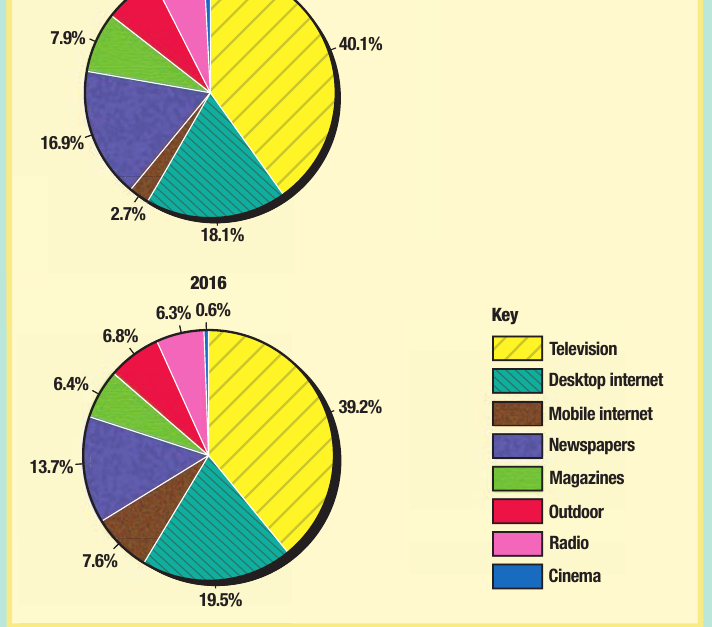
The data shows that while traditional media like television maintained a strong position (remaining around 39-40% of spending), digital platforms experienced substantial growth. Mobile internet advertising, for example, increased from 2.7% to 7.6% of the market between 2013 and 2016, while newspaper advertising declined from 16.9% to 13.7% over the same period. This shift reflects consumers' increasing use of mobile devices and declining readership of print media.
Above-the-line promotion
Above-the-line promotion refers to advertising through paid media channels such as television, newspapers, radio, cinema, and online platforms. Businesses pay media companies to broadcast, print, or display their advertisements to reach their target audience.
Above-the-line advertising can be categorized into three distinct types, each serving different strategic purposes:
Informative advertising focuses on raising consumer awareness by providing clear, factual information about products. This approach emphasizes product features, specifications, benefits, and availability. Classified advertisements in newspapers exemplify informative advertising, as they present straightforward details without emotional appeals. This type of advertising is particularly useful when launching new products or entering new markets where consumers need basic information to understand what is being offered.
Persuasive advertising aims to influence consumer behavior by encouraging purchase of a specific brand rather than competitors' alternatives. This approach typically appeals to emotions such as fear, happiness, aspiration, or belonging, rather than focusing solely on rational product features. Persuasive advertisements often leverage authority figures, celebrity endorsements, or lifestyle associations to create desire for the product. Television and cinema advertisements frequently employ persuasive techniques because these media allow for storytelling, music, and visual imagery that can create strong emotional connections.
Example
Example: Persuasive Advertising in Practice
Perfume advertisements often create aspirational images suggesting that purchasing the product will make consumers more attractive or sophisticated. Rather than focusing on the scent itself, these advertisements sell a lifestyle and emotional benefit - belonging to an exclusive, glamorous group.
Reassuring advertising targets existing customers rather than new ones, aiming to confirm that their purchase decision was correct and encouraging repeat purchases. This type of advertising provides comfort and validation, often emphasizing product reliability, quality, or the business's stability. Financial services companies frequently use reassuring advertising to convince customers that their money is 'safe' and well-managed, helping to build long-term customer loyalty and reduce the likelihood of customers switching to competitors.
Advertising media advantages and disadvantages
Different advertising media offer distinct benefits and limitations that businesses must consider when planning promotional campaigns. The choice of media significantly affects the reach, impact, and cost-effectiveness of advertising efforts.
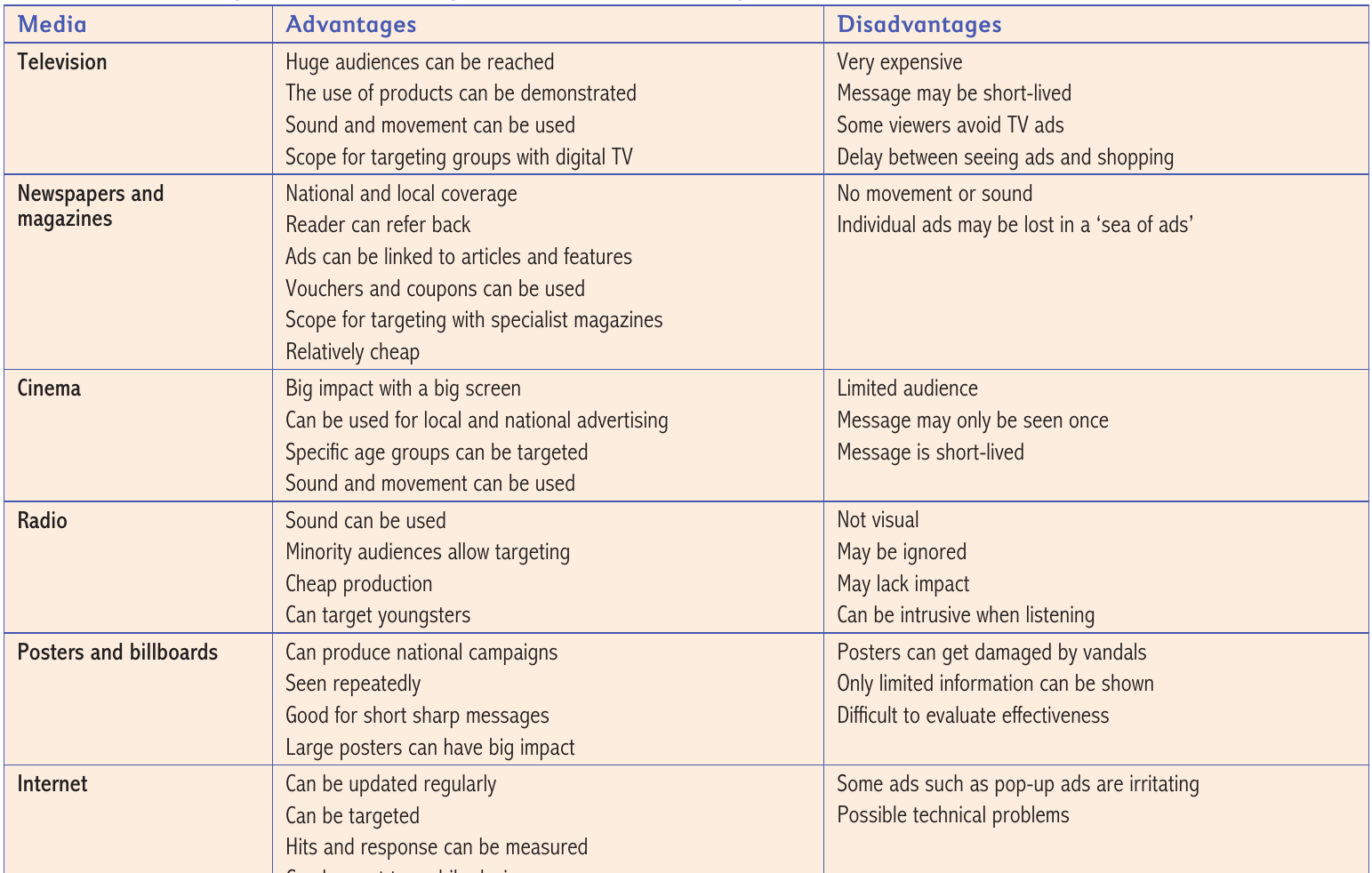
Television advertising provides access to massive audiences and allows businesses to demonstrate products in action using sound, movement, and storytelling. Digital television has enhanced targeting capabilities by enabling advertisers to reach specific demographic groups through specialized channels.
Important
However, television advertising is extremely expensive, particularly during peak viewing times or popular programs. Additionally, messages may be short-lived as viewers quickly forget advertisements, some actively avoid commercials by changing channels or fast-forwarding through recorded content, and there is typically a delay between seeing an advertisement and having the opportunity to purchase the product.
Newspapers and magazines offer both national and local coverage options, allowing businesses to target geographically. Readers can revisit advertisements multiple times, and advertisements can be positioned alongside relevant articles or features to increase relevance. Coupons and vouchers can be included to encourage immediate action and measure response rates. Specialist magazines provide excellent targeting opportunities by reaching niche audiences with specific interests. Production costs are relatively affordable compared to television. However, print advertising lacks the impact of movement and sound, individual advertisements may get lost among numerous competing advertisements on the same page, and declining newspaper readership (particularly among younger demographics) limits reach.
Cinema advertising creates significant impact through large screens and high-quality sound systems in a distraction-free environment where audiences are captive. It can be used for both local campaigns (in specific cinema locations) and national campaigns. Cinema audiences tend to be younger, allowing effective targeting of this demographic. However, cinema reaches limited audiences compared to television, viewers typically see advertisements only once, and messages are short-lived as people may not remember them days later.
Radio advertising allows use of sound, music, and voice to create memorable messages, and minority or specialist radio stations enable precise targeting of specific audience segments. Production costs are relatively low, and radio effectively reaches younger audiences who may be less engaged with traditional media. However, radio lacks visual elements, which limits the types of products that can be effectively promoted. Listeners may not pay full attention to advertisements, particularly if listening while driving or working, and radio can be intrusive, causing irritation.
Posters and billboards can create national campaigns with consistent messaging, and their static nature means they are seen repeatedly by the same audiences, reinforcing brand awareness. They are particularly effective for short, memorable messages and slogans. Large posters and billboards create significant visual impact, particularly in high-traffic locations. However, vandalism can damage posters, only limited information can be communicated due to space constraints and the brief exposure time as people pass by, and measuring effectiveness is challenging as it's difficult to track how many people see and respond to poster campaigns.
Internet advertising offers unique advantages including the ability to update content regularly, precise targeting based on user behavior and demographics, measurable results through tracking hits and responses, and the capability to send advertisements to mobile devices. For products available online, there is no delay between seeing an advertisement and making a purchase, reducing the risk of customers forgetting or changing their minds.
Note
However, some internet advertising formats such as pop-up advertisements are widely considered irritating and may damage brand perception. Technical problems with websites or compatibility issues can prevent advertisements from displaying correctly, and some consumers use ad-blocking software to avoid seeing online advertisements entirely.

Below-the-line promotion
Below-the-line promotion encompasses all promotional methods that do not involve paid advertising in media channels. These techniques often involve direct interaction with consumers or incentives to encourage purchase behavior.
Sales promotions
Sales promotions are short-term incentives designed to encourage immediate purchase or trial of products. These tactics aim to boost sales quickly by attracting new customers who may continue purchasing after the promotion ends, breaking into new markets, rewarding customer loyalty, and providing measurable results through tracking coupon redemption rates or loyalty card usage.
Free gifts involve offering complimentary products or services when customers purchase the main product. For example, computer manufacturers frequently bundle free software with hardware purchases to add value and differentiate their offering from competitors. This approach can clear excess stock of older products while promoting newer ones.
Coupons are money-off vouchers distributed through various channels including newspapers, product packaging, direct mail, or email. They provide customers with discounts on future purchases, encouraging trial among non-users and repeat purchase among existing customers. Businesses can track coupon usage to measure campaign effectiveness and gather data about customer shopping patterns.
Loyalty cards reward customers based on their cumulative spending, typically by awarding points that can be exchanged for cash, vouchers, or free products. Supermarkets, credit card companies, and retail stores extensively use loyalty schemes to encourage repeat purchases and gather valuable data about customer preferences and shopping behavior. This data enables personalized marketing and helps businesses understand customer value.
Competitions offer customers free entry into prize draws when they purchase products. Attractive prizes generate excitement and encourage purchase, while also providing opportunities for businesses to collect customer contact information for future marketing.
BOGOF offers (Buy One, Get One Free) provide immediate value perception and encourage customers to purchase more than they might otherwise. These promotions are popular with supermarkets, transport services, and restaurants because they increase transaction volume, clear stock, and encourage trial among new customers.
Money-off deals such as "30% off" or "extra 20% free" create urgency and value perception. These promotions are versatile and can be applied to wide ranges of products, making them popular across many retail sectors.
Public relations
Public relations (PR) involves managing communication between businesses and their stakeholders to build and maintain a positive image. The primary purpose of PR is increasing sales indirectly by enhancing the organization's reputation and credibility. PR activities often generate media coverage without direct advertising costs.
Press releases are written statements distributed to media organizations containing newsworthy information about the business. This might include announcements about new products, expansion plans, job creation, awards, or significant achievements. When media outlets publish or broadcast this information, the business receives publicity without paying for advertising space.
Example
Example: Press Release Impact
A business announcing 2,000 new jobs would likely receive positive media coverage, enhancing its reputation as a significant employer. This creates goodwill in the community and improves brand perception without any direct advertising costs.
Press conferences bring together business representatives and media professionals for verbal presentations and question-and-answer sessions. This format allows for detailed explanation of complex topics and immediate feedback. Businesses often hold press conferences for major product launches, significant announcements, or crisis management situations where direct communication with media is important.
Sponsorship creates association between brands and events, particularly sporting events, television programs, or films, by providing financial or material support in exchange for publicity. For instance, companies sponsoring major sporting events like the Indian Premier League or FIFA World Cup gain global brand exposure as their logos are displayed throughout events and in media coverage. Television program sponsorship, such as companies sponsoring popular shows, ensures brand visibility before, during, and after programs. The key advantage of sponsorship is gaining extensive brand exposure globally through television coverage without paying broadcasters directly for advertising time.
Donations to charities and local communities generate positive publicity and enhance corporate image. Significant donations typically receive media attention, particularly in local press, creating positive associations between the business and social responsibility. This approach can be particularly effective for businesses seeking to improve their reputation or demonstrate commitment to their communities.
Note
The main advantage of PR is its cost-effectiveness compared to paid advertising. Some businesses deliberately create controversial campaigns or provocative statements to generate media discussion, rapidly raising their profile at minimal or no cost, though this approach carries risks to brand reputation.
Merchandising and packaging
Merchandising involves arranging retail environments to make them interesting, attractive, and conducive to purchases. Effective merchandising influences customer behavior within stores, encouraging browsing, impulse purchases, and positive shopping experiences.
Product layout in stores is carefully planned to guide customers along specific routes past particular products. Items that retailers want to promote are positioned at prominent locations such as aisle ends (end caps) and at eye level on shelves. Basic necessities like milk and bread are often placed at the back of stores, forcing customers to walk past other products and increasing the likelihood of additional purchases. Products positioned at eye level typically achieve higher sales than those on lower or higher shelves.
Display materials including posters, leaflets, digital screens, and point-of-sale materials draw attention to specific products or offers. Lighting, music, and other sensory elements can enhance the shopping environment and influence mood and purchasing behavior. Window displays are particularly important for attracting passing customers into stores by showcasing featured products attractively and creating visual interest.
Stock management ensures shelves remain well-stocked because
empty shelves create negative impressions
about the store's efficiency and may cause customers to shop elsewhere. Consistent product availability builds customer confidence and encourages repeat visits.
Direct mailing
Direct mailing involves sending promotional materials directly to consumers through postal mail or, increasingly, through email and text messages (sometimes called spam when unsolicited). These communications may include information about new products, special offers, price changes, or personalized recommendations based on previous purchase history.
Note
The development of customer databases and information and communication technology has enabled more sophisticated personalized marketing, where businesses tailor messages to individual customers based on their preferences, purchase history, and demographic characteristics. This personalization can significantly increase response rates compared to generic mass mailings.
Direct selling and personal selling
Direct selling or personal selling involves sales representatives contacting potential customers directly, either by visiting homes or businesses, or by telephone from call centers. This approach allows for detailed discussion of product features, benefits, and customization options, enabling salespeople to address specific customer questions and objections immediately.
The interactive nature of personal selling can be highly effective for complex or expensive products requiring explanation or demonstration. However, many consumers find unsolicited sales calls or visits irritating and intrusive, particularly when they haven't requested contact. This can create negative perceptions of the business and damage brand reputation.
Exhibitions and trade fairs
Exhibitions and trade fairs provide opportunities for businesses to showcase products directly to potential customers, whether commercial buyers, end consumers, or both. Businesses set up stands or booths displaying their products and promotional materials, enabling face-to-face interaction with interested parties.
Popular UK exhibitions include the Motor Show, Ideal Homes Exhibition, and Boat Show, each attracting thousands of visitors interested in specific product categories. Trade fairs offer several advantages:
- Products can be tested with consumers before full market launch, providing valuable feedback for product development
- Overseas exhibitions enable businesses to enter foreign markets by meeting international buyers and distributors
- Products can be physically demonstrated and questions answered immediately
- Exhibitions often attract media coverage, providing additional publicity
- Customers can meet business owners or senior personnel directly, building relationships and trust
Choosing promotional methods
Businesses typically use multiple promotional methods simultaneously, but these must be coordinated and integrated to ensure consistent messaging and maximize effectiveness. Smaller businesses often face budget constraints requiring careful consideration when selecting promotional approaches.
Several factors influence promotional method selection:
Cost represents a primary consideration as not all businesses can afford expensive television advertising or national newspaper campaigns. Smaller businesses must identify cost-effective alternatives appropriate to their budget, such as local newspaper advertising, social media marketing, or community sponsorship.
Market type affects promotional choices significantly. Local businesses targeting nearby customers rely on local newspapers, community newsletters, local radio, and directories like the Yellow Pages. In contrast, businesses targeting national or international mass markets use television, national newspapers, and internet advertising. Businesses targeting niche markets use specialist magazines, industry publications, or targeted online advertising to reach their specific audience efficiently.
Important
Product type influences which promotional methods are most appropriate. Complex or expensive products like cars or industrial equipment benefit from methods allowing detailed explanation, such as personal selling, demonstrations at exhibitions, or informative advertising. Fast-moving consumer goods like groceries use sales promotions, point-of-sale merchandising, and television advertising.
Example
Example: Product-Specific Promotional Methods
Car manufacturers typically use television and cinema advertising, billboards, and sponsorship rather than sales promotions like BOGOF deals or loyalty cards. Conversely, supermarkets rely heavily on sales promotions and rarely use personal selling. This demonstrates how product characteristics determine appropriate promotional strategies.
Stage in the product life cycle determines appropriate promotional emphasis. New products often require significant investment in advertising and public relations to build awareness and explain product benefits. As products mature, promotional focus may shift toward sales promotions and loyalty-building activities to maintain market share against competitors. Products in decline may receive minimal promotional support as businesses focus resources on newer products.
Competitors' promotions influence business decisions as successful promotional methods used by rivals often get copied. When one business introduces an effective promotion, competitors typically respond with similar offerings to avoid losing market share. This can lead to promotional escalation in competitive markets.
Legal factors constrain promotional options in many markets. Consumer protection legislation regulates advertising content, requiring truthfulness and prohibiting misleading claims. Specific product categories face additional restrictions; for example, EU regulations prohibit tobacco product advertising on television, and alcohol advertising faces restrictions in many countries. Regulations may also govern sales promotions, requiring clear terms and conditions and honest representation of offers.
Types of branding
Branding involves giving products distinctive names, symbols, logos, designs, or other features enabling consumers to instantly recognize and differentiate them from competitors' offerings. Successful brands create strong associations in consumers' minds, building loyalty and allowing businesses to charge premium prices.
Brands take several forms depending on who controls and develops them:
Manufacturer brands are created by producers of goods and services, with products bearing the manufacturer's name. Examples include Kellogg's Corn Flakes®, Gillette razors, and Dell computers. Manufacturers control all aspects of these brands including production, distribution, promotion, and pricing decisions. This gives manufacturers direct control over brand image and positioning, but also requires significant investment in brand building and maintenance.
Own-label brands (also called distributor brands or private brands) are manufactured by one company but sold under a retailer's or wholesaler's name. For example, Tesco® sells many own-label products including Tesco® Baked Beans. Retailers sometimes create separate brand names for own-label ranges, such as Tesco's F&F clothing line, which doesn't explicitly reference Tesco.
Note
Own-label brands allow retailers to source products from the cheapest manufacturers, reducing costs and increasing profit margins. Retailers promote own-label products prominently in their stores, leveraging their store brand reputation. Own-label products typically sell at lower prices than manufacturer brands while generating higher percentage margins for retailers.
Generic brands carry only the product category name rather than specific company or brand names. Examples include aluminum foil, fresh produce like carrots, or pharmaceutical products like aspirin. Generic products usually sell at significantly lower prices than branded alternatives because they involve minimal branding and promotional investment. However, generic products account for only a small percentage of sales in most product categories as many consumers prefer the perceived quality assurance and status associated with branded products.
Benefits of strong branding
Building strong brands requires substantial investment in product quality, customer service, and marketing over extended periods. However, businesses with strong brands enjoy several significant competitive advantages that justify this investment.
Added value
Strong brands add value to products beyond their functional attributes by creating positive associations and emotional connections in consumers' minds. When brands successfully capture desirable images or values that resonate with target audiences, they gain competitive advantages difficult for rivals to replicate.
Example
Example: Added Value Through Branding
Perfume manufacturers exemplify this approach by using sophisticated television advertising featuring celebrities and aspirational imagery. These advertisements suggest that purchasing particular perfume brands will make consumers more elegant, sophisticated, confident, or attractive. The advertisements offer intangible benefits like glamour, status, and belonging to an exclusive group, rather than focusing solely on the perfume's scent. This emotional branding adds value for consumers who seek these associations, enabling premium pricing and differentiation in markets where functional product differences may be minimal.
Ability to charge premium prices
Products with strong, well-established brands can command higher prices than competitors' offerings because of the customer loyalty developed over time. Consumers who have developed preferences for particular brands become less price-sensitive and less likely to switch to cheaper alternatives, even when functional product differences are small or non-existent.
Heinz, the food processing company, exemplifies this phenomenon by consistently charging higher prices for its canned and bottled products compared to own-label alternatives. Many consumers perceive Heinz products as 'superior' or of higher quality than competing brands, based on brand reputation and past experience rather than objective product testing. This perception, built through decades of consistent quality and marketing, allows Heinz to maintain premium pricing and higher profit margins.
Reduced price elasticity of demand
Strong brands reduce price elasticity of demand, meaning that demand for the product remains relatively stable even when prices increase. This occurs because loyal customers continue purchasing their preferred brands despite price rises, particularly when the increases are relatively modest. Brand loyalty reduces customers' willingness to shop around or switch to cheaper alternatives.
Note
This reduced price elasticity provides businesses with pricing flexibility, enabling them to maintain or increase profit margins without suffering significant volume losses. During economic downturns or when costs increase, businesses with strong brands can raise prices with less risk of losing customers compared to businesses with weaker brands or unbranded products that compete primarily on price.
Summary
Key Points to Remember:
-
Promotion involves two main categories: above-the-line (paid media advertising) and below-the-line (all other promotional methods including sales promotions, PR, merchandising, direct marketing, and personal selling).
-
Different advertising types serve different purposes: informative advertising raises awareness, persuasive advertising influences purchase decisions through emotional appeals, and reassuring advertising confirms existing customers' purchase decisions.
-
Media selection requires balancing advantages and disadvantages: television offers huge reach but high costs; print allows detailed information but lacks movement; internet enables targeting and measurement but may irritate users; each medium suits different products and budgets.
-
Below-the-line promotion includes diverse tactics: sales promotions (BOGOF, coupons, loyalty cards) provide immediate incentives; public relations builds reputation cost-effectively; merchandising influences in-store behavior; exhibitions enable face-to-face product demonstration.
-
Strong brands deliver multiple benefits: they add value beyond functional attributes through emotional associations, enable premium pricing because loyalty reduces price sensitivity, and reduce price elasticity of demand, allowing pricing flexibility without significant volume loss.